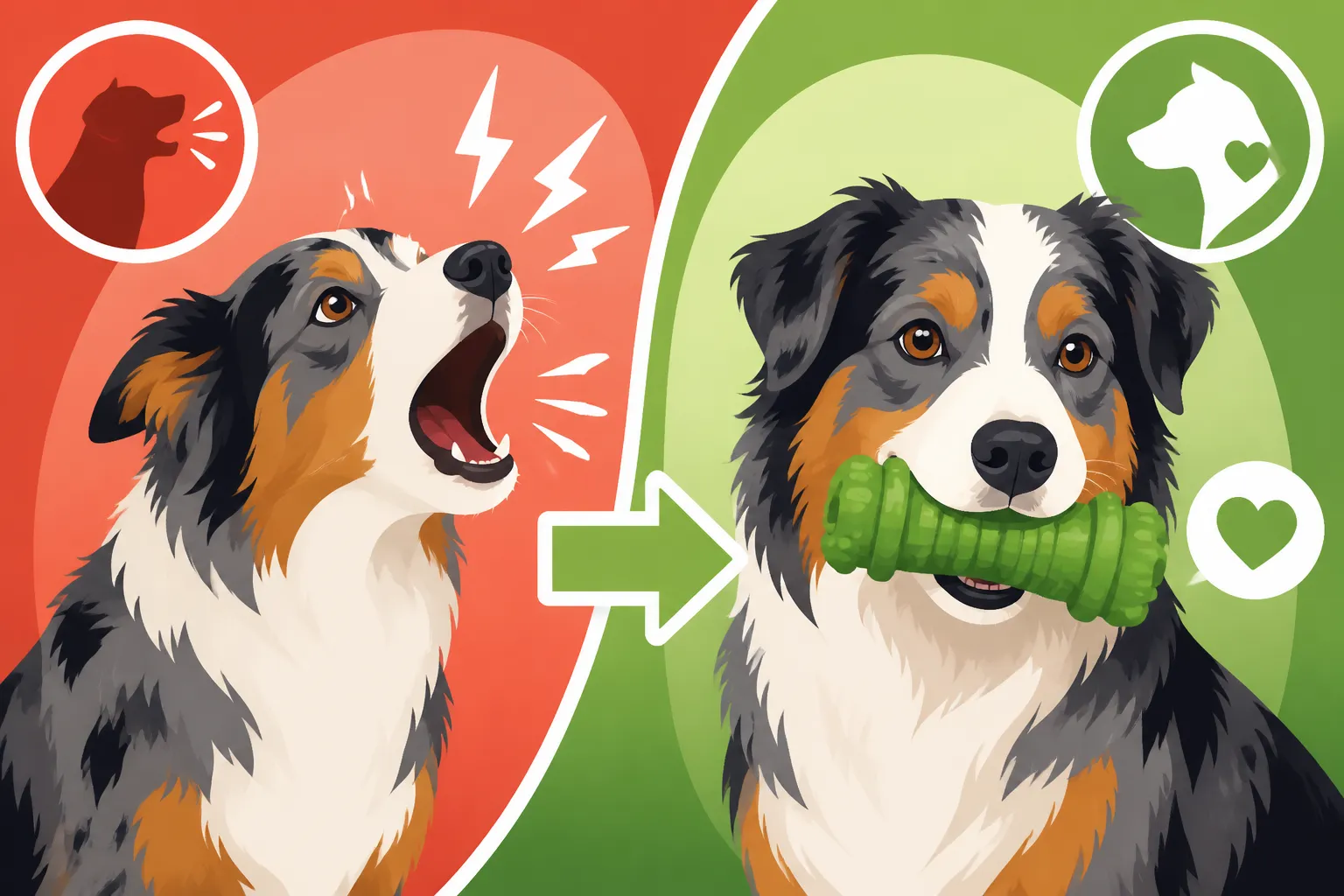
Giving an Aussie an Alternative to Barking
If you live with an Australian Shepherd, you know their intelligence, their boundless energy, and often, their incredible vocal range. From alert barks at every leaf blowing past the window to demand barks for attention, or even anxiety barking when you leave, it can feel like you're living in a constant symphony of "WOOF!" It's frustrating when you love your dog deeply but wish for a quieter home. This guide is here to help you understand why your Aussie barks and, more importantly, how to teach them positive, alternative ways to express themselves and get their needs met without driving you up the wall.
Unpacking the "Why": The Roots of Australian Shepherd Barking
Before we can even think about teaching our Aussies a different way to communicate, we have to play detective and figure out what’s actually prompting the barking. Australian Shepherds are bred to be vigilant, communicative, and highly sensitive to their environment. These traits, while excellent for working livestock, can quickly translate into excessive barking in a home setting if not properly channeled. It’s not about them being "bad dogs;" it's about them doing what comes naturally, often in an environment that doesn't fully understand their innate drives.
Alert and Territorial Barking
This is probably one of the most common barking types Aussie owners contend with. Your Australian Shepherd is a natural guardian, always attuned to their surroundings. That squirrel on the fence, the Amazon delivery driver pulling up, the neighbor walking their poodle, even a distant siren – all these can trigger a fervent, warning bark. They see themselves as protectors, and it's deeply ingrained. They're telling you, "Hey, I saw that! Something is out there!"
In a typical home, especially one with a view of a busy street or a shared fence line, this can quickly become constant. Your Aussie isn't just seeing a person; they're seeing a potential intruder to their flock (which is you, your family, and your home). It’s a job they take very seriously, and frankly, they often don’t trust that you’ve noticed the perceived threat, so they keep barking until they feel you understand the gravity of the situation. This kind of barking often escalates when they feel that their warnings are being ignored or if they are unable to physically investigate the perceived threat, leading to immense frustration. Understanding that this comes from a place of intense loyalty and inherent watchfulness helps us approach it with patience rather than anger. For a deeper dive into this, you might find our article on Australian Shepherd Barking and Noise Sensitivity helpful.
Demand and Attention-Seeking Barking
Oh, the demand bark. Every Aussie owner knows this one. It's the bark that says, "Pet me! Play with me! Throw the ball! I'm bored! I need to go out! Where's my dinner?!" This type of barking typically starts small. Maybe you ignored your Aussie for a moment, they let out a little "woof," and you instinctively looked at them, or worse, gave them what they wanted just to make them stop. Boom! Reinforcement. They've learned that barking is an effective tool to manipulate you into action.
This behavior is incredibly common in intelligent, high-drive breeds like Australian Shepherds because they are always looking for a job, always looking for engagement. If you're not actively providing that structure, they will create their own, and barking is a very low-effort, high-reward strategy for them. They're not being malicious; they're being efficient. They know what they want, and they know how to get it from you. The trick here is to be more clever than they are!
Boredom and Under-Stimulation Barking
An under-exercised or under-stimulated Australian Shepherd is a recipe for destructive and vocal behavior. These dogs were bred to work all day, thinking, running, and problem-solving. If their minds and bodies aren't being sufficiently challenged, that pent-up energy and intelligence has to go somewhere. Barking, along with chewing, digging, and general restlessness, is often the outlet. They're literally shouting, "I'M BORED! GIVE ME SOMETHING TO DO!"
It’s easy to think that an hour-long walk is enough, but for many Aussies, that’s just a warm-up. They need mental engagement just as much, if not more, than physical exercise. Imagine being cooped up all day with nothing to do. You'd probably start talking to yourself or pacing too! Aussies need a purpose. If you're struggling with this, exploring ideas for Mental Work That Actually Tires an Australian Shepherd could be a game-changer. Without proper outlets, the barking can become chronic and incredibly hard to break.
Teaching "Quiet" and Alternative Behaviors
Once you understand the 'why,' you can start focusing on the 'how.' The goal isn't to silence your Australian Shepherd completely – that's unrealistic and unfair – but rather to teach them when barking is appropriate and to offer them more acceptable ways to communicate or cope. This involves both teaching a "quiet" cue and consistently redirecting them to desirable behaviors.
The "Speak" and "Quiet" Method
This might sound counterintuitive, but teaching your Aussie to "speak" on command can actually make teaching "quiet" much easier. Why? Because it puts the barking under your control. Start by encouraging a bark (e.g., knocking on a door, ringing a doorbell, or having a helper stand outside). The instant they bark, say "Speak!" and reward them with a high-value treat. Repeat this many times until they bark reliably on cue.
Once they understand "Speak," you can introduce "Quiet." Command "Speak," let them bark once or twice, then immediately put a high-value treat to their nose. The moment they stop barking to sniff or take the treat, say "Quiet!" and give them the treat. The key is to reward the silence, not the barking itself. You're interrupting the barking with something more enticing and then rewarding the cessation. This takes consistent repetition in various environments. Remember, the goal isn't to eliminate all barking, but to have a clear way to stop it when it's not appropriate. This is particularly useful for those alert barks that linger longer than necessary.
Redirecting Alert Barking
For the territorial or alert barker, simply saying "Quiet" won't solve the underlying impulse. You need to give them an alternative action. When they start barking at something outside, acknowledge it calmly – "Thank you, I see it" – then immediately redirect them. This could mean:
- Move to a designated "place": Teach them to go to their bed or mat away from the window, and reward them for settling there.
- Engage in a quiet activity: Ask for a "sit" or "down" and give them a puzzle toy or a durable chew toy. The mental effort of working on something like a Kong stuffed with peanut butter or a sturdy Nylabone can be a great distraction. You can find many excellent options on Amazon that will stand up to an Aussie's chew power.
- "Look at me" command: Train a strong "look at me" cue, so you can break their focus on the outdoor stimulus and get their attention back on you, where you can then reward them for being calm and quiet.
The trick is to be proactive. If you know the mail carrier comes at 2 PM, have your Aussie on their "place" with a special chew before the bark fest starts. This pre-empts the unwanted behavior and rewards the calm alternative. Consistency is paramount. Every time they bark at the window, it's an opportunity to redirect and reinforce the desired behavior.
Addressing Demand Barking with Clear Communication
Dealing with demand barking requires strong personal discipline. The golden rule is: never reward the barking. If your Aussie barks for attention, turn your back, cross your arms, and completely ignore them. No eye contact, no talking. The instant they are quiet, even for a second, turn around and calmly praise them or give them what they wanted (a pet, a toy, etc.). This teaches them that silence gets them what they want, barking does not.
This can be incredibly hard, especially when they escalate their barking in frustration. Be prepared for an "extinction burst" where the barking gets worse before it gets better. Stick with it! For things like needing to go out, teach them an alternative cue, like ringing a bell by the door or sitting politely. For food, always make them sit and wait calmly before putting the bowl down. This reinforces that good manners, not demanding barks, are the way to earn things. Many online training programs, like those offered by BAXTER & Bella, can provide step-by-step guidance on teaching these polite communication skills, making it easier for you to implement them consistently. It's about empowering your Aussie to communicate in a way that respects both your needs and theirs.
Management Strategies and Environmental Changes
Sometimes, no amount of training will completely eradicate barking if the environment itself is constantly triggering it. Management is about controlling the situation to prevent the barking from happening in the first place, giving you and your Aussie a break, and creating more opportunities for successful training.
Reducing Visual Stimulation
If your Australian Shepherd is an alert barker at windows, reducing their ability to see triggers can dramatically decrease the barking. This isn't a long-term solution to the root cause but a vital management tool. Consider:
- Window film: Frosted or decorative window film allows light in but obscures the view, especially for lower windows.
- Blinds or curtains: Keep them closed during peak trigger times, like mail delivery or school pick-up.
- Strategic furniture placement: Move dog beds or crates away from windows.
- Restricted access: Use baby gates or close doors to rooms with problematic windows when you can't actively supervise.
While it might seem simple, removing the constant visual parade can significantly lower their arousal levels throughout the day, making them less prone to react vocally to other stimuli. It gives their brain a break from feeling like they're constantly on guard duty. This strategy directly aids in managing scenarios that often lead to An Australian Shepherd That Barks at Everything That Moves Outside.
Providing Ample Mental and Physical Exercise
We cannot stress this enough for an Australian Shepherd: they need a job. A tired Aussie is a good Aussie, but it's not just physical tiredness. They need to use their brains. Incorporate a variety of activities into their daily routine:
- Structured walks: Not just sniffing, but active walks where they practice loose-leash walking, heel, and other commands.
- Dog sports: Agility, obedience, rally, barn hunt, or even treibball (urban herding with a large ball) are excellent outlets for their energy and intelligence. Many local clubs offer beginner classes.
- Puzzle toys and scent work: These are fantastic for mental stimulation. Hide treats around the house and let them use their nose to find them, or invest in a snuffle mat. Items like those found on Amazon that challenge their problem-solving skills, from slow feeders to intricate treat dispensers, can provide hours of quiet engagement. Scent Games That Tire an Australian Shepherd are particularly effective.
- Daily training sessions: Even 10-15 minutes of trick training or practicing basic obedience can be incredibly tiring for their minds. Teaching them new skills, like fetching specific items or putting toys away, can keep them engaged and feeling purposeful. Our article on Trick Training as Aussie Mental Work offers more ideas.
Remember, an Australian Shepherd often needs more than just a walk. They need an opportunity to work their minds and bodies in a structured way. Without this, you're constantly fighting an uphill battle against boredom-induced barking and other problematic behaviors.
Creating a Safe, Quiet Space
Every dog needs a den, a place where they can retreat and feel secure. For an Australian Shepherd, this can be particularly helpful for managing overstimulation and anxiety-related barking.
- Crate training: A properly crate-trained Aussie views their crate as a safe haven. Cover the crate with a blanket to make it den-like, and ensure it's in a quiet area of the house. This can be their refuge during stressful times, like when visitors arrive or when you need to leave them alone.
- "Place" command: Teach your Aussie to go to a specific mat or bed on command and stay there until released. This gives them a default quiet spot to go to when they're over-aroused or when you need them to settle.
- White noise or calming music: If your Aussie barks at outdoor noises, playing calming music or a white noise machine can help mask those sounds, creating a more peaceful environment. This can be especially useful for Building Sound Confidence in an Aussie Puppy or an adult dog prone to noise sensitivity.
Providing a reliable safe space can reduce their overall stress levels, making them less likely to resort to barking out of fear, anxiety, or frustration. It gives them an anchor in a sometimes overwhelming world.
The Journey to a Quieter Home: Consistency and Professional Help
Transforming a habitual barker isn't an overnight fix. It requires immense patience, consistency, and sometimes, the guidance of a professional. Understanding that your Aussie isn't trying to annoy you, but rather communicating in the best way they know how, is the first step toward a more harmonious household.
The Power of Consistency
This is probably the single most important factor in changing any dog's behavior, especially with a smart breed like an Australian Shepherd. Every member of the household needs to be on the same page, consistently applying the same rules and responses. If one person ignores demand barking while another gives in, your Aussie will learn that persistence pays off, and they'll bark even more to find the person who will give them what they want.
- Unified approach: Discuss the training plan with everyone in the family. What are the rules? What are the cues? What are the rewards?
- Timing is everything: Rewards must be given immediately (within 1-2 seconds) after the desired behavior (e.g., quiet, looking at you, going to their mat) so your Aussie can make the connection.
- Patience during extinction bursts: As mentioned, when you stop reinforcing a behavior (like barking for attention), it will often get worse before it gets better. Stay strong! Don't give in, or you'll accidentally teach your Aussie that if they just try harder and bark longer, they'll eventually get what they want.
Inconsistency is confusing for your dog and frustrating for you. A clear, predictable routine will help your Australian Shepherd feel more secure and understand what is expected of them, leading to a decrease in unnecessary barking. This consistency is also vital when dealing with more complex behaviors, as discussed in An Aussie That Stops Reading the Room.
When to Seek Professional Guidance
Sometimes, despite your best efforts, the barking persists or even escalates. This is absolutely nothing to be ashamed of; some behaviors are deeply ingrained or stem from anxieties that are difficult for an owner to address alone. This is when a qualified professional can be an invaluable resource.
- Certified Professional Dog Trainers (CPDT-KA): These trainers can assess your Aussie's specific barking triggers and develop a customized training plan. They can help you refine your timing, technique, and provide invaluable insights into your dog's behavior. Look for trainers who use positive reinforcement methods. When choosing, consider Vetting a Trainer Before Booking an Aussie.
- Veterinary Behaviorists (DACVB): For severe or complex barking issues, especially those linked to anxiety, fear, or obsessive behaviors, a board-certified veterinary behaviorist might be necessary. These are veterinarians who have specialized in animal behavior and can prescribe medication if appropriate, in conjunction with behavior modification. They understand the nuances of how health can impact behavior; for example, if your Aussie has Australian Shepherd Autoimmune Thyroiditis, it could potentially affect their temperament.
- Online Resources and Programs: Many online platforms offer structured courses that can guide you through common behavior challenges. Programs like BAXTER & Bella provide comprehensive training solutions that are accessible from home, offering a wealth of knowledge and support for addressing barking and other Aussie-specific behaviors. These can be a great starting point before or in conjunction with in-person training.
Don't wait until you're at your wit's end. Barking can be incredibly stressful for both you and your Australian Shepherd. Early intervention and professional help can make a huge difference in creating a calm and happy home environment. Remember, you're not just silencing a bark; you're teaching your highly intelligent and sensitive Australian Shepherd how to navigate their world more effectively and communicate their needs in a way that works for everyone.
Disclaimer
This article is for general informational purposes only and does not constitute professional advice. Laws, prices and regulations vary by location and change over time. Consult a qualified professional for guidance on your specific situation.