Solid Black and Solid Red Australian Shepherds
When you picture an Australian Shepherd, your mind probably jumps straight to those stunning blue merle or red merle coats, right? Maybe a flashy black tri with bright copper points. But here's a little secret that often gets overlooked: Australian Shepherds come in solid colors too, specifically solid black and solid red. These dogs are just as magnificent, intelligent, and full of that classic Aussie drive, even without the dramatic merle pattern or prominent tri-color markings. This guide is here to shed some light on these less-talked-about, yet equally wonderful, solid-colored Australian Shepherds, helping you understand their genetics and what makes them unique within the breed.
The Genetic Blueprint of Aussie Colors
Understanding why an Australian Shepherd might be solid black or solid red means taking a quick dive into the fascinating world of canine genetics. It’s not about being less "Aussie," but simply about the specific combination of genes they inherited.
The Basic Black and Red Color Genes
At the very foundation of an Australian Shepherd’s coat color are two primary genetic switches: one for black and one for red.
Think of it like this: there's a gene called the B locus. A dominant 'B' allele results in black pigment, while a recessive 'b' allele results in liver or red pigment. So, an Aussie that is 'BB' or 'Bb' will have black pigment in its coat, nose, and paw pads, while an Aussie that is 'bb' will have liver (brown) pigment. This is the base color.
Then, there's the E locus, which controls whether that base color actually shows up or if it's overridden by red. If an Aussie has at least one dominant 'E' allele (meaning 'EE' or 'Ee'), then whatever base color it has (black or liver) will be expressed. However, if an Aussie has two recessive 'e' alleles ('ee'), then regardless of its B locus genes, its coat will appear red. This is why you can have a "liver-pigmented red" (a true red Aussie with brown nose/paw pads) or a "black-pigmented red" (an Aussie that is genetically black but expresses as red due to 'ee', and thus has a black nose/paw pads). It’s a bit of a head-scratcher until you get used to it!
The Absence of the Merle Pattern
The key to a "solid" Australian Shepherd lies in what's missing – the merle gene. The merle gene, denoted as 'M' (for merle) or 'm' (for non-merle), is responsible for the striking mottled patches of lighter and darker pigment that are so characteristic of blue merle and red merle Aussies.
A solid black or solid red Australian Shepherd simply doesn't carry the merle allele. Genetically, they are 'mm' at the merle locus. This means there's no gene present to dilute patches of their base coat color into merle patterns. Their entire base coat, whether black or red, remains undiluted.
This absence is actually incredibly important for responsible breeding. Breeders carefully test their dogs for the merle gene because breeding two merle dogs together (an 'Mm' x 'Mm' cross) can result in what's known as a "double merle" puppy ('MM'). Double merles often face severe health issues like deafness and blindness. Solid Aussies, being 'mm', are crucial in breeding programs as they can be safely bred to merle dogs ('Mm') to produce a litter of both merle and non-merle (solid) puppies without the risk of double merle. You can learn more about The Merle Gene and How It Dilutes Aussie Coat and Why Merle-to-Merle Aussie Breeding Is Called Reckless.
Distinguishing Solid from Bi-color or Tri-color
This is where things can get a little confusing for new Aussie enthusiasts. When we talk about "solid black" or "solid red," we're primarily referring to the absence of the merle pattern. However, these dogs can still have white markings and/or copper (tan) points.
- White Markings: Most Australian Shepherds, even merles, will have some degree of white on their muzzle, blaze, chest, belly, and legs. This is completely normal and acceptable within the breed standard. A "solid black" Aussie often still has these white markings, making it look like a black bi-color (black and white) or a black tri-color (black, white, and copper), but without the merle patterning.
- Copper (Tan) Points: The presence of copper or tan points is governed by another gene, the 'at' allele at the A locus (agouti series). An Aussie with two copies of the 'at' allele will express tan points. So, a genetically solid black Aussie that also has these tan points is what we typically call a black tri-color. If it lacks the tan points, it's a black bi-color. The crucial point is that neither of these dogs has merle patterning.
So, a "solid" Aussie means no merle, but it doesn't necessarily mean no white or copper! It's a common misunderstanding, but once you grasp the genetics, it becomes clear. For a deeper dive into the array of colors, check out Merle, Tri and Every Australian Shepherd Color, or specifically Black Tricolor Australian Shepherds and Red Tricolor Australian Shepherds.
Understanding a Solid Black Australian Shepherd
A solid black Australian Shepherd is, in its own quiet way, incredibly striking. They possess all the beauty and intelligence of the breed, just in a sleek, powerful, undiluted coat.
The Appearance of a True Solid Black Aussie
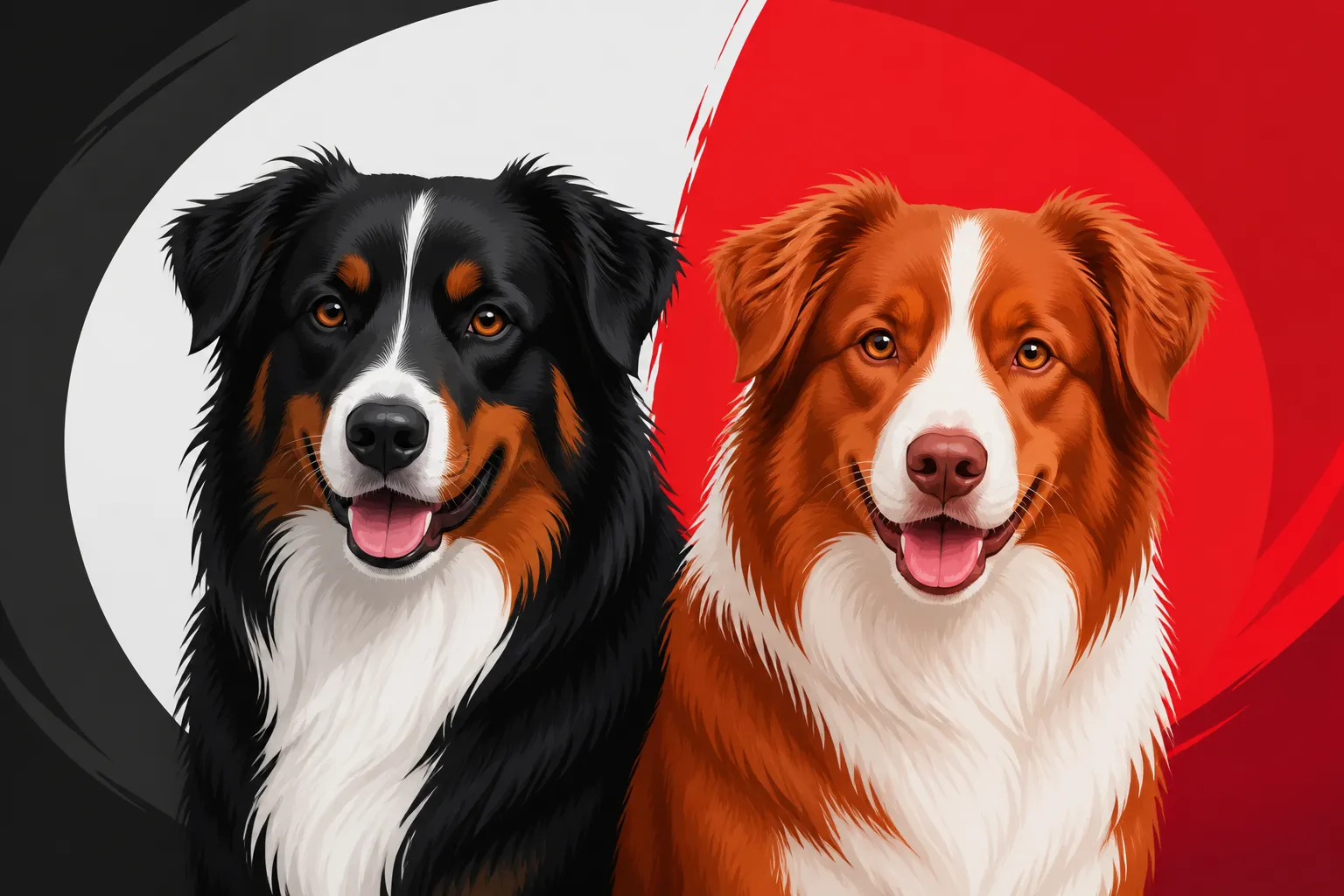
When we talk about a solid black Aussie, we're talking about a dog whose primary coat color is a rich, undiluted black. They don't have the mottled, diluted patches that the merle gene creates. Their black coat is deep and uniform, often with a lustrous sheen.
However, as discussed, these dogs very frequently have white markings on their face (a blaze, a muzzle stripe), chest, legs, and tail tip. They can also have those beautiful copper (tan) points above their eyes, on their cheeks, legs, and under their tail. So, while they are "solid" in the sense of not being merle, they are often seen as black bi-colors or black tri-colors. The critical distinction is the absence of the merle gene that would otherwise break up that black base coat into shades of grey.
Their nose, eye rims, and paw pads will always be black, consistent with their base black pigment. Their eyes can be brown, amber, or even blue, although blue eyes are less common in solid black dogs compared to merles. The standard eye colors are typically dark brown or amber, reflecting the rich depth of their coat.
Genetic Importance in Breeding
Solid black Australian Shepherds play a crucial role in maintaining the health and genetic diversity of the breed. Since they are 'mm' (non-merle), they can be safely bred to merle dogs ('Mm') without producing 'MM' (double merle) puppies, which often suffer from severe vision and hearing impairments.
A responsible breeder will use solid dogs in their breeding program to ensure healthy litters, even when breeding merle to non-merle pairings. They understand that a beautiful, healthy dog is far more important than a specific color pattern. These solid dogs are champions in their own right, carrying robust genetics forward. Reputable breeders will always conduct extensive health and genetic testing, including panels that identify specific genes like merle. Knowing The Genetic Panel Every Australian Shepherd Needs is vital for any prospective owner or breeder.
Diving into Solid Red Australian Shepherds
Just like their black counterparts, solid red Australian Shepherds carry a unique charm. Their warm, rich coats are a testament to the diverse genetic tapestry of the breed.
The Recessive Red Factor
A solid red Australian Shepherd occurs when a dog inherits two copies of the recessive 'e' gene at the E locus (referred to as 'ee'). This genetic combination essentially overrides any black pigment genes, causing the dog to express as red. It's important to remember that 'red' in Aussies can encompass a range of shades, from a light cinnamon or fawn to a deep, rich liver or mahogany.
Because the 'ee' genotype effectively blocks black pigment from showing in the coat, you can have two different types of red Aussies based on their 'B' locus (black/liver) genes:
- Black-pigmented Red (BBee or Bbee): These dogs are genetically black at the B locus, but because of the 'ee' gene, their coat is red. Their nose, eye rims, and paw pads will be black.
- Liver-pigmented Red (bbee): These dogs are genetically liver (brown) at the B locus, and also have the 'ee' gene. Their coat is red, and importantly, their nose, eye rims, and paw pads will be liver/brown.
Both types are stunning and considered solid red, as neither exhibits the merle pattern.
Shades of Red and Pigmentation
The depth and hue of a solid red Aussie's coat can vary significantly. Some might have a lighter, golden-red appearance, while others boast a profound, dark copper or even reddish-brown tone. These variations are perfectly normal and add to the individual beauty of each dog.
Consistent with their genetic makeup, a red Aussie will have either black or liver (brown) pigmentation on its nose, eye rims, and paw pads. This pigmentation will match the underlying genetic base color. For instance, a red Aussie with a liver-colored nose is often called a "red" or "liver" red, while one with a black nose is sometimes referred to as a "black" red, even though their coat is red.
Just like solid blacks, solid red Aussies can also display white markings on their chest, face, and legs, and distinct copper (tan) points, making them "red bi-colors" or "red tri-colors" in appearance, but crucially, without any merle dilution.
Common Misconceptions and the Breed Standard
It’s easy to get caught up in the flashiness of merle patterns, leading to some common misunderstandings about solid-colored Australian Shepherds. Let's clear those up.
Solid Colors are Not a "Faulty" Color
One of the biggest misconceptions is that solid black or solid red Australian Shepherds are somehow "lesser" or "faulty" because they don't have the merle pattern. This couldn't be further from the truth! These dogs are fully recognized by the breed standard and are simply a natural expression of Australian Shepherd genetics.
The Australian Shepherd Club of America (ASCA) and the American Kennel Club (AKC) breed standards both list black and red as acceptable base colors, with or without white and copper markings. The critical factor for exhibition is the absence of the merle pattern if the dog is to be judged as a "solid" or "bi-color/tri-color" black or red. These dogs are genetically sound, healthy, and possess the same incredible temperament and working ability as their merle siblings. They are simply part of the breed's natural genetic variation. When looking at the full spectrum of colors, remember that The Australian Shepherd Standard and What Judges Want is quite inclusive.
The "Solid" vs. "Bi/Tri" Clarification
Let's reiterate this key point: when an experienced breeder or genetics enthusiast talks about a "solid" Australian Shepherd, they are referring to a dog that does not carry the merle gene (mm). This is a genetic distinction, not a visual description of markings.
This means:
- A dog can be genetically 'mm' (solid non-merle) and still have white markings, making it a "black bi-color" or "red bi-color."
- A dog can be genetically 'mm' (solid non-merle) and have both white markings and copper points, making it a "black tri-color" or "red tri-color."
The term "solid" often gets confused with the idea of a dog having no white or copper markings at all, but that's not the primary meaning in the context of genetics. The absence of merle is the defining characteristic. So, if you see a dog described as a "black tri," it's likely a solid (mm) black base with white and copper, not a merle. Understanding this helps immensely in communicating about Aussie coat colors accurately.
Importance for Responsible Breeders
For any responsible Australian Shepherd breeder, understanding the genetics of solid colors is fundamental. It's not just about producing a beautiful litter, but about ensuring the health and welfare of every single puppy.
Breeders use DNA tests, readily available through companies like Chewy, to identify the merle status of their breeding dogs. Knowing whether a dog is 'mm' (solid non-merle) or 'Mm' (merle) is crucial for making ethical breeding decisions. As mentioned earlier, breeding two 'Mm' dogs together puts puppies at risk for being 'MM' double merles, with potential severe health issues. Therefore, solid (mm) dogs are invaluable in a breeding program as they can be bred to merle (Mm) dogs to diversify litters and completely avoid the 'MM' combination. These solid dogs ensure that healthy genetics continue to thrive within the Australian Shepherd breed. You can also explore The Genetic Panel Every Australian Shepherd Needs to understand the full scope of genetic testing for Aussies.
Here's a quick table to help visualize the distinction between solid black and solid red Aussies:
| Feature | Solid Black Australian Shepherd | Solid Red Australian Shepherd |
|---|---|---|
| Genetic Base | Genetically carries dominant black gene (B_) | Genetically carries two recessive red genes (ee) |
| Merle Gene Status | Always non-merle (mm) | Always non-merle (mm) |
| Primary Coat Color | Deep, uniform black | Ranges from light copper to deep liver/mahogany |
| White Markings? | Often present (bi-color, tri-color appearance) | Often present (bi-color, tri-color appearance) |
| Copper Points? | Can be present (tri-color appearance) | Can be present (tri-color appearance) |
| Nose/Eye Rim/Pad Color | Black (consistent with black pigment) | Black or Liver/Brown (depends on B locus genes) |
| Eye Color | Brown, amber, occasionally blue | Brown, amber, occasionally blue |
| Breed Standard | Fully acceptable | Fully acceptable |
| Breeding Significance | Essential for safe breeding with merle partners | Essential for safe breeding with merle partners |
In the end, whether an Australian Shepherd sports a dramatic merle coat or a sleek, solid one, they all share that unmistakable intelligence, loyalty, and zest for life. The solid black and solid red Aussies are beautiful, healthy, and valuable members of the breed, proving that an Aussie's heart is always golden, no matter the color of its fur.
Disclaimer
This article is for general informational purposes only and does not constitute professional advice. Laws, prices and regulations vary by location and change over time. Consult a qualified professional for guidance on your specific situation.