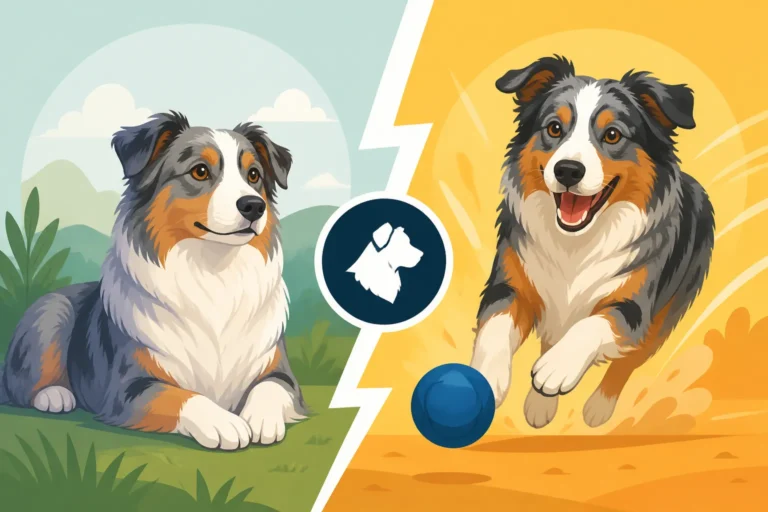
The Aussie Traits Owners Mention Most
Bringing an Australian Shepherd into your home is often imagined as a picturesque scene: a beautiful, intelligent dog trotting beside you, eager to please. While Aussies are undeniably all of those things, many new owners quickly discover there's a unique set of traits that truly define living with this breed, traits that go far beyond their striking looks. This guide delves into the characteristics Aussie owners consistently highlight, giving you a realistic picture of what to expect from these incredible, high-drive companions.
The Relentless Drive to Work and Herd
If there's one trait Australian Shepherd owners bring up more than any other, it's the breed's incredible, almost boundless energy and an inherent drive to work. This isn't just about needing a daily walk; it's a fundamental part of their being that shapes every aspect of their life and yours.
Non-Stop Energy and Mental Stimulation Needs
An Australian Shepherd's energy isn't like a battery that simply runs down with a quick sprint. It's more like a constantly recharging power plant. These dogs were bred for endurance and problem-solving in a ranch environment, meaning they can go, and go, and go some more. Many new owners are completely blindsided by the sheer volume of exercise required. A simple stroll around the neighborhood or a quick trip to the dog park often barely touches the surface of their needs. They'll come home, seemingly refreshed, and start looking for the next thing to do.
What many folks misunderstand is that it's not just physical exertion that tires an Aussie; it's mental engagement. Their minds are constantly whirring, observing, and processing. If you don't give them a productive outlet for this mental energy, they will absolutely find one for themselves – and it's usually not something you'll appreciate, like reorganizing your trash cans or barking at every leaf that blows by the window. Realistically, an Aussie needs a "job," even if that job is learning new tricks, puzzle toys, or participating in dog sports. You can find many durable options for stimulating toys, like those available at Chewy, that stand up to an Aussie's determination. If you're wondering just how much they need, we have a whole article on How Much Daily Exercise an Australian Shepherd Needs.
This isn't to say they don't enjoy a good nap—they do!—but those naps are usually earned after significant physical and mental work. Owners often find themselves creatively structuring their day to include multiple short training sessions, longer sniff walks, and dedicated playtimes to keep their Aussie from bouncing off the walls. Without this dedication, that "non-stop energy" quickly translates into a frustrated, demanding, or even destructive companion. It's a commitment that defines ownership.
The Instinct to Gather and Organize Everything
Hand-in-hand with their drive to work is their powerful herding instinct, which doesn't magically disappear just because they live in a suburban home instead of on a sheep ranch. Australian Shepherds were bred to control livestock, and that innate desire to gather, direct, and organize things—or people—is deeply ingrained. For owners, this often manifests in surprisingly persistent behaviors. You might find your Aussie gently, or not so gently, nipping at your heels as you walk from one room to another, especially if they perceive you as wandering too far from the "flock." Children and even other pets, particularly cats, become prime targets for this "rounding up" behavior, leading to frustrated kids or terrified felines.
This instinct isn't malicious; it's simply how their brain is wired. They see movement, and their natural response is to try and bring it under control. This can extend to inanimate objects too, from the vacuum cleaner to a scattered pile of toys. I've heard countless stories of Aussies trying to "herd" neighborhood children, cyclists, or even lawnmowers, proving that their instinct has a mind of its own. It's why understanding Why an Australian Shepherd Nips at Heels is so important. You can't train this instinct out of them, but you can definitely redirect it.
Successful owners learn to embrace and redirect this drive into appropriate channels. This could mean using a flirt pole to simulate chasing and gathering, teaching them to herd large exercise balls, or enrolling in actual herding classes. Without proper redirection and consistent training, an Aussie's herding tendencies can become a real nuisance, making everyday life a constant negotiation of boundaries and personal space. It requires patience and a deep understanding of their innate programming.
Their Fierce Loyalty and Reserved Nature
While their boundless energy and herding instincts are outward manifestations of their breed, another defining trait often mentioned by Aussie owners is their unique temperament: a deep, unwavering loyalty to their inner circle, paired with a distinct wariness of outsiders.
Devotion to Their Chosen People
Australian Shepherds are famous for forming incredibly strong, often singular bonds with one or two individuals in their family. This isn't to say they don't love everyone in the household, but there's usually a clear preference, a "person" they follow from room to room, whose gaze they constantly seek, and whose presence brings them the most comfort. This intense devotion is a hallmark of the breed and something that new owners often find both endearing and, at times, a little overwhelming. They are truly your shadow, your confidant, and your most ardent supporter.
This deep loyalty stems from their working heritage, where a strong bond with their handler was essential for effective cooperation in the field. They weren't bred to be indiscriminate greeters or social butterflies; their focus was on their human partner and the task at hand. Because of this, when an Aussie chooses you, it's a profound connection that goes beyond mere affection. They become incredibly attuned to your moods, your routines, and your subtle cues, often anticipating your next move before you've even fully thought it. Understanding this intense bond can help you appreciate Australian Shepherd Loyalty to One Person and build a relationship based on trust and mutual respect.
For families, this can mean that one person takes on the primary training and care roles, fostering that core relationship, while others build secondary, but still meaningful, connections. It's important for everyone in the home to respect this aspect of their personality and ensure that all interactions are positive and consistent. This isn't a breed that will easily transfer its affections or be equally thrilled by every family member; their loyalty is a precious commodity, earned and cherished.
Suspicion Towards Strangers and New Situations
In stark contrast to their intense loyalty to their family, Australian Shepherds typically exhibit a reserved, sometimes outright suspicious, demeanor toward strangers. This isn't shyness in the timid sense; it's a cautious evaluation. They'll often hang back, observe from a distance, and assess a new person or situation before deciding whether it poses a threat or is simply benign. Unlike many retriever breeds that greet every newcomer with a wagging tail and an open invitation for pets, an Aussie tends to be more selective, taking their time to warm up, if they do at all. This is a common trait, and something many owners learn to manage as they understand Why an Australian Shepherd Reserves Itself With Strangers.
This natural reserve can be misinterpreted by guests or casual acquaintances, who might view the dog as unfriendly or even aggressive. However, it's actually another facet of their protective, watchful nature. They're bred to be guardians of their flock and their people, and part of that job involves being discerning about who is allowed into their inner circle. It’s crucial for owners to understand this distinction and never force interactions. Allowing the dog to approach on its own terms, or simply ignore a stranger, is often the best approach.
Early and consistent socialization is vital to help an Aussie navigate the human world without becoming overly fearful or reactive. This means positive exposures to a wide variety of people, sights, and sounds from a young age, always ensuring these experiences are safe and confidence-building. The goal isn't to turn them into an indiscriminate greeter, but to teach them that most strangers are not a threat, allowing them to remain calm and neutral in novel situations rather than becoming anxious or defensive.
The Incredible Intelligence and Problem-Solving Skills (Sometimes to Their Own Detriment)
Australian Shepherds are renowned for their sharp minds, a trait that makes them incredibly trainable and capable of complex tasks. However, this high intelligence comes with its own set of challenges, as many owners quickly discover.
Learning at Lightning Speed (Good and Bad)
If there's one thing an Aussie excels at, it's learning. These dogs are sponges, soaking up commands, routines, and observations at an astonishing pace. This makes them incredibly rewarding to train; they pick up new tricks, obedience cues, and even complex sport sequences with remarkable speed. You'll often hear owners proudly declare how quickly their Aussie mastered "sit," "stay," or even more intricate commands like "find the remote." This eagerness to learn and please their beloved handler is a huge advantage in training. For enriching mental exercises, look into Trick Training as Aussie Mental Work.
However, this lightning-fast learning ability is a double-edged sword. Just as quickly as they pick up desirable behaviors, they can also learn undesirable ones, often reinforcing them inadvertently. An Aussie quickly figures out that barking at the mail carrier makes them go away (correlation, not causation, but the dog doesn't know that!). They'll learn that whining at the dinner table sometimes yields a dropped morsel, or that jumping on guests gets attention, even if it's negative. Their problem-solving skills mean they're constantly looking for patterns and ways to manipulate their environment—and their humans—to get what they want.
This requires owners to be incredibly consistent, clear, and always a step ahead. What you permit, you promote, and with an Aussie, that's never been truer. Owners often joke that living with an Aussie is like living with a canine genius who uses their intellect to plot elaborate schemes for extra treats or longer play sessions. It's a mental chess game, and you have to be ready to play every day.
The Capacity for Boredom and Destructive Creativity
An intelligent mind needs stimulation, and for an Australian Shepherd, a lack of it can lead to some truly "creative" behaviors, much to an owner's dismay. These dogs crave mental puzzles and tasks. If their brains aren't engaged, they don't simply lie around and relax; they get bored, and a bored Aussie is often a destructive Aussie. They'll invent their own entertainment, which rarely aligns with your preferences.
This destructive creativity can manifest in various ways: furniture might be "rearranged" via chewing, doors might be scratched as they try to "open" them, or valuable items might be turned into confetti. Excessive barking, digging in the yard, or frantic pacing are also common signs of an Aussie suffering from mental under-stimulation. They are not doing this to be "bad"; they are simply fulfilling their innate need to do something. When you're dealing with The Aussie That Cannot Be Left With Nothing to Do, these behaviors become all too common.
This is where puzzle feeders, interactive toys, and consistent training sessions become not just fun, but essential. Investing in durable, engaging toys from places like Chewy can be a lifesaver. Rotate their toys to keep them novel, hide treats around the house for "nose work" games, and continue teaching new tricks throughout their lives. Owners must understand that physical exercise alone is rarely enough; their minds need a workout just as much as their bodies. Otherwise, that brilliant problem-solving ability will be directed toward finding innovative ways to unravel your home, testing the patience of even the most dedicated owner.
The Ever-Present Shedding
For all their striking beauty and intelligence, there's one undeniable reality that every Australian Shepherd owner lives with: the hair. Their magnificent double coat is a blessing in terms of protection and aesthetics, but it's also a constant source of fuzz in your home and on your clothes.
The Reality of the Double Coat
Australian Shepherds possess a thick, weather-resistant double coat, consisting of a soft, dense undercoat and a coarser, longer outer coat. This coat structure was developed to protect them from harsh weather conditions while working outdoors, keeping them warm in winter and insulated from heat in summer. It's truly a marvel of natural engineering, but its effectiveness comes at a cost: constant shedding. Understanding The Australian Shepherd Double Coat Explained really highlights why this is such a prevalent issue for owners.
Owners quickly learn that "shedding season" is less a seasonal event and more a year-round phenomenon, punctuated by two major "coat blows" each year (typically in spring and fall) where they shed an almost unbelievable amount of hair. During these times, it can feel like you're sweeping up enough fur to knit another dog every day. Even outside of these intense periods, a steady stream of hair is part of daily life with an Aussie. It gets everywhere: on furniture, embedded in carpets, clinging to your clothes, and even floating into your food.
Managing this requires acceptance and proactive measures. Owners invest in good vacuums designed for pet hair, lint rollers become indispensable accessories, and wearing light-colored clothes suddenly makes a lot more sense. It's a trade-off for their stunning looks and protective coat, but it's a reality that often surprises those who haven't lived with a double-coated breed before.
Brushing and Grooming as a Daily Ritual
Given the reality of their double coat, consistent grooming isn't just about aesthetics; it's a health and sanity requirement for both the dog and the owner. Regular brushing helps to remove loose hair, distribute natural oils, prevent mats, and keep the skin healthy. For many Aussie owners, brushing becomes a daily ritual, especially during those heavy shedding periods. If you're only Brushing an Australian Shepherd Twice a Week, you'll quickly fall behind during coat blow.
Investing in the right grooming tools is critical. An undercoat rake is essential for reaching that dense underlayer and pulling out dead hair before it turns into mats or ends up on your floor. A slicker brush helps with the outer coat and feathering, while a good de-shedding tool can work wonders. Regular brushing not only reduces the amount of hair shed around the house but also prevents painful mats, particularly behind the ears, in the armpits, and on their "trousers" (the longer hair on their hind legs). These mats can pull on the skin and cause discomfort, or even skin infections.
Many owners opt for professional grooming every few months to get a thorough de-shedding treatment, especially if they struggle to keep up with the volume of hair at home. However, even with professional help, daily home maintenance is still crucial. This dedication to grooming is a significant time commitment, but it's an integral part of responsible Australian Shepherd ownership, ensuring your dog is comfortable and your home isn't perpetually covered in a fine layer of Aussie fluff.
A Snapshot of Aussie Traits
To give you a clearer picture, here's a table summarizing the key traits Australian Shepherd owners consistently highlight:
| Trait Category | Specific Trait | Owner Experience & Implications |
|---|---|---|
| Energy & Drive | Non-Stop Energy | Requires 1-2 hours of vigorous exercise daily, plus significant mental stimulation. A bored Aussie is a destructive Aussie. Owners need to be creative with activities beyond simple walks. |
| Herding Instinct | Tends to "herd" children, other pets, or even objects by circling, nudging, or nipping at heels. Needs redirection into appropriate outlets like herding balls, flirt poles, or actual herding sports. | |
| Temperament & Loyalty | Intense Loyalty | Bonds deeply with one or two family members, becoming their shadow and protector. Highly attuned to their chosen person's moods. May be less outwardly affectionate with other family members. |
| Reserved with Strangers | Naturally cautious and watchful of new people and situations. Not typically an "everyone's friend" dog. Requires careful, positive socialization to ensure confidence and prevent fearfulness, but will likely retain some aloofness. | |
| Intelligence | Fast Learner (Good & Bad) | Picks up commands, tricks, and routines incredibly quickly. Also quickly learns undesirable behaviors if accidentally reinforced. Requires consistent, clear training and vigilance from owners. |
| Prone to Boredom | Without adequate mental and physical stimulation, they will create their own "jobs," often involving destruction (chewing, digging), excessive barking, or anxious pacing. Needs puzzle toys, training, and enrichment activities. | |
| Coat & Grooming | Double Coat & Heavy Shedding | Possesses a dense undercoat and coarser outer coat. Sheds year-round, with two major "coat blows" seasonally. Requires daily grooming during shedding periods; hair will be prevalent in the home. |
| High Grooming Needs | Regular brushing with appropriate tools (undercoat rake, slicker brush) is essential to prevent mats and manage shedding. Can be a significant time commitment, but crucial for coat health and cleanliness. |
These defining traits are what make Australian Shepherds such unique and rewarding companions for the right owners. They require a significant investment of time, energy, and understanding, but the loyalty, intelligence, and vibrant personality they bring to a home are truly unparalleled.
Disclaimer
This article is for general informational purposes only and does not constitute professional advice. Laws, prices and regulations vary by location and change over time. Consult a qualified professional for guidance on your specific situation.