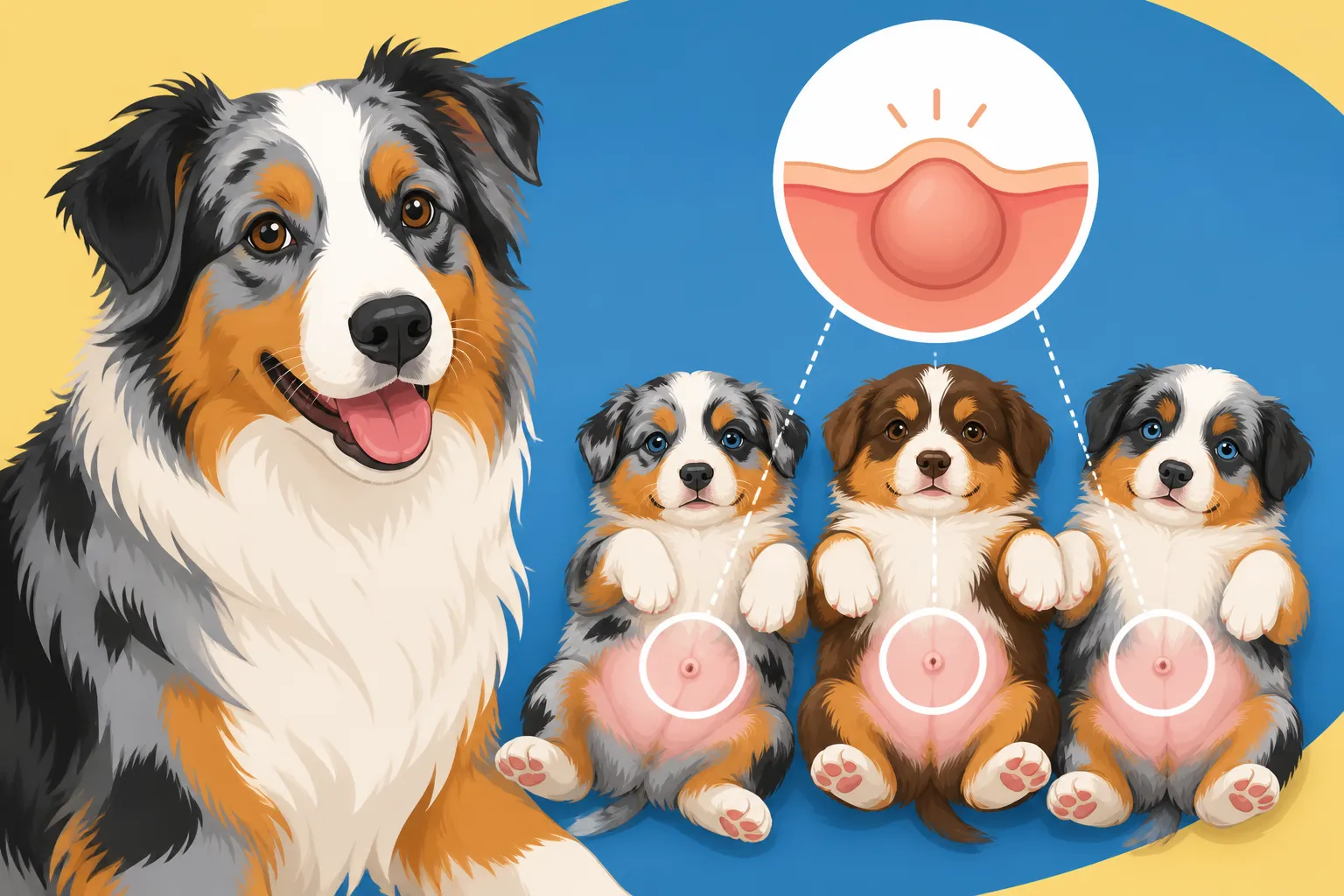
Umbilical Hernias in an Aussie Litter
Discovering a soft, squishy bulge near your adorable Australian Shepherd puppy's belly button can trigger a wave of concern. It’s natural to worry about what this might mean for their health and future, especially when you’re still getting to know your new furry family member. This guide is here to demystify umbilical hernias in Aussie litters, explaining exactly what they are, why they happen, how veterinarians diagnose them, and the most common treatment paths, so you can feel prepared and confident in caring for your pup.
Understanding Umbilical Hernias in Australian Shepherds
When you first notice a little lump on your Aussie puppy's tummy, right where their umbilical cord used to be, it’s easy for your mind to jump to the worst-case scenario. But take a deep breath; umbilical hernias are actually one of the more common developmental anomalies we see in puppies, and in many cases, they’re not nearly as scary as they first appear.
What Exactly Is an Umbilical Hernia?
Imagine your puppy's abdominal wall as a protective blanket. Before birth, the umbilical cord passes through a small opening in this blanket, known as the umbilical ring, allowing nutrients and oxygen to reach the developing puppy. After birth, this opening is supposed to close up completely as the puppy grows. An umbilical hernia occurs when that opening, or a portion of it, doesn't quite seal shut, leaving a small defect in the abdominal musculature.
Through this small, persistent opening, a bit of fatty tissue, or sometimes even a loop of intestine, can push outward, creating that soft, often reducible bulge you feel. It's almost like a tiny pouch forming under the skin. It’s crucial to understand that this is distinct from other potential lumps; it's specific to the belly button area and feels different from a hard tumor or a fluid-filled cyst, though your vet will certainly confirm this during a thorough examination. The worry is completely valid, as any unexpected growth on your pet can be unsettling, but knowing the precise nature of an umbilical hernia can ease some of that initial panic.
Genetic Predisposition in Australian Shepherds
While any puppy can develop an umbilical hernia, some breeds, including Australian Shepherds, do seem to have a higher incidence, suggesting a genetic component at play. It's not usually as simple as a single gene causing the issue; rather, it's often considered a polygenic trait, meaning several genes working together can increase a puppy's susceptibility. This genetic link makes it a significant consideration for responsible Aussie breeders.
If an Australian Shepherd has a hernia, especially a larger one that doesn't close on its own, it raises questions about whether that dog, or its parents, should be part of a breeding program. Responsible breeders strive to produce healthy puppies, and minimizing the risk of inherited conditions is a key part of that commitment. They often meticulously track health information within their lines, including instances of umbilical hernias, and choose not to breed dogs that consistently produce offspring with this issue. This helps to reduce the prevalence of hernias within the breed over time, protecting future generations of Aussie pups.
Common Symptoms and Early Detection
The most unmistakable symptom of an umbilical hernia is the presence of a soft, usually painless swelling located directly at your puppy's belly button. This bulge can vary quite a bit in size, from something as small as a pea that’s barely noticeable to a golf ball-sized protrusion that’s quite prominent. Most often, owners discover these hernias when their Aussie puppy is very young, typically within the first few weeks or months after birth, during routine cuddles or when Australian Shepherd Puppy Health Checks at Eight Weeks are performed.
A key characteristic of most umbilical hernias is that they are "reducible," meaning you can gently push the contents back into the abdomen with a light touch. This indicates that the hernia opening is still relatively open and nothing is trapped. However, it's important to monitor the hernia closely. If the bulge suddenly becomes hard, red, warm to the touch, or if your puppy shows signs of pain, lethargy, loss of appetite, or vomiting, these are red flags. Such symptoms could indicate that a portion of intestine has become trapped (incarcerated) or, worse, twisted (strangulated), which is a serious, life-threatening emergency requiring immediate veterinary attention. Fortunately, these severe complications are quite rare with typical umbilical hernias.
Diagnosis and Initial Assessment
So, you’ve spotted a bulge. What happens next? The process of diagnosing an umbilical hernia is usually straightforward for your veterinarian, but it's important to get it checked out to rule out other issues and determine the best course of action.
The Vet Examination and Palpation
When you bring your Aussie puppy to the vet with a suspected umbilical hernia, the first thing they’ll do is a thorough physical examination. The vet will gently palpate, or feel, the area around the belly button. They’ll be looking for several key indicators: the size of the bulge, its consistency (soft or firm), and whether it's reducible. By carefully feeling the edges of the opening, they can estimate the size of the umbilical ring defect – how big the "hole" is.
For most uncomplicated umbilical hernias, this tactile examination is usually enough to confirm the diagnosis. A small, soft, reducible hernia containing only fat is typically considered less urgent than a larger, firm, or irreducible one that might contain a segment of intestine. Your vet might also observe your puppy as it stands or lies down, sometimes even asking you to encourage a yawn or stretch, as these actions can make the hernia more prominent or, conversely, cause it to recede. This initial assessment helps determine the immediate risk and guides the discussion about potential treatment.
Differentiating from Other Conditions
While the soft, reducible lump at the navel is a pretty strong indicator of an umbilical hernia, your veterinarian will always consider other possibilities, especially if the presentation is unusual. In very rare cases, a growth could be something else entirely, like an abscess, a cyst, or even a very rare tumor. However, these are generally uncommon in young puppies, and the distinct location and feel of an umbilical hernia usually make it clear what you’re dealing with.
The good news is that most umbilical hernias are benign and pose little immediate threat to your puppy's health. The main concern, as mentioned before, is the risk of incarceration or strangulation, which is why monitoring and a proper diagnosis are so important. Having your vet confirm the diagnosis not only gives you peace of mind but also allows for an informed plan for observation or intervention. It’s always best to be cautious and let a professional evaluate any unusual lumps or bumps on your Australian Shepherd.
Factors Influencing Severity and Treatment Decisions
Not all umbilical hernias are created equal, and several factors will influence your vet's recommendation for management or treatment. The size of the actual opening in the abdominal wall is perhaps the most critical factor. A tiny defect, perhaps just a millimeter or two, might allow only a small amount of fatty tissue to protrude and is far more likely to close on its own than a larger defect.
The contents of the hernia also play a huge role. If it's just fat, the risk of serious complications like strangulation is extremely low. However, if a loop of intestine is pushing through, the stakes are higher, as the intestine can become pinched, obstructed, or lose its blood supply. Your puppy's age is another consideration; very young puppies often have small hernias that spontaneously close as their abdominal muscles strengthen and grow. Vets usually prefer to wait until the puppy is a few months old before deciding on surgical intervention, often timing it with their spay or neuter procedure if possible, to minimize the number of anesthetic events. Understanding these factors helps you and your vet make the best decision for your unique Aussie pup.
Treatment Approaches for Aussie Umbilical Hernias
Once an umbilical hernia is diagnosed, the conversation naturally shifts to treatment. The good news is that many small hernias in puppies don't require aggressive intervention and resolve on their own.
Conservative Management and "Wait and See"
For many Australian Shepherd puppies presenting with small, soft, and easily reducible umbilical hernias, veterinarians often recommend a "wait and see" approach. This strategy is based on the understanding that as puppies grow and their abdominal muscles develop, the small umbilical ring defect can naturally close up. This is particularly true for hernias that only involve fatty tissue and have a small opening.
During this period, typically spanning up to four to six months of age, your role as an owner is crucial. You'll need to monitor the hernia regularly. This means gently checking its size, ensuring it remains soft and reducible, and watching for any signs of discomfort or changes in your puppy's behavior. If the hernia grows larger, becomes firm, is painful to the touch, or if your puppy exhibits any lethargy, vomiting, or loss of appetite, it’s time for an immediate vet visit. However, for the majority of small, uncomplicated hernias, patience and observation often pay off, with the bulge gradually disappearing as your Aussie matures.
Surgical Repair Options
When an umbilical hernia doesn't close on its own, or if it's large, irreducible, or symptomatic (meaning it causes your puppy discomfort or other issues), surgical repair becomes the recommended course of action. This procedure is generally quite routine and highly successful. The good news is that veterinarians often schedule the hernia repair to coincide with a puppy's spay or neuter surgery, typically performed around six months of age, provided Neuter Timing Around Aussie Growth Plates is considered. This allows your Aussie to undergo anesthesia only once, reducing overall stress and recovery time.
During the surgery, the vet will make a small incision over the hernia, carefully push any protruding tissue back into the abdomen, and then stitch the edges of the umbilical ring defect together. This effectively closes the opening and prevents future protrusion. While any surgery carries inherent risks, such as those associated with anesthesia or infection, the success rate for umbilical hernia repair is very high, and complications are rare. It's an investment in your dog's long-term health and can prevent potentially serious issues down the line. Pet insurance providers, like Healthy Paws, often cover necessary surgical repairs, which can provide significant financial relief for unexpected procedures like this.
Post-Surgery Care and Recovery
Just like any surgical procedure, proper post-operative care is essential for a smooth and successful recovery. After your Australian Shepherd puppy comes home from their hernia repair, your vet will provide detailed instructions to ensure the incision site heals properly and to prevent complications.
A critical part of post-surgical care is preventing your puppy from licking, chewing, or scratching at the incision. This usually means an Elizabethan collar (E-collar), often affectionately called the "cone of shame," will be necessary for 10-14 days. Keeping the incision clean and dry is also vital; avoid baths or swimming until your vet gives the all-clear. Restricting activity is another key component. High-energy Aussies can be a challenge to keep calm, but short, leashed potty breaks are generally all that’s allowed during the initial recovery period to prevent stress on the healing abdominal muscles. You’ll also need to monitor the incision for any signs of redness, swelling, discharge, or if the stitches come undone. Most puppies recover quickly and uneventfully from umbilical hernia repair, eager to get back to their playful selves once the stitches are out and the cone is off.
Long-Term Outlook and Prevention
Understanding the long-term implications and how to prevent future occurrences of umbilical hernias is crucial for any responsible Australian Shepherd owner or breeder. The good news is, for most cases, the outlook is excellent.
Prognosis After Repair or Spontaneous Closure
Whether an Australian Shepherd's umbilical hernia closes spontaneously or requires surgical repair, the long-term prognosis is overwhelmingly positive. Once the abdominal wall defect is closed, either naturally or surgically, the chance of recurrence is extremely low. For puppies whose hernias resolved without intervention, there are typically no lasting health concerns related to the prior hernia. They can go on to live full, active lives, just like any other healthy Aussie.
Similarly, an Aussie that has undergone surgical repair of an umbilical hernia, provided the recovery was smooth and without complications, is expected to make a complete recovery. The repair is usually strong and durable, and it should not impede their ability to run, play, or perform any of the tasks a working Australian Shepherd might undertake. This successful outcome means that the initial worry and any investment in veterinary care lead to a healthy, happy dog with no compromised quality of life due to this particular condition.
Breeding Considerations for Affected Aussies
Given the strong indication of a genetic component in Australian Shepherd umbilical hernias, responsible breeding practices are paramount. While a small, spontaneously closing hernia might be less concerning, any Aussie that develops a significant umbilical hernia, especially one requiring surgical correction, should ideally not be used for breeding. The goal of ethical breeding is to improve the health and vigor of the breed, and knowingly passing on a predisposition to a potentially costly or health-affecting condition runs counter to that goal.
Breeders committed to the health of their lines will ensure that parent dogs have a full The Genetic Panel Every Australian Shepherd Needs and will carefully consider any family history of umbilical hernias. When looking for an Australian Shepherd puppy, asking breeders about their practices regarding umbilical hernias and checking The Test Results an Aussie Breeder Must Produce for both parents can give you peace of mind. While the occurrence might be an unfortunate random event in some cases, minimizing the risk through thoughtful breeding choices is a critical step in maintaining the breed's health.
Financial Planning for Potential Vet Costs
While many umbilical hernias are minor, the potential for surgical intervention does present a financial consideration for Australian Shepherd owners. The cost of diagnosing a hernia is relatively low, typically part of a regular puppy check-up. However, if surgery is required, it can range from a few hundred dollars to over a thousand, depending on the complexity, geographic location, and whether it's combined with a spay or neuter. Thinking about Aussie Vet Bills Between $15,000 and $40,000 over a lifetime, it's wise to consider how unexpected surgeries fit into your budget.
This is where pet insurance, such as a policy from Healthy Paws, can be incredibly valuable. Policies like Australian Shepherd Insurance at $35 to $55 a Month can help mitigate the financial impact of unforeseen medical expenses, including surgical repairs for conditions like umbilical hernias. It’s important to enroll your puppy early, ideally before any conditions are diagnosed, as many insurance plans consider pre-existing conditions (those diagnosed before the policy starts or during a waiting period) ineligible for coverage. Exploring options for Enrolling an Australian Shepherd Before Age One is a proactive step toward safeguarding your finances and ensuring your beloved Aussie always has access to the best care.
| Hernia Type | Size of Defect | Contents Often Protruding | Likelihood of Spontaneous Closure | Recommended Action | Potential Complications |
|---|---|---|---|---|---|
| Small Umbilical Hernia | < 1 cm (e.g., pea-sized) | Mostly fatty tissue | High (often by 4-6 months) | "Wait and see" with monitoring | Rare: Incarceration, strangulation |
| Large Umbilical Hernia | > 1 cm (e.g., golf ball-sized) | Fatty tissue, sometimes intestine | Low | Surgical repair | Higher risk of incarceration, strangulation, obstruction |
Disclaimer
The information provided in this article is intended for general knowledge and informational purposes only, and does not constitute professional veterinary advice. Always consult with a qualified veterinarian for any health concerns or before making any decisions about your Australian Shepherd's medical care.