Why Aussies Have No Australian Ancestry at All
It’s a common moment for any Australian Shepherd owner: you mention your beloved dog’s breed, and someone inevitably asks, "Oh, so they’re from Australia, right?" It's a perfectly logical assumption, given the name, but the reality is quite different and often a source of mild confusion for many. This guide is here to unravel that historical knot, explaining why the Australian Shepherd, despite its name, has absolutely no Australian ancestry and is, in fact, an American success story through and through.
The Misleading Name and Its True Origin Story
The name "Australian Shepherd" is a fascinating misnomer, a geographical red herring that has led many to mistakenly believe the breed originated Down Under. But if you look at their history, you'll find their roots firmly planted in the rugged landscapes and bustling ranches of the American West, with a strong European foundational influence. It's a story of migration, necessity, and the evolution of a truly remarkable working dog.
Why "Australian" Caught On
The simplest explanation for the name lies not with the dogs themselves, but with the sheep they so expertly herded. In the mid-19th century, during America's fervent Gold Rush, there was a significant influx of sheep imported from Australia to meet the growing demand for wool and meat in the burgeoning Western settlements. These sheep, often of the Merino breed, came from Spain via Australia, and with them, came the shepherds who managed them. These experienced sheepmen often brought their working dogs from their home countries, and when these specific "Australian sheep" arrived, the dogs accompanying them or bred to work with them eventually became colloquially known as "Australian Shepherds." It was a convenient, if ultimately inaccurate, descriptor based on the origin of their primary flock. It was less about the dog's passport and more about its immediate association with a highly visible, newly arrived commodity.
The shepherds themselves, particularly the Basque people, were skilled and came from regions with long traditions of herding. As these sheep and their handlers moved across the American landscape, the association solidified in the minds of American ranchers and stockmen. Imagine seeing a distinct type of sheep arrive, consistently managed by a particular kind of dog; it’s easy to see how the name could stick, even if the actual canine lineage was European and then American, rather than Australian.
The Basque Connection
To truly understand the Australian Shepherd's beginnings, we need to trace a path back to the Pyrenees mountains, nestled between France and Spain. This is the ancestral home of the Basque people, renowned for their sheepherding traditions and their hardy, intelligent working dogs. As economic opportunities shifted and global migrations increased, many Basque shepherds sought new lives, first in Australia during its own sheep boom, and then, crucially, in the American West.
During the late 19th and early 20th centuries, waves of Basque immigrants arrived in the Western United States, particularly in states like California, Oregon, Nevada, and Idaho. They brought with them their ancestral knowledge of sheep husbandry and, more importantly, their trusted working dogs. These were not a standardized breed as we know them today, but rather a collection of resilient, versatile herding dogs, often referred to simply as "pastor dogs" or "sheepdogs" from their homeland. These dogs, honed by generations of demanding work in challenging mountainous terrain, formed the genetic bedrock of what would become the Australian Shepherd. They were selected for their intelligence, endurance, and innate ability to control livestock, attributes that would prove invaluable on the vast American ranches. You can learn more about their specific lineage in The Basque Shepherds Behind the Australian Shepherd.
It's this journey, from the Pyrenees, through other parts of Europe, and then directly to the American West, that truly defines the foundational ancestry of the Australian Shepherd. The "Australian" element was a temporary label that became permanent, overshadowing the true, complex narrative of European migration and American development.
American Ranches and Rodeo Arenas: The True Home
While the ancestral dogs arrived with European shepherds, it was on the sprawling, diverse ranches of the American West where the Australian Shepherd truly came into its own, solidifying its identity and purpose. This harsh, demanding environment called for a specific kind of dog, and the evolving Aussie fit the bill perfectly.
Developing a Herding Legend in the American West
The landscape of the American West was, and still is, vast and varied, presenting unique challenges for ranchers. They needed dogs that could work large flocks and herds over diverse terrain, from open plains to mountainous regions. The dogs the Basque shepherds brought were skilled, but American ranchers also introduced other types of herding dogs into the mix, potentially including various Collie breeds and English Shepherds, to refine specific traits. The emphasis was always on utility: a dog that could control cattle as effectively as sheep, retrieve strays, and withstand the extreme weather conditions of the high desert and mountains.
Breeders and ranchers in states like California, Colorado, and Idaho, started selectively breeding these versatile dogs for specific working abilities. They prioritized intelligence, trainability, intense focus, and a strong but controllable herding instinct. Unlike European breeding programs that might focus on specific breed standards and lineage, these American working dog fanciers were driven by function. The goal was to create the ultimate ranch hand, a dog that could think for itself, anticipate livestock movements, and work tirelessly from dawn till dusk. This intensive, functional selection pressure sculpted the Australian Shepherd into the adaptable and highly intelligent dog we know today. Their development in this rugged environment is explored further in Aussies Bred in California, Colorado and Idaho.
Rodeo Stars and Popularity Surge
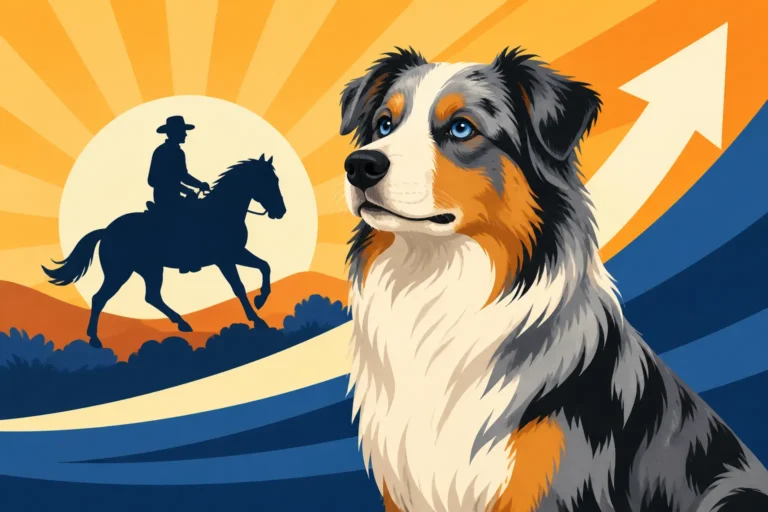
Beyond the dusty fields and quiet ranches, another uniquely American institution played a pivotal role in catapulting the Australian Shepherd into wider public consciousness: the rodeo. In the post-World War II era, rodeos and equestrian shows experienced a boom in popularity across the United States. Cowboys and horsemen began featuring their exceptionally talented working dogs in demonstrations, showcasing their intelligence, agility, and incredible bond with their handlers.
One of the most famous figures in this era was Jay Sisler, a horseman from Idaho, who gained national recognition for his trick dogs—Australian Shepherds named Shorty and Stubby. These dogs performed astonishing feats of agility, balance, and obedience, captivating audiences with their quick wits and enthusiastic performances. Sisler’s dogs became sensations, even appearing in Walt Disney films and popularizing the breed far beyond its ranching roots. Australian Shepherds in Rodeo Arenas delves deeper into how these talented dogs stole the show.
This exposure transformed the Australian Shepherd from a regional working dog to a beloved national breed. People were enchanted by their intelligence and athleticism, and demand for these versatile dogs grew. While their primary function remained herding, their aptitude for performance and companionship made them appealing to a broader audience, solidifying their status as a distinctly American breed forged in the crucible of the Old West and polished in the spotlight of the rodeo arena.
Tracing the Ancestry: No Kangaroos, Just Sheep and Hard Work
When we delve into the Australian Shepherd's genealogical tree, the branches unequivocally lead back to Europe and then directly into the American West, with no detours through the Australian continent. This isn't just about a name; it's about understanding the specific influences that shaped their character and capabilities.
What We Know About Their European Roots
The foundational stock of the Australian Shepherd largely consisted of various European herding dogs, primarily those brought over by Basque shepherds. While definitive breed records were scarce in those early, functional breeding days, genetic and historical analyses point to breeds like the Pyrenean Shepherd, and various types of British Collies (such as Scottish Collies or early Border Collie types), as strong contributors. These were dogs selected purely for their working prowess: their ability to gather, drive, and protect livestock with minimal human intervention.
These ancestral dogs were hardy, intelligent, and possessed the intense "eye" and strong herding instinct crucial for managing challenging animals across vast distances. The focus was entirely on function over form. A dog's appearance was secondary to its ability to perform its job effectively. This utilitarian approach to breeding meant that traits like intelligence, stamina, resilience, and a cooperative temperament were highly valued and passed down through generations. It's this pragmatic selection, deeply rooted in European herding traditions, that gifted the Australian Shepherd with its inherent drive and mental acumen.
Many aspects of their temperament today, like their occasional heel-nipping or their intense focus, can be directly traced back to these working lineage dogs. It’s also why understanding their genetic background is so important for responsible ownership and breeding, as highlighted in The Genetic Panel Every Australian Shepherd Needs.
The Lack of Documented Australian Contribution
Despite the persistent misconception, there is a distinct lack of historical or genetic evidence to suggest any significant contribution from dogs originating directly in Australia to the foundation of the Australian Shepherd breed. The "Australian" in their name, as we've discussed, referred to the sheep imported from that continent, not the dogs themselves. While it's possible some Basque shepherds may have made a stop in Australia before heading to America, the dogs they brought with them would have been European in origin, continuing their genetic line.
No verifiable records exist of specific Australian dog breeds, such as the Australian Cattle Dog or Kelpie, playing a role in the formation of the Australian Shepherd. These Australian breeds, while also exceptional herders, developed in a different geographical and historical context. The Australian Shepherd's lineage is consistently traced back through European working dogs brought to America, where they were further developed. The breed, as recognized today, emerged entirely on American soil. This distinction is vital for understanding Why the Australian Shepherd Carries That Name and its true heritage. It's a testament to the strong working traditions of the American West and the adaptability of European herding stock that this unique breed came into being without any actual Australian canine input.
Common Misconceptions and Why It Matters
The enduring myth of the Australian Shepherd's Australian origins persists, often leading to misunderstandings about the breed's characteristics and historical context. Clearing up these misconceptions isn't just about historical accuracy; it's about deeply understanding the dog you share your life with.
Debunking the Myths
One prevalent myth is that the Australian Shepherd somehow "evolved" from dogs brought directly from Australia. This isn't supported by historical records or genetic studies. The journey of the breed's ancestors was primarily from Europe to North America. Another idea suggests that the name simply implies they look like Australian dogs. While some may see superficial resemblances to breeds like the Border Collie, which shares some distant British Isles ancestry with some Aussie lines, this is purely coincidental rather than indicative of direct Australian lineage.
It’s crucial to distinguish between the destination of the sheep and the origin of the dogs. The imported "Australian sheep" were the vessel for the name, but the canine genes traveled a different, albeit parallel, path. It’s a classic case of mistaken identity due to a naming convention that stuck for practical reasons in a working environment. This clarity helps us appreciate the true journey of this unique American breed.
Why Knowing the True History Enriches Our Understanding
Understanding the Australian Shepherd's true American-European ancestry, rather than an imagined Australian one, offers invaluable insights into their temperament, drives, and needs. These dogs were bred for demanding work on vast, rugged American ranches. This heritage explains:
- Their intense herding drive: They weren't bred in a vacuum; they were selectively developed to control diverse livestock in challenging environments. This drive is a core part of their "operating system," as detailed in Why Herding Instinct Is the Aussie Operating System.
- Their intelligence and problem-solving abilities: On a ranch, a dog often had to make independent decisions. This fostered a highly intelligent and adaptable mind, capable of complex tasks and requiring significant mental stimulation.
- Their loyalty and protective instincts: Working closely with a single handler or family on an isolated ranch forged strong bonds and a natural wariness of strangers, which is still a hallmark of the breed’s typical Australian Shepherd Temperament and Working Character.
- Their physical hardiness and endurance: The American West demanded a dog that could withstand long hours, varied terrain, and extreme weather. Their double coat, sturdy build, and boundless energy are direct reflections of this working past.
Knowing this history empowers owners to provide the best care, training, and enrichment for their Aussies. It helps us understand why they do what they do, from their boundless energy that needs a constructive outlet (perhaps through toys from Chewy that can stand up to their play) to their reserved nature with new people. It moves beyond a simple name to a deeper appreciation of the breed's unique strengths and challenges. When considering adding an Australian Shepherd to your family, researching their true origins and what it means for their needs is one of the most important steps. You'll find a wealth of information to guide you in Choosing an Australian Shepherd Breeder and other valuable resources.
| Feature | Common Misconception | Historical Reality |
|---|---|---|
| Origin Country | Australia | United States (developed), European (ancestral) |
| Why "Australian"? | Dogs directly imported from Australia | Named for "Australian" sheep they herded in the US |
| Ancestral Breeds | Australian Kelpie, Cattle Dog | Pyrenean Shepherds, various Collies from Europe |
| Development Site | Australian farms and outback | American Western ranches and rodeos |
| Primary Influence | Australian working dog characteristics | European herding traditions, American ranching needs |
Disclaimer
This article is for general informational purposes only and does not constitute professional advice. Laws, prices and regulations vary by location and change over time. Consult a qualified professional for guidance on your specific situation.