Puzzle Feeders and Enrichment Gear for an Aussie
Many Australian Shepherd owners find themselves scratching their heads, wondering why their seemingly well-exercised, happy-go-lucky dog still manages to find trouble, often by redecorating the couch with its teeth or developing an impressive digging career in the backyard. This common frustration stems from a fundamental misunderstanding of what these incredibly intelligent and driven dogs truly need: not just physical exercise, but robust mental stimulation. This guide will dive deep into the world of puzzle feeders and enrichment gear, explaining how these tools can transform your Aussie's daily life, curb destructive behaviors, and foster a calmer, more contented companion.
Why Mental Stimulation is Non-Negotiable for Your Australian Shepherd
It’s easy to look at an Australian Shepherd and think, "Wow, they have so much energy, they must just need endless walks and runs!" And while physical exercise is undoubtedly crucial for these athletic dogs, it's only half the equation. Aussies were bred to work, to think, to make decisions, and to manage livestock – a job that requires significant brainpower. When that powerful mind isn't given appropriate outlets, it will create its own "job," and trust me, that job usually involves things you won't appreciate.
The Boredom-Driven Aussie and Destructive Behaviors
Imagine being a brilliant strategist, a master problem-solver, but being stuck at a desk with nothing but a blank piece of paper all day. That's often how an under-stimulated Australian Shepherd feels. Their minds are constantly whirring, seeking purpose and engagement. When that purpose isn't provided, boredom quickly sets in. This isn't just a minor inconvenience for your dog; it's a profound source of frustration that can manifest in various unwanted behaviors.
A bored Aussie might decide that the leg of your dining room table makes an excellent chew toy, or that excavating a new crater in your prize-winning flower bed is a perfectly reasonable afternoon activity. Persistent barking at every leaf that blows by, pacing incessantly, or even demonstrating anxiety-driven behaviors like tail chasing or excessive licking can all be symptoms of a mind desperate for engagement. These aren't signs of a "bad" dog; they're signs of a dog that needs more. Think of these behaviors not as defiance, but as your Aussie trying to tell you, "Hey, I need something to do up here!" Providing mental challenges through puzzle feeders and enrichment gear is a direct way to alleviate this boredom and redirect that powerful drive into something constructive.
Channeling Herding Instinct and Energy Positively
Australian Shepherds possess an incredibly strong herding drive, an instinct that is deeply ingrained in their DNA. This drive makes them exceptional working dogs, but in a domestic setting, it can lead to behaviors like nipping at heels, circling family members (especially children), or trying to "herd" anything that moves – from bicycles to the vacuum cleaner. You can spend hours trying to train away this instinct, but as many owners discover, it's often more productive to channel it. This is why you simply cannot train out their natural drive, as detailed in our guide, "The Australian Shepherd Herding Drive You Cannot Train Out".
Enrichment gear provides a safe, appropriate outlet for these inherent behaviors. A herding ball, for instance, allows your Aussie to push, chase, and direct an object, satisfying that primal urge without causing havoc in your home or yard. Puzzle feeders, especially those that involve manipulating objects or "hunting" for food, tap into their problem-solving skills and their natural foraging instincts. Instead of endlessly chasing a frisbee, which primarily burns physical energy, a puzzle feeder engages their brain, forcing them to strategize and work for their reward. This kind of mental work is often far more tiring and satisfying for an Aussie than just physical exertion alone. It's about giving them a "job" that truly speaks to their breed's purpose, even if that job is just figuring out how to get a treat out of a dispenser.
Stress Reduction and Confidence Building
Beyond preventing destructive behaviors and channeling instincts, mental enrichment plays a vital role in your Australian Shepherd's emotional well-being. A dog that is constantly bored or under-stimulated can become anxious, stressed, or even develop neurotic tendencies. Imagine the frustration of having a powerful brain but no way to use it meaningfully. That constant unfulfilled mental energy can be incredibly taxing.
Engaging with puzzle feeders and other enrichment gear offers a fantastic way to reduce stress. When your Aussie is focused on solving a puzzle, their mind is occupied in a positive, goal-oriented way. The act of successfully solving a puzzle and earning a reward releases feel-good hormones, boosting their confidence and providing a sense of accomplishment. This is particularly beneficial for dogs who might be a bit shy or anxious in new situations. Giving them a familiar puzzle can help them settle and feel more secure. It teaches them to engage with their environment in a productive way, fostering independence and resilience. It's a key component of what truly makes mental work tiring for an Australian Shepherd, as discussed in our article, "Mental Work That Actually Tires an Australian Shepherd".
Choosing the Right Puzzle Feeders for Your Aussie
When you first start looking at puzzle feeders, the sheer variety can be overwhelming! There are so many options out there, from simple slow-feeder bowls to complex multi-step puzzles. The key is not to just grab the flashiest one, but to consider your Australian Shepherd's individual needs, personality, and current skill level. You wouldn't hand a toddler a calculus textbook, and the same principle applies to your dog's brain games.
Types of Puzzle Feeders and Their Difficulty Levels
Puzzle feeders come in a fantastic range of designs, each offering a different type of challenge. Understanding these categories will help you pick the perfect starting point and progressively increase the difficulty.
- Slow Feeder Bowls: These are the most basic form of food enrichment, designed to make mealtime last longer by creating obstacles your dog has to eat around. They're excellent for Aussies who inhale their food too quickly, reducing the risk of bloat, a serious concern for deep-chested breeds. While not a "puzzle" in the traditional sense, they do require more effort than a flat bowl. You can find a wide selection of these, from plastic designs to ceramic options, on sites like Chewy. They often have ridges, mazes, or pillars that force your dog to slow down.
- Level 1 (Beginner) Puzzles: These are perfect for introducing your Aussie to mental work. Think simple sliding tops, flip-open compartments, or balls with large treat openings. The reward is usually immediately visible, and the effort required is minimal. Brands like Outward Hound offer excellent beginner options, often labeled as "Level 1" or "Easy." These help build confidence and teach your dog the basic concept of "work for food."
- Level 2 (Intermediate) Puzzles: Once your Aussie has mastered the basics, you can move up. These puzzles might involve multiple steps, such as lifting a piece before sliding another, or require a more precise manipulation. They often have smaller treat openings or more complex barriers. They start to truly engage your Aussie's problem-solving abilities and require a bit more sustained focus.
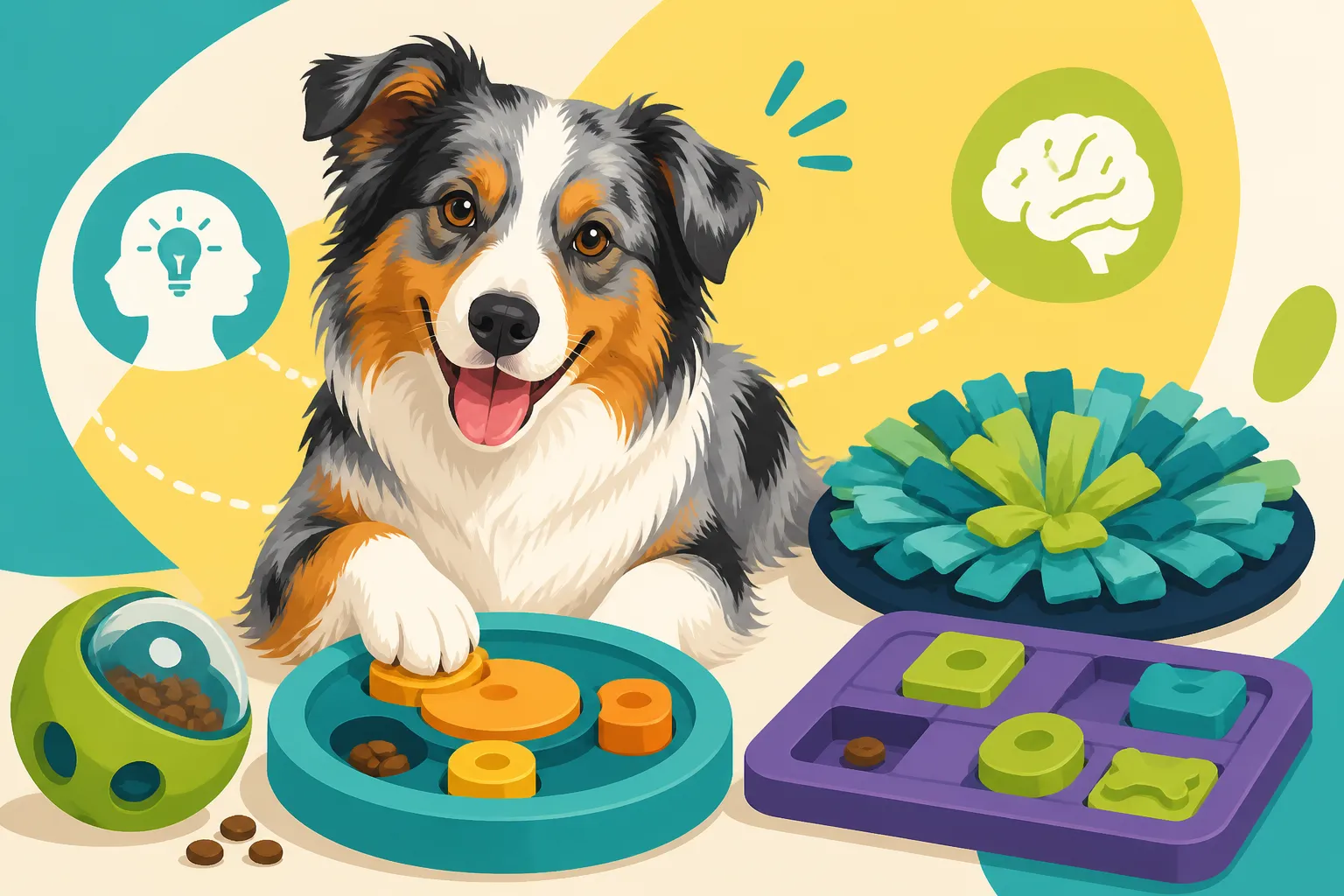
- Level 3 (Advanced) Puzzles: For the true brainiacs, advanced puzzles offer significant challenges. These can involve rotating discs, multiple compartments, pull-out drawers, or even scent discrimination. They often require a sequence of actions or a deeper understanding of how the puzzle works. Some advanced puzzles can be quite pricey, but they provide hours of enrichment. For a truly durable, high-difficulty puzzle, brands like Nina Ottosson (available on Chewy and other pet retailers) are popular choices, known for their robust construction and clever designs.
Matching the Puzzle to Your Aussie's Personality and Skill
This is where knowing your dog really comes into play. Not all Aussies are the same, and what excites one might frustrate another.
- The Eager Learner: If your Aussie is naturally curious, enjoys learning new tricks, and shows persistence, you can probably move them through the puzzle levels fairly quickly. Start with a Level 1 to build their confidence, then don't hesitate to introduce more challenging options. They might thrive on puzzles that require pushing, pulling, or even figuring out levers.
- The Easily Frustrated: Some Aussies, especially those new to mental games, might give up quickly if a puzzle is too hard. For these dogs, start with very simple puzzles where the reward is easily accessible. You might even "cheat" at first, leaving some treats partially out or in an unlocked compartment, so they get the idea quickly. The goal is to build positive associations and prevent frustration. A puzzle that’s too hard will just be ignored or, worse, destroyed.
- The Destroyer: If your Aussie tends to chew everything, you'll need to prioritize durability. Look for puzzles made from tough, non-toxic plastics or rubber. Avoid anything with small, easily detachable parts. Remember to supervise initially to ensure they're using the puzzle as intended and not trying to eat it whole. For these chewers, traditional puzzle toys might be less suitable than durable treat-dispensing toys like classic Kongs.
- The Scent Hound: Aussies have excellent noses! Puzzles that rely heavily on scent work, like snuffle mats or toys with hidden compartments, might be particularly engaging for them. These tap into their natural instinct to forage.
Always introduce new puzzles under supervision. Watch how your Aussie interacts with it. Are they engaged? Frustrated? Trying to pick it up and shake it? This feedback will tell you whether the puzzle is a good fit or if you need to adjust the difficulty.
Integrating Puzzle Feeders into Daily Routines
Puzzle feeders aren't just for special occasions; they can become a valuable part of your Australian Shepherd's daily rhythm. Incorporating them regularly provides consistent mental stimulation and can help manage their energy throughout the day.
- Mealtime Enrichment: Instead of dumping their kibble into a bowl, use a puzzle feeder for one or even all of their daily meals. This simple switch transforms eating from a 30-second gulp into a 15-20 minute mental exercise. For an Aussie prone to eating too fast, a slow feeder bowl is a great start to prevent potential health issues like bloat, which we discuss in "Why an Aussie's Deep Chest Raises Bloat Risk". For more advanced challenges, consider using a larger, multi-compartment puzzle that can hold an entire meal.
- Quiet Time Occupation: Need to focus on a work call or get some chores done? A stuffed Kong or a puzzle feeder can provide a fantastic, calm activity for your Aussie. It teaches them to settle down and engage independently. This is especially helpful if your Aussie struggles with boredom or separation anxiety when you're busy or step out for a short period.
- Before or After Exercise: A puzzle feeder can be a great way to "warm up" their brain before a training session or to "cool down" mentally after a physically active outing. It provides a transition from high-energy to a more focused state.
- As a Reward: Instead of just a quick treat, offer a small puzzle filled with a high-value treat as a reward for good behavior, coming when called, or successfully completing a training task. This makes the reward more engaging and long-lasting.
- During Confinement: If your Aussie spends time in a crate, a puzzle feeder can turn that space into a more positive and engaging environment. A frozen Kong, for example, can keep them occupied for a good stretch of time. Ensure any puzzle used in a crate is safe and cannot be easily destroyed or become a choking hazard.
Integrating these tools consistently helps establish a routine where your Aussie expects and enjoys mental challenges, making them a more balanced and happier companion.
Beyond Food Puzzles: Other Enrichment Gear for Australian Shepherds
While puzzle feeders are fantastic, the world of enrichment for your Australian Shepherd extends far beyond just food-dispensing toys. Tapping into their natural senses and instincts with a variety of gear can provide a well-rounded and deeply satisfying experience for their active minds.
Sniffing and Foraging Toys
One of the most powerful senses an Australian Shepherd possesses is their nose. Dogs naturally use their sense of smell to navigate the world, gather information, and find food. Engaging this powerful tool is a surefire way to provide profound mental stimulation.
- Snuffle Mats: These fantastic mats are made of dozens of fabric strips, creating a dense, shaggy surface where you can hide kibble or small treats. Your Aussie has to use their nose and paws to "snuffle" through the fabric and find the food. This mimics natural foraging behavior and is incredibly calming and mentally tiring. Snuffle mats are especially great for older dogs who might not be as mobile for traditional physical games but still need brain work. You can purchase them ready-made from many pet stores or online, or even make one yourself with fleece scraps and a rubber mat.
- Treat-Dispensing Balls and Toys: While some of these are classified as puzzle feeders, many are simpler, focusing more on the chase and the gradual reward. Toys like the KONG Wobbler or other durable treat balls require your Aussie to nudge, roll, and bat them around to get the food to fall out. This combines physical movement with mental engagement, tapping into their instinct to "hunt" and retrieve. Make sure to choose a size appropriate for your Aussie to prevent choking hazards.
- Scent Games: These don't always require a specific toy, but they heavily leverage your Aussie's nose. You can create your own scent trails in your yard, hiding treats and letting your dog sniff them out. Or, try a simple "find it" game indoors, hiding treats around a room and encouraging your Aussie to use their nose. These activities are incredibly effective at tiring an Australian Shepherd's mind, far more so than just a walk around the block, as we discuss in "Scent Games That Tire an Australian Shepherd".
Durable Chew Toys and Interactive Games
Australian Shepherds are often powerful chewers, especially when bored or stressed. Providing appropriate, durable chew toys is not just about saving your furniture; it’s a crucial form of mental and physical enrichment.
- Long-Lasting Chews: Bones (appropriate and safe varieties, always consult your vet), tough rubber toys, or edible chews designed for strong chewers provide a constructive outlet for their natural chewing instincts. Chewing is a self-soothing behavior for dogs and can help reduce anxiety. Look for brands known for durability, such as Nylabone, Benebone, or West Paw. On sites like Chewy, you can often filter by "tough chewer" to find suitable options.
- Stuffable Toys: The classic KONG toy is a staple for a reason. These hollow rubber toys can be stuffed with peanut butter, yogurt, kibble mixed with wet food, or even specific recipes. Freezing a stuffed KONG makes the challenge last even longer. This is excellent for keeping your Aussie occupied and mentally stimulated for extended periods, especially when you need them to settle down. Many pet parents also like to use fresh food options like those offered by Ollie for stuffing these types of toys, as they provide high-value, nutritious rewards.
- Flirt Poles: These are essentially a long stick with a rope or toy attached to the end, similar to a cat wand, but scaled for dogs. They allow you to safely encourage your Aussie's chasing and pouncing instincts, providing an incredible burst of physical and mental engagement. It's a fantastic way to burn off energy in a small space and to work on impulse control (e.g., "leave it" before you let them grab the toy).
- Tug Toys: Tug-of-war is a fantastic interactive game that builds a strong bond between you and your Aussie, while also providing an outlet for their prey drive and strength. Ensure you teach rules, like "drop it" on command, to maintain control and make it a positive experience. Look for durable tug toys that can withstand strong pulling.
Training Aids and Cognitive Games
Australian Shepherds are incredibly intelligent and thrive on learning. Incorporating specific training aids and cognitive games can elevate their mental enrichment, turning playtime into a continuous learning opportunity.
- Trick Training Props: Beyond basic obedience, teaching your Aussie a variety of tricks—like 'spin,' 'weave through legs,' 'play dead,' or 'fetch specific items'—provides immense mental satisfaction. Simple props like cones, hoops, or even household items can be used to facilitate these tricks. This type of engagement is not only fun but also deeply fulfilling for an Aussie who loves to use their brain. It's a fantastic form of mental work, as explored in our piece on "Trick Training as Aussie Mental Work".
- Advanced Brain Games: These go a step beyond simple puzzle feeders, often requiring your Aussie to understand concepts or sequences. For example, a set of graduated cups that hide a treat under one, requiring your dog to remember which cup, or even basic shell games. There are also dog-specific board games where your Aussie learns to move pieces to uncover treats. These games really challenge their cognitive abilities and memory.
- Clicker Training Kits: While not a toy, a clicker and some high-value treats are invaluable tools for mental enrichment through training. Clicker training is a positive reinforcement method that helps dogs quickly understand what behaviors earn rewards, making the learning process clear and engaging. It encourages your Aussie to think and offer behaviors, rather than just passively receiving commands.
- Interactive Buttons for Communication: For the truly advanced Aussie, some owners use programmable buttons that dogs can press to "speak" words like "outside," "play," or "food." While this requires significant dedication, it represents an incredible level of cognitive engagement and communication for your dog, pushing the boundaries of traditional training.
By offering a diverse range of these enrichment tools, you're not just keeping your Aussie busy; you're nurturing their intelligence, reinforcing positive behaviors, and strengthening your bond. Remember, variety is the spice of life, even for our four-legged friends!
Maximizing the Benefits of Enrichment Gear
Just acquiring a pile of puzzle feeders and toys isn't enough; how you use them makes all the difference. To truly harness the power of enrichment gear, you need a strategy that keeps things fresh, safe, and integrated into your Australian Shepherd's overall well-being.
Rotating Toys and Maintaining Novelty
Imagine getting the same present for your birthday every single year. After a while, it loses its sparkle, right? The same goes for your Australian Shepherd and their enrichment toys. Even the most complex puzzle can become mundane if it’s always available. The trick is to keep things fresh and exciting!
- The Power of Rotation: Don't leave all the toys out all the time. Instead, create a rotation system. Divide your Aussie's toys and puzzles into groups and put most of them away. Bring out one group for a few days or a week, then swap it for another. This makes each reintroduction feel like a brand new discovery, rekindling your dog's interest and engagement. When a favorite toy reappears after a hiatus, it's often met with renewed enthusiasm.
- Introducing New Challenges: Periodically, invest in a new type of puzzle or toy to add to the rotation. This ensures your Aussie is continuously exposed to novel challenges, preventing them from becoming "stale" in their problem-solving routine. It keeps their brain agile and their curiosity piqued.
- Varying the Fillings: For stuffable toys and puzzle feeders, don't always use the same kibble. Mix it up with different high-value treats, canned dog food, plain yogurt, cooked sweet potato, or even a dollop of peanut butter (xylitol-free!). Freezing these concoctions in a Kong or other stuffable toy can also dramatically extend the challenge and novelty. Brands like Ollie offer nutrient-dense, fresh food options that can make excellent high-value fillings, turning a simple puzzle into a gourmet experience for your Aussie.
Safety Considerations and Supervision
While enrichment gear is designed to be beneficial, safety should always be your top priority. Accidents can happen, and responsible ownership means taking precautions to ensure your Aussie's playtime remains safe and healthy.
- Choosing Appropriate Sizes: Always select toys and puzzle feeders that are appropriate for your Australian Shepherd's size and chewing strength. Small toys can become choking hazards, especially if your Aussie tries to swallow them whole. Larger toys that they can't get their mouth around might be frustrating or ignored.
- Durability and Materials: Aussies can be powerful chewers. Opt for toys made from durable, non-toxic materials. Regularly inspect all toys for wear and tear, cracks, or loose pieces. Discard any damaged toys immediately to prevent your dog from ingesting broken parts, which could lead to serious internal injuries. If your Aussie tends to destroy toys quickly, lean towards options specifically marketed for "power chewers."
- Supervision, Especially with New Toys: When introducing a new puzzle or toy, always supervise your Aussie closely. Watch how they interact with it. Are they trying to chew off pieces? Are they getting frustrated to the point of aggression towards the toy? Supervision allows you to intervene if there's a safety concern or if the puzzle is proving too difficult or unsuitable.
- Cleaning and Hygiene: Enrichment gear, especially food-related puzzles, can harbor bacteria if not cleaned regularly. Follow manufacturer instructions for cleaning. Most plastic or rubber puzzles can be washed with warm, soapy water or placed in the dishwasher. Snuffle mats often need to be machine washed. Regular cleaning prevents bacterial buildup and keeps the toys appealing.
Combining Physical and Mental Exercise
It's crucial to understand that mental enrichment, while powerful, is not a replacement for physical exercise. Australian Shepherds are working dogs through and through, and they need plenty of opportunities to run, jump, and expend their physical energy. The magic truly happens when you combine both.
- The Full Package: Think of it like this: physical exercise tires the body, and mental exercise tires the brain. An Aussie needs both to be truly fulfilled. A long walk or a good game of fetch burns off physical steam, making them more receptive to engaging with a puzzle feeder afterward. Conversely, a good mental workout can reduce their frantic need to run endlessly, making their physical exercise more focused and less frenetic. Many owners find that even with two hours of running, their Aussie still isn't settled, which is explored in "Why Two Hours of Running Never Settles an Aussie". This is where mental work steps in to bridge that gap.
- Structured Play: Incorporate enrichment into structured play sessions. For example, a game of fetch followed by hiding treats in a snuffle mat, or a brisk walk that ends with a challenging puzzle toy when you return home. This balance ensures all aspects of your Aussie's needs are met.
- Training as Both: Remember that training itself is a fantastic form of both mental and often physical exercise. Learning new commands, practicing obedience, or engaging in dog sports like agility or herding (if accessible) combine physical exertion with intense mental focus. These activities are the pinnacle of enrichment for an Australian Shepherd, offering a true "job."
- Understanding the "Job" Mindset: Australian Shepherds thrive on having a purpose. When they've had a good run and spent time solving a puzzle or learning a new trick, they feel accomplished. This leads to a calmer, more content, and ultimately happier dog who is less likely to create their own (often destructive) entertainment. Providing them with a consistent routine that integrates both physical activity and mental challenges ensures their powerful brains and energetic bodies are always working in harmony.
| Puzzle Feeder Type | Difficulty Level | Best For | Benefits | Safety Tip |
|---|---|---|---|---|
| Slow Feeder Bowl | Easy | Fast eaters, preventing bloat | Extends mealtime, reduces gulping | Choose non-toxic, sturdy materials. |
| Treat-Dispensing Ball | Easy/Medium | Active dogs, encouraging movement | Combines mental & physical, satisfying chase | Ensure size is appropriate to prevent choking. |
| Snuffle Mat | Easy/Medium | All dogs, especially scent-driven Aussies | Calming, natural foraging, mental fatigue | Wash regularly, supervise if dog tries to eat fabric. |
| Sliding Puzzle | Medium/Hard | Problem-solvers, builds confidence | Engages cognitive skills, diverse challenges | Check for small, detachable parts your Aussie could chew. |
| Stuffable Chew Toy | Easy/Hard | Strong chewers, separation anxiety | Soothes, occupies for long periods, versatile | Use only durable, non-toxic rubber; check for wear. |
Ultimately, investing in and strategically using puzzle feeders and enrichment gear is one of the best investments you can make in your Australian Shepherd's overall health and happiness. It’s a proactive approach to preventing behavior problems, fostering their intelligence, and deepening the incredible bond you share.
Disclaimer
Please note that the information provided in this article is for educational and informational purposes only and does not constitute veterinary advice. Always consult with a qualified veterinarian or professional dog trainer for any health concerns or before making any changes to your Australian Shepherd's diet, exercise routine, or training regimen. Individual dogs may react differently to various foods, exercise levels, and training methods.