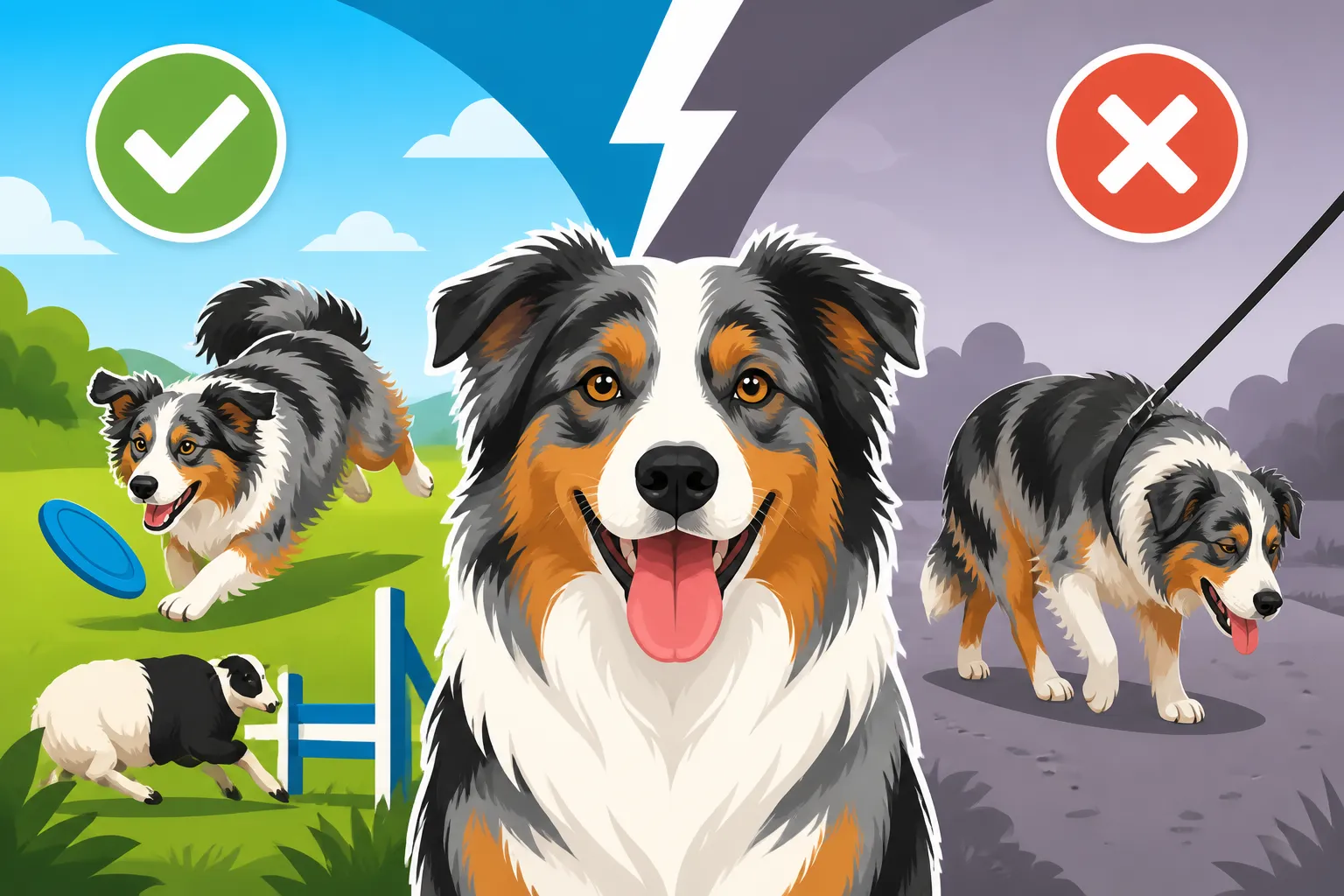
Why Aussie Exercise Type Beats Duration
It’s a common scenario: you’ve spent an hour, maybe even two, throwing the ball for your Australian Shepherd, trekking through the park, or going for a long run. You feel completely exhausted, but your Aussie? They’re still giving you that intense stare, ready for more, perhaps even starting to get a bit nippy or destructive. This guide is for every Aussie parent who has felt that frustration, trying to understand why sheer exercise duration often falls short of truly satisfying their energetic, intelligent companion.
The Common Misconception About Aussie Exercise
Many new Australian Shepherd owners, and even some seasoned ones, fall into the trap of thinking that if their dog just had more physical exercise, all their boundless energy would dissipate. It sounds logical, right? If you’re tired, you rest. So, if your dog is high-energy, run them until they drop! But with an Australian Shepherd, this approach often leads to more problems than it solves. It's like trying to fill a bucket with a hole in it – you can keep pouring, but it never truly feels full.
We see it all the time on social media: people proudly posting about their 10k runs with their Aussie, or hours of non-stop fetch. While these activities provide a fantastic physical outlet, they often neglect a critical component of an Australian Shepherd's well-being: mental engagement. A dog that is physically tired but mentally bored can still be a handful, channeling that unused brain power into less desirable behaviors. It’s not just about burning calories; it’s about stimulating their incredibly sharp minds.
The Endless Fetch Loop Trap
Think about it: an hour of fetch is largely repetitive. While it's great for their cardiovascular health and burning off some physical steam, it doesn't ask your Australian Shepherd to problem-solve, strategize, or engage their nuanced herding instincts. For many Aussies, an endless game of fetch can actually increase their arousal levels rather than calming them down. They get into a high-drive state, fixated on the movement of the ball, and it becomes harder for them to "switch off" afterwards. It's a bit like giving a hyperactive child a sugary drink and expecting them to settle down.
This can create a cycle where you feel compelled to throw the ball even more, creating a dog that needs constant external stimulation to feel "exercised." You might find your Aussie staring at you intently, dropping the ball at your feet relentlessly, or even pawing at you, demanding more. They learn that you are the source of their entertainment, rather than learning to engage with their environment or settle themselves. The goal isn't just to wear them out physically, but to fulfill their inherent need for purpose and mental work. Why Two Hours of Running Never Settles an Aussie explores this phenomenon in more detail.
Why Generic Exercise Misses the Mark
Generic exercise, like simply running or walking on a leash, can become monotonous for an Australian Shepherd. They thrive on variety, on challenges, and on tasks that require them to use their brains. A long walk around the block, while good for stretching their legs, doesn't engage their instincts to gather, drive, or flock. It doesn't ask them to use their keen senses to track a scent, or their intelligence to figure out a puzzle.
This isn't to say that physical exercise isn't important – it absolutely is! But it needs to be paired with activities that challenge them mentally. Without that mental component, many Aussies remain "on" all the time, constantly scanning their environment for a "job" to do. If you don't provide a constructive job, they might just invent one, and it's usually not one you'll appreciate, like herding your kids, nipping at heels, or rearranging your furniture. It's a fundamental misunderstanding of what makes an Australian Shepherd tick.
Unpacking the Australian Shepherd's Working Brain
To truly understand why exercise type trumps duration for an Australian Shepherd, we have to look back at their roots. These aren't just pretty dogs with striking eyes; they were meticulously bred for generations to be intelligent, independent-thinking, and highly cooperative working partners on ranches. Their brains are wired to solve problems, anticipate movement, and manage livestock – complex tasks that require far more than just physical endurance.
Their intelligence isn't just about learning tricks quickly; it's about their inherent ability to analyze situations, make decisions, and adapt. When we ignore this innate cognitive drive, we leave a huge part of their brain unused, leading to frustration and behavioral issues. They're like a supercomputer that's only ever used as a basic calculator.
Herding Instinct: The Aussie Operating System
The Australian Shepherd’s defining characteristic is its powerful herding instinct. This isn't just a cute quirk; it's the very blueprint of their operating system. When an Aussie herds, they aren't just running around. They are strategizing, observing the flock, anticipating movements, and working in concert with their human handler. They use their eyes to "read" the sheep, their body language to influence direction, and their minds to make split-second decisions. This is an incredibly taxing mental exercise, far more draining than a simple physical sprint. You can read more about this in Why Herding Instinct Is the Aussie Operating System.
This instinct is so strong that even pet Aussies, generations removed from working livestock, still possess it. They might try to herd your children, the vacuum cleaner, or even other pets. Ignoring this fundamental drive doesn't make it go away; it just redirects it, often in ways that are inconvenient or problematic. Providing outlets that tap into this herding brain, even without livestock, can be profoundly satisfying for them. It gives them a sense of purpose that a simple walk never could.
The Need for Purpose and Problem-Solving
Beyond herding, Australian Shepherds thrive on having a purpose. They are happiest when they feel they are contributing, that they have a job to do, no matter how small. This isn't just a physical job; it's a mental one. They want to figure things out, to use their cognitive abilities to achieve a goal. This is why puzzle toys are often so effective, or why they excel at complex obedience routines and dog sports.
If their days are filled with physical activity but lack mental challenges, they often become bored and restless. A bored Aussie is an inventive Aussie, and their inventions rarely align with human household rules. They might start chewing inappropriate items, digging in the yard, incessantly barking at every leaf that blows by, or developing compulsive behaviors. Providing purposeful, problem-solving activities channels this energy into constructive and healthy outlets.
Quality Over Quantity: Engaging Their Minds and Bodies
So, if simply throwing the ball isn't enough, what is? The key lies in activities that engage both your Australian Shepherd’s body and their brilliant mind. We’re talking about exercises that require thought, strategy, and cooperation, not just brute force or endless repetition. These types of activities will leave your Aussie truly tired, not just physically, but mentally, which is where the real "off switch" lies.
It’s about making every minute of exercise count, rather than just clocking in hours. Imagine the difference between an accountant simply entering numbers versus an accountant solving a complex tax puzzle. Both are working, but one is far more mentally taxing and satisfying. Your Aussie craves that mental puzzle.
Scent Work and Nose Games
One of the most underrated ways to tire out an Australian Shepherd is through scent work. Dogs experience the world largely through their noses, and asking them to use this powerful sense to find hidden treats or toys is incredibly stimulating. Think about how a detective uses clues – your Aussie is doing the same thing. Scent Games That Tire an Australian Shepherd offers a deeper dive into this. You don't need fancy equipment to start; you can simply hide treats around your house or yard and encourage your Aussie to find them.
For a more structured approach, look into local scent work classes or try out dedicated scent work kits. Companies like Chewy offer a fantastic array of scent work puzzles and snuffle mats that encourage natural foraging behavior and mental engagement. Just 15-20 minutes of intense nose work can be as tiring, if not more so, than an hour of running. It taps into their natural instincts and requires intense focus, leaving them pleasantly fatigued.
Trick Training and Advanced Obedience
Teaching your Australian Shepherd new tricks or engaging in advanced obedience commands is another excellent way to combine physical movement with mental gymnastics. Each new command or trick requires your Aussie to think, process information, and coordinate their body. It builds their confidence, strengthens your bond, and provides a clear, constructive outlet for their intelligence.
Consider teaching them complex sequences like "fetch your leash," "put your toys away," or "go to your mat and settle." These aren't just impressive party tricks; they're cognitive exercises that challenge their memory, understanding, and impulse control. Using a variety of rewards, including high-value treats (perhaps from a brand like Ollie, known for fresh, appealing options), keeps them engaged and motivated. This kind of mental work really helps develop that "off switch" by teaching them to focus and then relax. Trick Training as Aussie Mental Work further explains the benefits of this approach.
Structured Play and Dog Sports
Beyond informal games, structured dog sports like agility, flyball, or even herding (if available) are phenomenal for Australian Shepherds. These activities are designed to tap into their natural athleticism, intelligence, and drive. They require focus, coordination, problem-solving, and a deep understanding of cues. Australian Shepherd Agility and Disc Sports highlights some of the most popular choices.
Even if you don't plan to compete, introductory classes in these sports offer an incredible outlet. An agility course, for example, demands that your Aussie navigate obstacles, follow commands, and make quick decisions, all at speed. This is a holistic workout that exhausts both their body and their brain in a way that simply running in circles cannot. Many local training clubs offer beginner sessions, and you can find equipment and books on Amazon to practice some skills at home.
Tailoring Exercise to Your Aussie's Individual Needs
While there are general guidelines for Australian Shepherd exercise, it's crucial to remember that every dog is an individual. What works for one Aussie might not work for another. Their age, health status, previous experiences, and even their specific personality traits will all influence the type and intensity of exercise they need. A one-size-fits-all approach is almost guaranteed to fail.
Observing your own dog and understanding their unique signals is paramount. Are they overstimulated by certain activities? Do they shut down under pressure? Do they have any underlying health conditions that limit physical exertion? Answering these questions will help you craft an exercise regimen that truly suits them.
Age and Developmental Stages
A young Australian Shepherd puppy has different exercise needs than an adult or a senior dog. Puppies, especially during their critical growth phases, should have their physical exercise limited to prevent damage to their developing joints. Too much forced, high-impact exercise can contribute to issues like hip or elbow dysplasia later in life. Instead, focus on short bursts of play, lots of socialization, and gentle mental stimulation. Think more about introducing them to new sights and sounds, short training sessions, and puzzle toys. Exercise Limits for a Growing Australian Shepherd offers more specific advice on this.
As they mature, their physical stamina increases, but their mental needs remain high. Senior Aussies, on the other hand, might have reduced physical capabilities due to arthritis or other age-related conditions. For them, gentle walks combined with more sedentary mental games like advanced scent work or puzzle feeders become even more important. The goal is to keep their minds sharp and their bodies moving comfortably, without overexertion. Senior Australian Shepherd Care and Slowing Down covers this crucial stage of their life.
Health Considerations and Limitations
Any underlying health conditions can significantly impact your Aussie’s exercise capacity and type. For instance, an Australian Shepherd with hip dysplasia might struggle with high-impact activities like jumping in agility or long, strenuous runs. In such cases, swimming or hydrotherapy can offer a fantastic low-impact physical workout, combined with plenty of mental games.
Similarly, an Aussie prone to bloat (Gastric Dilatation-Volvulus) needs careful timing of exercise around meals. It’s always best to consult with your veterinarian to tailor an exercise plan that is safe and beneficial for your individual dog’s health. They can advise on appropriate activities and any necessary precautions. Ignoring health limitations can lead to injury or exacerbate existing conditions, making your Aussie uncomfortable and potentially worsening behavioral issues due to pain.
Personality and Temperament
Just like people, Australian Shepherds have distinct personalities. Some might be more reserved and prefer one-on-one activities, while others might be social butterflies who thrive in group classes. Some might be natural athletes, eager for intense physical challenges, while others might prefer slower-paced, intricate mental puzzles.
Observe your Aussie’s reactions to different activities. Do they light up during a game of tug, or do they prefer sniffing out treats in the yard? Are they easily overstimulated by a dog park, or do they genuinely enjoy playing with other dogs? Tailoring their exercise to their natural inclinations will lead to a happier, more fulfilled dog. If your Aussie is prone to Australian Shepherd Reactivity and Overarousal, high-energy group activities might be counterproductive. Finding a balance that respects their temperament is key to preventing stress and burnout for both of you.
Integrating Brain Games and Structured Activities
Now that we understand the 'why' behind quality exercise, let's talk about the 'how.' Incorporating mental stimulation and structured activities doesn't have to be complicated or require vast amounts of extra time. It's often about making small, consistent changes and thinking creatively about how you spend your time with your Australian Shepherd. The goal is to weave these enriching experiences into their daily routine, rather than seeing them as separate, burdensome tasks.
Consistency is key here. A few minutes of dedicated brain work every day is far more beneficial than one long, overwhelming session once a week. This regular engagement helps keep their minds sharp and their energy levels balanced.
Daily Mental Challenges
Make mental challenges a regular part of your Aussie's day. This can be as simple as ditching the bowl for mealtime and using a puzzle feeder instead. Brands like Chewy and Amazon offer a huge variety of puzzle feeders, from simple maze bowls to complex multi-step toys that require your dog to manipulate levers or slide compartments to get their food. This turns mealtime into a problem-solving exercise, engaging their brains before they even burn a single calorie running.
Another easy integration is using training as part of their "walk." Instead of just walking, incorporate short bursts of obedience work: sit, stay, heel, recall around distractions. Make them work for their progress down the street. The Aussie Puppy Curriculum Month by Month is a great resource for structuring early training, but these principles apply to adult dogs too. You can also hide treats along your walking path, encouraging them to use their nose and search, turning a mundane walk into a scavenger hunt.
Structured Play Sessions
Structured play is different from just letting your dog run wild in the yard. It involves games with rules, clear boundaries, and an "off switch." Think about games like "find it" where you hide a toy and they have to search, or "tug-of-war" with clear start and stop cues. Tug is fantastic for Aussies, as it allows them to use their mouths and bodies in a controlled way, fulfilling some of that herding drive without actual livestock. Tug as a Legal Outlet for Aussie Herding Drive explains this further.
These sessions teach impulse control and focus, which are invaluable skills for an Australian Shepherd. Incorporate different types of toys – squeaky toys for chasing, durable chew toys from brands like Kong or Nylabone found on Amazon, and interactive ones they can manipulate. Varying the games keeps their interest piqued and prevents boredom. Remember to always end play on a positive note, before your Aussie becomes overstimulated or loses interest, reinforcing that "off switch."
Exploring New Environments
While not strictly mental games, exploring new environments offers immense mental stimulation through novel sights, sounds, and smells. A hike on a new trail, a visit to a different park, or even a walk through a bustling town square (if your Aussie is comfortable with crowds) exposes them to a wealth of sensory information that engages their brains. They're processing new data, observing different creatures, and using their navigation skills.
Just be mindful of their comfort levels. For some Aussies, a busy city environment might be overwhelming, leading to stress rather than enrichment. Always prioritize their well-being and build up exposure gradually. Even a change of route on your regular walk can offer a fresh perspective for their curious minds. These excursions are also fantastic opportunities to practice Australian Shepherd Recall Around Moving Things in various settings, which is a life-saving skill.
Recognizing Signs of Under-Stimulation vs. Physical Exhaustion
It can be tough to distinguish between a truly tired Australian Shepherd and one who is just physically exhausted but mentally wired. Often, the behaviors look similar on the surface – restlessness, panting, maybe even some destructive tendencies. However, understanding the subtle differences is crucial for providing the right kind of intervention. Giving a mentally bored dog more physical exercise can sometimes make the problem worse, leading to an over-tired, overstimulated, and still-demanding dog.
Your Aussie communicates their needs through their behavior. Learning to "read" these signals will help you adjust their routine to ensure they are getting both their physical and mental needs met appropriately. It’s about being a detective in your own home.
Signs of Mental Under-Stimulation
A mentally under-stimulated Australian Shepherd might exhibit a range of behaviors even after a long walk or run. They might pace aimlessly, incessantly bark at minor sounds, or develop destructive habits like chewing furniture or digging in the yard. Their eyes might still have that intense, searching gaze, as if they’re looking for a job you haven’t given them. They might be overly vocal, demanding attention with whines or barks, or constantly bringing you toys, unable to settle.
Other signs include:
- Persistent Nipping or Herding attempts: They might nip at your heels, herd children or other pets, or even inanimate objects. This is their brain trying to find an outlet for its primary drive. An Australian Shepherd Nipping a Toddler's Ankles is a common, frustrating example of this.
- Difficulty settling: Even after physical exercise, they might struggle to relax in the house. They might follow you from room to room, unable to find a comfortable spot to just rest. An Australian Shepherd That Cannot Switch Off describes this state perfectly.
- Exaggerated reactions to stimuli: Small noises or movements might cause an outsized reaction (excessive barking, lunging) because their brain is already in an alert, hyper-vigilant state due to boredom.
- Obsessive behaviors: Staring at shadows, chasing reflections, or licking paws excessively can sometimes stem from a lack of appropriate mental outlets.
Signs of Physical Exhaustion
Physical exhaustion, on the other hand, looks more like genuine tiredness. Your Australian Shepherd will likely lie down readily, perhaps even snoozing deeply. Their breathing and heart rate will slow, and their body will appear relaxed. They won't be looking for more to do; they'll simply be resting and recovering.
Key indicators of physical exhaustion (often without mental satisfaction if not paired with brain work) include:
- Lagging behind on walks: They might start to slow down, struggle to keep pace, or even lie down during exercise.
- Excessive panting or drooling: Beyond normal post-exercise cool-down, indicating their body is working hard to regulate temperature.
- Reluctance to play: They might ignore toys or invitations to engage in further activity, choosing rest instead.
- Limping or stiffness: A clear sign of overexertion or potential injury, warranting immediate attention. An Aussie Stiff After a Career in Agility might be exhibiting these symptoms.
By learning to differentiate these signs, you can better understand what your Australian Shepherd truly needs. Is it another mile on the trail, or is it 15 minutes of Scent Games That Tire an Australian Shepherd? Often, the answer leans heavily towards engaging their powerful minds.
Disclaimer
This article is for general informational purposes only and does not constitute professional advice. Laws, prices and regulations vary by location and change over time. Consult a qualified professional for guidance on your specific situation.