Retinal Atrophy Taking an Aussie’s Night Vision
It's incredibly unsettling when you notice your active, sharp Australian Shepherd starting to hesitate in dim light, bumping into furniture they once navigated with ease, or perhaps seeming a bit lost in the evening. This isn't just "getting old" – it could be the insidious creep of progressive retinal atrophy (PRA), a group of inherited eye diseases that slowly steal your beloved Aussie's vision, often starting with their night sight. This guide is here to walk you through what PRA is, how to recognize its signs, manage the condition, and understand the crucial role of responsible breeding.
Understanding Progressive Retinal Atrophy in Australian Shepherds
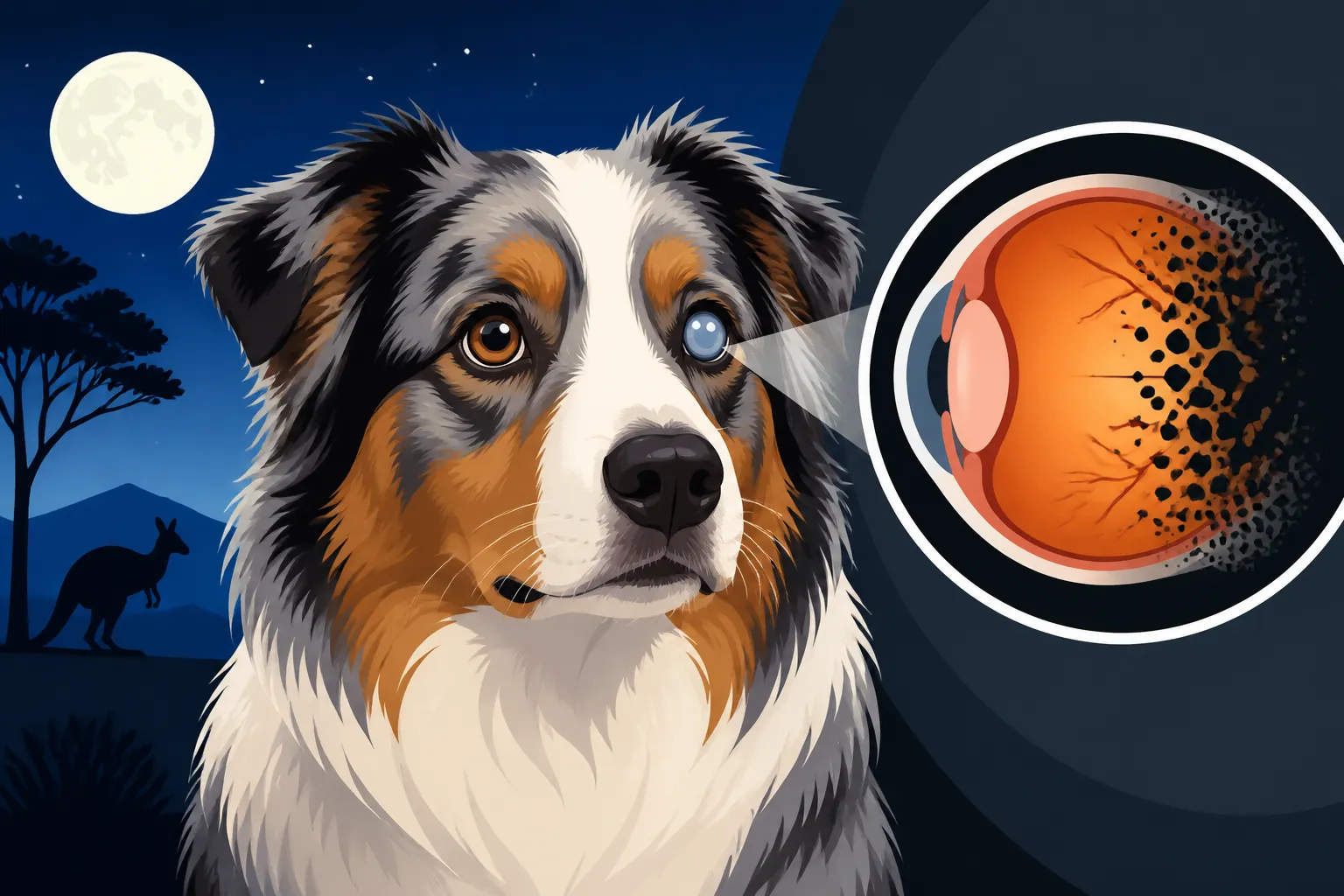
Progressive Retinal Atrophy (PRA) isn't just one single disease; it's a broad term for a collection of genetic eye conditions that cause the gradual degeneration of the photoreceptor cells in the retina. Think of the retina as the film in a camera – it's responsible for capturing light and sending those signals to the brain to create an image. When these crucial cells start to die off, vision inevitably deteriorates, leading ultimately to blindness. For many Australian Shepherds affected by PRA, the first and most noticeable change is a loss of night vision, which can be incredibly disorienting for a dog so reliant on its keen senses.
This isn't a condition that strikes overnight; it's a slow, relentless process. The timeline can vary greatly depending on the specific genetic mutation at play, with some forms showing up in puppyhood and progressing rapidly, while others might not manifest until an Aussie is well into its senior years. The crucial thing for us as owners is to understand that this isn't something we caused, nor is there a cure, but early recognition and proactive management can significantly enhance our dog's quality of life.
The Science Behind PRA: Rods and Cones in Aussie Eyes
To really grasp what's happening with PRA, it helps to understand a little about how your Australian Shepherd's eyes work. Inside their retina, there are two main types of photoreceptor cells: rods and cones.
Rods are the superstars of low-light vision and detect motion. They're what allow your Aussie to navigate a dark yard, spot a squirrel scampering across the lawn at dusk, or follow your hand signals even when the light is fading. Dogs, generally speaking, have a much higher concentration of rods than humans, which is why their night vision is inherently superior to ours. Cones, on the other hand, are responsible for daylight vision, color perception, and fine detail. While dogs do see some color, it's not the vibrant spectrum we experience, and their world is more focused on movement and changes in light intensity.
In most forms of PRA that affect Australian Shepherds, the rod cells are the first to degenerate. This means that an affected dog will progressively lose their ability to see in dim light or darkness. They might struggle to find their toys under the couch, become reluctant to go out for a late-night potty break, or seem unusually clumsy during evening walks. As the disease progresses, the cone cells also begin to fail, eventually leading to complete blindness, even in bright light. This transition can be a long and emotionally challenging journey for both the dog and their human family, as they slowly lose one of their primary senses.
Different Forms of Progressive Retinal Atrophy
While "PRA" is a blanket term, there are several specific genetic forms of the disease, each with its own nuances in terms of onset and progression. For Australian Shepherds, identifying the exact genetic mutation responsible is becoming increasingly important thanks to advancements in DNA testing. One of the more common forms across many breeds, and sometimes seen in Aussies, is generalized PRA, where both rods and cones degenerate, with rods typically affected first.
The challenge lies in the fact that different mutations can lead to similar clinical signs. Some forms are "early-onset," meaning puppies or young adults might start showing signs between 6 months and 3 years of age. Others are "late-onset," with vision problems not appearing until an Aussie is 5, 6, or even 8 years old. The speed of progression can also vary – some dogs might lose their sight relatively quickly over a year or two, while others might have a much slower decline over several years. Knowing the specific type of PRA, if identified through genetic testing, can help your vet give you a more accurate prognosis regarding the likely timeline of vision loss and allow you to prepare more effectively for the changes ahead.
Spotting the Subtle Signs of Vision Loss in Your Aussie
One of the hardest things about PRA is how subtly it can begin. Your Australian Shepherd is incredibly resilient and will try to compensate for their diminishing vision, especially in familiar environments. This means you might not notice anything is amiss until the disease has progressed significantly. However, being observant and knowing what to look for can help you intervene earlier, allowing you to adapt your home and routine to make life easier for your dog.
It’s often those little hesitations or unusual behaviors that are the first clues. Your Aussie might start to rely more heavily on their other senses – scent, hearing, and touch – to navigate their world, making them appear almost normal during the day. But when the lights dim, or they're in an unfamiliar place, that's when their struggles become most apparent.
Behavioral Changes in Dim Light
The earliest and most telling signs of PRA will almost always involve a change in your Aussie’s behavior when lighting conditions are less than ideal. Because their rod cells are typically the first to go, their night vision takes the initial hit.
You might notice your typically confident dog starting to hesitate at the top or bottom of stairs in the evening. They might bump into furniture they usually dance around, especially if you've moved something even slightly. Picture your Aussie, who once darted through the house with abandon, now moving much more slowly, perhaps with their nose to the ground, sniffing their way along the walls. They might seem more startled by sudden movements or noises in low light, simply because they didn't see whatever caused the disturbance. If they're usually enthusiastic about evening walks but now seem reluctant or pull back from stepping out into the darkening yard, that's a significant red flag. They might even struggle to find a dropped treat on the floor once the sun goes down. These subtle shifts in confidence and navigation, particularly as day turns to night, are crucial indicators that their night vision is diminishing.
Changes in Eye Appearance and Reflexes
While behavioral changes are often the first sign, certain physical changes in your Australian Shepherd's eyes can also be indicative of PRA, though these usually become noticeable in later stages.
One common sign is increasingly dilated pupils, even in moderate light. This happens as the eye tries to let in as much light as possible to compensate for the failing photoreceptors. When you look at your Aussie, their pupils might seem larger and more open than usual. Sometimes, owners report seeing a greenish or yellowish "eye shine" or tapetal reflection in their dog's eyes when light catches them just right, similar to how cats' eyes glow in the dark. This is often more pronounced in dogs with PRA because the retina is thinning, making the reflective layer behind it more visible. In advanced cases, the lens of the eye may become cloudy, leading to secondary cataracts, which further obscure vision. This is different from the primary Hereditary Cataracts in an Australian Shepherd that some Aussies can develop, but it can be a complication of advanced PRA. If you notice any of these changes, coupled with behavioral signs, it's definitely time for a visit to your veterinarian or a veterinary ophthalmologist.
Here’s a quick overview of how PRA symptoms might progress:
| Stage of PRA | Behavioral Symptoms (Night Vision) | Behavioral Symptoms (Day Vision) | Ocular Changes |
|---|---|---|---|
| Early Stage | Hesitation in dim light, bumping into objects in the dark, reluctance to go out at night. | Normal daytime vision, may seem a little less keen on catching fast-moving toys. | Pupils may appear slightly more dilated than usual in moderate light. |
| Mid Stage | Significant difficulty navigating in low light, easily startled, more reliance on scent/hearing, personality changes due to insecurity. | Reduced visual acuity in daylight, difficulty tracking moving objects, may miss treats. | Pupils consistently dilated, noticeable "eye shine," possible early cataract formation. |
| Advanced Stage | Complete night blindness, extreme disorientation, anxiety in any non-bright environment. | Complete daytime blindness, bumping into objects even in bright light, constant pupil dilation. | Advanced cataracts, possibly secondary glaucoma. Retina may appear pale or dull. |
Getting a Diagnosis and What Comes Next
If you're noticing any of the signs we've discussed, the next step is a trip to your vet. While it's natural to feel anxious, getting an accurate diagnosis is the first crucial step in understanding and managing your Australian Shepherd's condition. Your regular veterinarian can perform an initial eye exam, but for a definitive diagnosis of PRA, they'll likely recommend a visit to a board-certified veterinary ophthalmologist. These specialists have the equipment and expertise to really delve into the intricacies of eye health.
Remember, a diagnosis of PRA is not a death sentence, but it does mean a significant adjustment for both you and your dog. Knowing what to expect, and having a plan, can make all the difference. This is also where having a good pet insurance policy, like one from Healthy Paws, can truly ease the financial burden of specialist consultations and advanced diagnostic tests.
The Ophthalmic Exam and Specialist Visit
When you visit a veterinary ophthalmologist, they'll perform a thorough examination of your Australian Shepherd's eyes. This isn't just a quick look; it's a comprehensive assessment that may include several specialized tests.
They'll typically start with an indirect ophthalmoscopy, using a special light and lens to visualize the back of the eye, specifically the retina. In dogs with PRA, the ophthalmologist might observe changes like a dull, granular appearance of the retina, thinning of the retinal blood vessels, and an increased reflectivity of the tapetum (the reflective layer behind the retina), which usually happens as the retina degenerates. They might also perform an electroretinography (ERG). This non-invasive test measures the electrical activity of the retinal cells in response to flashes of light, similar to an EKG for the heart. An ERG is considered the gold standard for diagnosing PRA because it can detect functional changes in the retina even before visible structural changes or behavioral symptoms become obvious. It can also help differentiate PRA from other conditions that cause blindness, like Hereditary Cataracts Clouding an Aussie Eye. This detailed diagnostic work is precisely why considering pet insurance like Healthy Paws early on can be a lifesaver, as these specialized tests can add up.
The Importance of Genetic Testing
Beyond the physical exam, genetic testing plays a vital role in diagnosing PRA in Australian Shepherds and understanding the specific mutation at fault. Since PRA is an inherited disease, a DNA test can identify if your dog carries the gene mutations known to cause the condition.
For Australian Shepherds, a number of genetic tests for various forms of PRA are available. If your dog tests positive for a specific PRA mutation, it confirms the diagnosis and can also help predict the likely onset and progression, if that specific mutation has been well-studied. More importantly, genetic testing is absolutely critical for breeders. It allows them to identify carriers – dogs who don't show symptoms themselves but can pass the faulty gene on to their offspring. This is part of The Genetic Panel Every Australian Shepherd Needs and one of The Health Tests Every Australian Shepherd Parent Needs that responsible breeders should always perform. By using this information, breeders can make informed decisions to avoid breeding affected dogs or carriers, thereby reducing the incidence of PRA in future generations. Even if your Aussie is already showing signs, genetic testing can provide closure, confirm the diagnosis, and help you understand the hereditary nature of the disease within their lineage.
Helping Your Aussie Adapt to Diminished Vision
A diagnosis of PRA can be heartbreaking, but it's important to remember that dogs are incredibly adaptable. While they may be losing their sight, their other senses – smell, hearing, and touch – become remarkably heightened. Your Australian Shepherd can still live a full, happy, and enriching life, albeit with some adjustments to their routine and environment. The key is to be patient, consistent, and proactive in helping them navigate their new reality.
It's a journey, and there will be good days and challenging days. But with your love and support, your Aussie can continue to thrive. This phase of life can also bring you closer, as you learn to communicate and interact in new, meaningful ways.
Creating a Safe and Predictable Environment
One of the most impactful things you can do for an Australian Shepherd with diminishing vision is to create a predictable and safe home environment. Consistency is key here.
Avoid moving furniture around unnecessarily. Your dog will create a mental map of your home, and even small changes can be disorienting and frustrating, leading to bumps and falls. Keep pathways clear of clutter – shoes, bags, or toys should always be put away in the same spot. If you have stairs, consider placing baby gates at the top and bottom to prevent accidents, or explore ramps for easier navigation. Using different textures of mats or rugs near doorways or steps can provide tactile cues. Some owners even use scent markers – a drop of essential oil (safe for dogs, like lavender or chamomile, used sparingly and diluted) on doorframes or furniture corners – to help their dog orient themselves. Remember to keep their food and water bowls, bed, and toys in consistent locations. For outdoor spaces, ensure fences are secure and identify any potential hazards like sharp objects or uneven ground. These simple, consistent actions will help your Aussie feel secure and confident in their own home.
Training and Communication Adaptations
As your Australian Shepherd's vision declines, your communication methods will naturally need to evolve. You’ll find yourself relying less on visual cues and more on verbal commands, sounds, and touch.
Start by reinforcing clear verbal commands for everything: "stay," "wait," "step up," "step down," "find your bed." Consistency in your tone and wording is crucial. You can also introduce new verbal cues like "obstacle" or "careful" to warn them of upcoming changes in terrain or objects in their path. Using a jingle bell on your shoes can help your Aussie locate you in a room, or jingling your keys before you walk into a room can alert them to your presence. Touch can also become a powerful tool – a gentle tap on the shoulder to get their attention, or guiding them with a hand on their side. When outside, always keep them on a leash, or use a long line in a securely fenced area. Consider a "blind dog" vest or harness, which signals to others that your dog has vision impairment, preventing unexpected approaches that might startle them. Remember, patience is paramount. It takes time for your dog to learn new ways of interpreting their world, and for you to learn new ways of guiding them.
Living Longer with Progressive Retinal Atrophy
While a diagnosis of PRA is life-altering, it doesn't mean your Australian Shepherd's quality of life needs to diminish. Many visually impaired Aussies adapt beautifully and continue to enjoy their lives, often living to a full Australian Shepherd Lifespan Across Twelve to Fifteen Years. The key is to focus on their overall health, provide ample mental and physical enrichment adapted to their abilities, and ensure you're addressing not just their physical needs but their emotional ones as well.
This period requires a deep bond between you and your dog, built on trust and understanding. Your consistency and patience will be their guiding light, allowing them to navigate their world with confidence.
Maintaining Overall Health
Even with a vision impairment, maintaining your Australian Shepherd's overall health is paramount. Regular veterinary check-ups are more important than ever. Your vet can monitor for any secondary conditions that might arise, such as cataracts that worsen, or even other health issues that can sometimes accompany genetic predispositions. For instance, sometimes other unrelated genetic conditions might be part of The Genetic Panel Every Australian Shepherd Needs.
Nutrition plays a vital role in supporting their general well-being, though there's currently no specific diet or supplement proven to halt or reverse PRA. Ensure they're on a high-quality, balanced diet suitable for their age and activity level. Mental enrichment, like puzzle toys, scent work games, and familiar walks where they can explore with their nose, becomes incredibly important when visual stimulation is reduced. Gentle, consistent exercise, such as leash walks in familiar, safe areas, will keep their bodies healthy. If you’re concerned about the costs associated with frequent vet visits, specialized diets, or even emergency care, having pet insurance like Healthy Paws can provide significant peace of mind, allowing you to focus on your Aussie's health without the added financial stress.
Emotional Support for Both Dog and Owner
It's okay to feel sad, frustrated, or even grieve when your Australian Shepherd receives a PRA diagnosis. You're losing a part of the relationship you once had, and watching your dog struggle can be incredibly difficult. However, your dog will pick up on your emotions, so try to project calm confidence.
For your Aussie, the loss of vision can lead to anxiety, confusion, or even changes in personality, such as becoming more reserved or easily startled. Providing extra comfort, sticking to routines, and offering plenty of verbal praise and gentle touch can help them feel secure. Continue to engage them in activities they love, adapting them as needed. For example, instead of fetch with a visual target, try a treat-dispensing ball or a game of "find it" using their nose. Creating a safe haven, like a comfy bed in a quiet corner, can give them a place to retreat when they feel overwhelmed. Don't hesitate to seek support for yourself, too. Online forums, local support groups, or even talking to your vet can provide valuable advice and emotional understanding during this challenging but ultimately rewarding journey.
Breeding Responsibly and Genetic Health
Because Progressive Retinal Atrophy is an inherited condition, responsible breeding practices are absolutely fundamental to reducing its prevalence in Australian Shepherds. For any breeder, the goal should be to produce healthy, sound dogs, and that includes clear vision. This involves a proactive approach to genetic health testing and careful consideration of pedigrees before any breeding decisions are made.
We all want healthy puppies, and a significant part of achieving that involves understanding the genetic risks associated with the breed. The commitment to eradicating diseases like PRA starts with the choices made by breeders.
Genetic Screening and Pedigree Research
Responsible Australian Shepherd breeders understand that genetic screening is not an option; it's a necessity. Before breeding any dog, they should conduct comprehensive genetic testing for all known inherited diseases prevalent in the breed, including PRA. This often includes using a full The Genetic Panel Every Australian Shepherd Needs to screen for various conditions, including specific forms of PRA.
In addition to genetic DNA tests, breeding dogs should undergo regular eye examinations by a board-certified veterinary ophthalmologist. The Orthopedic Foundation for Animals (OFA) and the American College of Veterinary Ophthalmologists (ACVO) maintain databases of these results. Breeders should seek an annual The ACVO Eye Exam Australian Shepherd Breeders Run for all breeding stock. These exams can detect subtle changes in the eye that might indicate the onset of PRA or other eye conditions like Collie Eye Anomaly (CEA) or primary cataracts. Furthermore, thorough pedigree research is crucial. A responsible breeder will delve into the health history of both the sire and dam, looking for any incidence of PRA or other genetic eye diseases in their lineage. This layered approach of DNA testing, regular eye exams, and pedigree analysis is the most effective way to identify and avoid passing on the genes responsible for PRA.
Ethical Breeding Practices
Ethical breeding goes beyond simply conducting tests; it's about making conscientious decisions based on those results. Any Australian Shepherd diagnosed with PRA, or identified as carrying a gene mutation for a severe, early-onset form of PRA, should not be bred. This is a tough decision, especially if the dog possesses other desirable traits, but it's a vital step in safeguarding the health of the breed.
When a dog is a carrier (meaning they have one copy of the recessive gene but don't express the disease themselves), breeders must exercise extreme caution. A carrier can safely be bred to a dog that has tested "clear" (meaning they don't have any copies of the gene), as no affected puppies would result. However, breeding two carriers together is a risky gamble, as there's a 25% chance of producing affected puppies. Reputable breeders prioritize health over all else, even if it means retiring a promising dog from their breeding program. This commitment ensures that fewer families will experience the heartbreak of An Old Australian Shepherd Losing Its Sight due to preventable genetic conditions, creating a healthier future for our beloved Australian Shepherds.
Disclaimer
The information provided in this article is for general informational purposes only and does not constitute veterinary advice. Always consult with a qualified veterinarian or veterinary ophthalmologist for any health concerns or before making any decisions about your pet's health or treatment.