The Height Range for a Female Aussie
It's completely understandable to wonder about the size of a female Australian Shepherd, especially if you're bringing one home or just trying to understand your own furry companion better. There's a lot of variation out there, and sometimes what you read in a breed standard doesn't quite match the sturdy, active dog bouncing around your living room. This guide is here to shed some light on the typical height range for female Aussies, exploring what the breed standards say, what factors can influence their stature, and why these measurements matter for their overall health and lifestyle.
Understanding the Breed Standard for Female Australian Shepherds
When you look at official breed standards, like those from the Australian Shepherd Club of America (ASCA) or the American Kennel Club (AKC), they lay out a very specific blueprint for what an Australian Shepherd "should" look like. This includes everything from their head shape to their tail, and yes, their height. For female Australian Shepherds, these standards provide a guideline that helps maintain consistency within the breed, especially for those involved in conformation shows.
The general consensus across these major registries sets a specific height range that is considered ideal for a female Australian Shepherd. This range is usually measured from the highest point of the shoulder blade, known as the withers, down to the ground. It’s not just an arbitrary number; it relates to their functional purpose as a working dog – agile enough to herd, but substantial enough to command respect from livestock. A female that falls outside this range might still be a fantastic pet and working partner, but she wouldn't meet the aesthetic criteria for the show ring.
It's important to remember that these are ideals. Just like people, not every dog will fit perfectly into the mold. Some females might be a touch taller, some a bit shorter, and still be wonderful, healthy individuals. The standard provides a framework, but real-life Aussies often present a beautiful spectrum of sizes within that general scope. If you're looking for a comprehensive overview of the breed's characteristics, you might find The Australian Shepherd Standard and What Judges Want a helpful read to grasp all the nuances.
Typical Height Range for Female Aussies
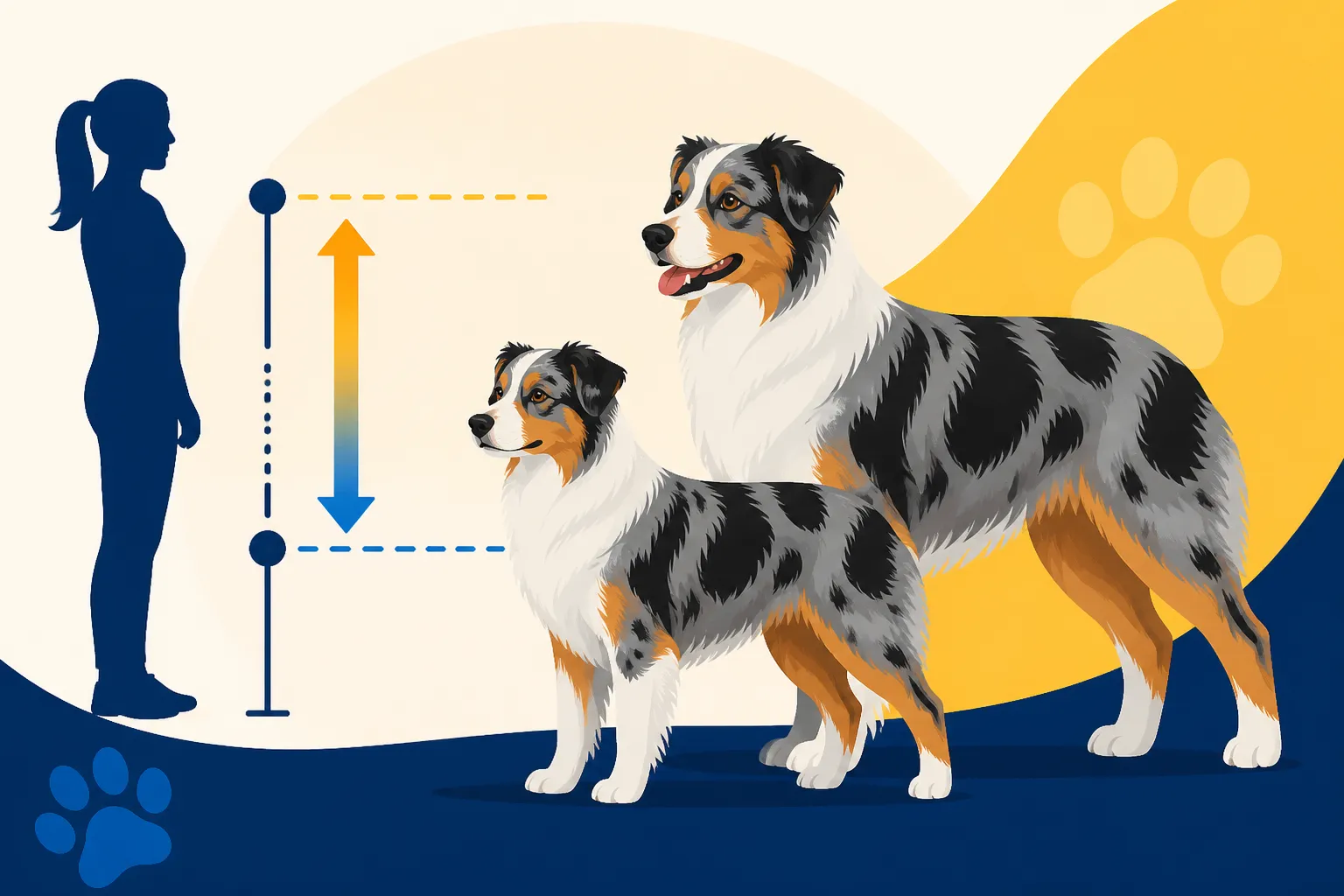
So, what exactly is that typical height range for a female Australian Shepherd? Generally speaking, you'll find that female Aussies are expected to stand a bit smaller than their male counterparts. This isn't unusual in many dog breeds, where males tend to be larger and heavier.
For a female Australian Shepherd, the accepted height at the withers typically falls between 18 to 21 inches. This is a fairly consistent range across most reputable breed organizations. A dog standing at the lower end of that spectrum, say 18 or 19 inches, would still be perfectly within the standard, just as a female at the upper end of 20 or 21 inches would be. It allows for a degree of individual variation while still defining the breed's overall physical type.
This measurement is taken when the dog is fully grown, usually around 18 months to two years of age, though most Aussies reach their adult height earlier than that. Before that, they're often still in a lanky, growing phase. Understanding this range can be really useful when you're first looking at puppies, or if you have a young dog and are wondering how big she'll ultimately get. It helps set expectations, although as we'll discuss, there are several factors that can nudge an individual Aussie outside these statistical norms. If you're curious about general physical attributes, checking out Australian Shepherd Height and Weight can give you a broader picture.
| Gender | Height Range (at Withers) | Typical Weight Range |
|---|---|---|
| Male Aussie | 20 – 23 inches | 50 – 65 pounds |
| Female Aussie | 18 – 21 inches | 40 – 55 pounds |
Please note: These are general guidelines based on breed standards and typical averages. Individual dogs may vary.
Factors Influencing a Female Aussie's Height
It's easy to think that a dog's height is purely genetic, a simple inheritance from their parents. While genetics play a massive role, it's not the only piece of the puzzle. Several factors can influence whether your female Aussie lands precisely in the middle of the standard height range, or leans towards the shorter or taller side.
Genetics and Lineage
Of course, the most significant determinant of your female Aussie's adult height will be her genetic blueprint, inherited from her sire and dam. If both parents are on the taller side of the standard, there's a good chance their female offspring will also be taller. Conversely, if the parents are smaller, the puppies will likely follow suit. This is why good breeders will be transparent about the size of their breeding stock and often show you pedigrees that include height information for previous generations.
Beyond just the immediate parents, the overall "lineage" or "type" of Australian Shepherd also plays a part. You have working lines and show lines, and while both adhere to the breed standard, there can be subtle differences. Working line Aussies, bred primarily for their herding ability and endurance, might sometimes be a bit more varied in size, or perhaps lean towards a slightly more compact, agile build that serves them well in the field. Show lines, on the other hand, are often bred to conform very closely to the physical descriptions in the breed standard, including height. This is a great topic to explore further if you're interested in Ranch Bred Against Ring Bred Australian Shepherds.
Sometimes, even if a dog has excellent genetics, certain genetic markers or unforeseen combinations can result in an individual that's a bit of an outlier. It's the beauty and complexity of genetics!
Nutrition During Growth
What your Australian Shepherd eats during her crucial puppy and adolescent growth phases has a huge impact on her skeletal development and, consequently, her adult height. Feeding a high-quality, balanced diet specifically formulated for large-breed puppies or all life stages is paramount. These foods are designed to provide the right balance of protein, fats, vitamins, and minerals to support healthy, steady growth without promoting excessively rapid bone development, which can lead to joint problems later on.
Overfeeding, especially with foods too high in calories for a growing pup, can cause a puppy to grow too quickly. While this might make them seem larger at a young age, it can actually put undue stress on their developing growth plates and joints, potentially impacting their final height and overall soundness. Similarly, a diet deficient in essential nutrients can stunt growth. Think of it like building a house – you need the right materials and a steady construction pace to get a strong, well-proportioned result. Many owners find trusted brands for their dog food; for example, browsing options on Chewy can help you find appropriate large-breed puppy formulas to ensure optimal nutrition for your growing Aussie.
It’s about steady, healthy growth, not speed. A good quality food from Chewy, appropriate for her age and expected adult size, can make all the difference in her long-term health and how she fills out.
Environmental Factors and Health
Beyond genetics and nutrition, a few other environmental and health-related factors can subtly influence a female Aussie's final height. A puppy that experiences significant illness or nutritional deficiencies during critical growth periods might end up slightly smaller than her genetic potential. Chronic stress or parasites can also divert resources away from growth.
Likewise, injuries during puppyhood, particularly those affecting the growth plates in their long bones, can impact how a limb develops and, therefore, the dog's overall height. This is why it's so crucial to monitor a growing puppy's activity and avoid excessive, high-impact exercise that could harm their developing joints. For more on this, consider reading Australian Shepherd Growth Plates and When They Close and Exercise Limits for a Growing Australian Shepherd. It truly highlights why gentle play and supervised activity are best for young, growing Aussies, rather than intense, prolonged runs or jumps.
It's a delicate balance, and while you can't control every variable, providing excellent care, a balanced diet, and appropriate exercise gives your female Aussie the best chance to reach her full, healthy genetic potential.
Why Height Matters (and Sometimes Doesn't) for Your Female Aussie
When we talk about a dog's height, it's not just about bragging rights or show ring eligibility. For Australian Shepherds, their size and build are intrinsically linked to their health, athletic ability, and even how they fit into your life.
Health and Longevity Considerations
A female Aussie's height, especially in relation to her bone structure and weight, can have implications for her long-term health. Dogs that are significantly oversized for their breed standard can sometimes be prone to increased joint stress, potentially leading to conditions like hip or elbow dysplasia earlier in life. On the flip side, dogs that are much smaller than the standard might be more prone to certain injuries if they're still expected to perform high-impact activities designed for a larger, sturdier build.
Maintaining a healthy weight, regardless of her exact height, is always paramount for joint health. An Aussie who is slightly taller or shorter than average but carries a lean, athletic body condition is often healthier than one perfectly "standard" in height but overweight. Regular vet check-ups and discussions about your dog's ideal weight and body condition are key. Many vets will refer you to a comprehensive The Genetic Panel Every Australian Shepherd Needs or discuss The Health Tests Every Australian Shepherd Parent Needs to preemptively identify potential issues related to size and overall health.
Ultimately, what matters most is a dog that is well-proportioned, sound, and healthy, rather than rigidly adhering to an exact inch measurement. A healthy weight and proper exercise throughout her life will likely contribute more to her longevity than being exactly 19.5 inches tall.
Performance in Sports and Activities
For those who are interested in dog sports, a female Aussie's height can certainly play a role. In some sports, like agility, there are height divisions. A female Aussie on the smaller side of the standard might find herself in a different jump height class than a taller one, which could influence her competitive strategy or even her natural aptitude for certain obstacles. A slightly more compact female might have a quicker turn radius, for example, while a taller one might have a longer stride.
In herding, their natural athletic abilities are paramount. While height isn't the sole factor, a dog that is well-proportioned for her size – not too leggy, not too stocky – will have the endurance, speed, and agility needed to work stock effectively. A female Aussie with proper angulation and muscle development, regardless of whether she's 18 or 21 inches, will likely excel. This also applies to other high-energy activities like disc dog, flyball, or long hikes. You want a dog whose body is built for sustained, powerful movement. When considering any intense activities, always remember to monitor for signs of wear and tear, and keep Australian Shepherd Arthritis After Years of Work in mind as your dog ages.
Fitting into Your Home and Lifestyle
Perhaps the most practical consideration for pet owners is how their female Aussie's height fits into their home and lifestyle. A slightly smaller female might take up less space on the couch, or fit more comfortably in a smaller car. A taller, more substantial female might be a better match for activities that require a bit more reach or presence.
Consider things like crating – a taller dog will need a larger crate. Or if you live in an apartment, a more compact Aussie might feel less cramped, though their energy needs remain the same regardless of size. When choosing beds, harnesses, or even toys from a store like Chewy, knowing her approximate adult size will help you make the right selections. You wouldn't want to accidentally get a tiny collar for a dog that's going to grow up to be a sturdy 50-pound girl!
Ultimately, whether your female Aussie is on the shorter or taller side of the standard range, her personality, training, and your commitment to meeting her exercise and mental stimulation needs will have a far greater impact on your shared life than a couple of inches here or there. Focus on her health, her happiness, and her unique traits, and you’ll have a wonderful companion no matter her exact stature. Don't forget their daily maintenance; good Australian Shepherd Dental Care is important regardless of size.
Addressing Concerns About Female Aussie Size
It's common for owners to have questions or even worries about their Australian Shepherd's size. Maybe your puppy seems to be growing faster or slower than you expected, or perhaps you've adopted an adult and are wondering if her size is "normal." Let's tackle a few common concerns.
My Female Aussie Seems Too Small/Too Large
If your female Australian Shepherd seems significantly outside the 18-21 inch height range, the first step is always a veterinary check-up. For puppies, a vet can assess their overall health, growth rate, and nutrition. Sometimes, a puppy may just be destined to be on the smaller or larger end of the spectrum due to genetics, and that's perfectly healthy. Other times, a growth spurt might be on its way, or a dietary adjustment might be needed.
For adult dogs, if they are markedly outside the standard, it's usually due to their genetic background. Perhaps their parents were outliers, or they come from lines that prioritize other traits over strict adherence to height. Unless the size difference is causing health issues (like extreme dwarfism or gigantism, which are rare but can occur in any breed), it's often just a variation within the breed. Some breeders, unfortunately, don't breed to standard, or might even claim to have "mini" or "toy" Aussies that are simply undersized examples of the breed, or mixed breeds. Reputable breeders strive for dogs within the standard, but even then, nature sometimes has its own plans.
The important thing is her health and functionality. If she's happy, active, and your vet gives her a clean bill of health, a few inches outside the "ideal" is typically nothing to worry about.
Impact of Spaying/Neutering on Growth
There's a lot of discussion in the dog community about the impact of spaying or neutering on a dog's growth and joint health. The general consensus from many veterinary and orthopedic specialists is that early spaying (before a female Aussie's growth plates have fully closed) can potentially lead to her growing slightly taller than she otherwise would have. This is because the sex hormones play a role in signaling the growth plates to close. Without these hormones, the plates may remain open longer, allowing for a bit more growth in the long bones.
While this might mean your female Aussie could end up an inch or two taller, it's not a guarantee and the effects are often subtle. The decision of when to spay your female Aussie should be a careful conversation with your veterinarian, weighing the potential impacts on growth and joint health against other factors like preventing unwanted pregnancies, mammary cancer, and pyometra. They can provide the most current recommendations based on your individual dog and lifestyle.
Dealing with "Miniature" or "Toy" Aussie Claims
You might encounter terms like "Miniature Australian Shepherd" or "Toy Australian Shepherd" when researching the breed. It's crucial to understand that, officially, these are distinct breeds or types, and true Australian Shepherds (as recognized by the AKC and ASCA) have a defined size standard. The Miniature American Shepherd is a separate breed, developed from smaller Australian Shepherds, and has its own distinct breed standard and size range (typically 13-18 inches for females). There is no "Toy Australian Shepherd" recognized by major kennel clubs.
Often, dogs marketed as "mini" or "toy" Aussies are either Miniature American Shepherds, small Australian Shepherds that fall below the breed standard, or even mixed-breed dogs. If you specifically want an Australian Shepherd, stick to breeders who adhere to the official breed standards and health clearances. If you're interested in a smaller version of the Aussie, then researching the Miniature American Shepherd is the correct path. Always be wary of breeders who use misleading terms or claim to have "rare" tiny Aussies, as this can sometimes be a red flag for irresponsible breeding practices.
It's about being informed and ensuring you're supporting ethical breeding and getting the dog that truly fits your expectations and lifestyle.
Disclaimer
This article is for general informational purposes only and does not constitute professional advice. Laws, prices and regulations vary by location and change over time. Consult a qualified professional for guidance on your specific situation.