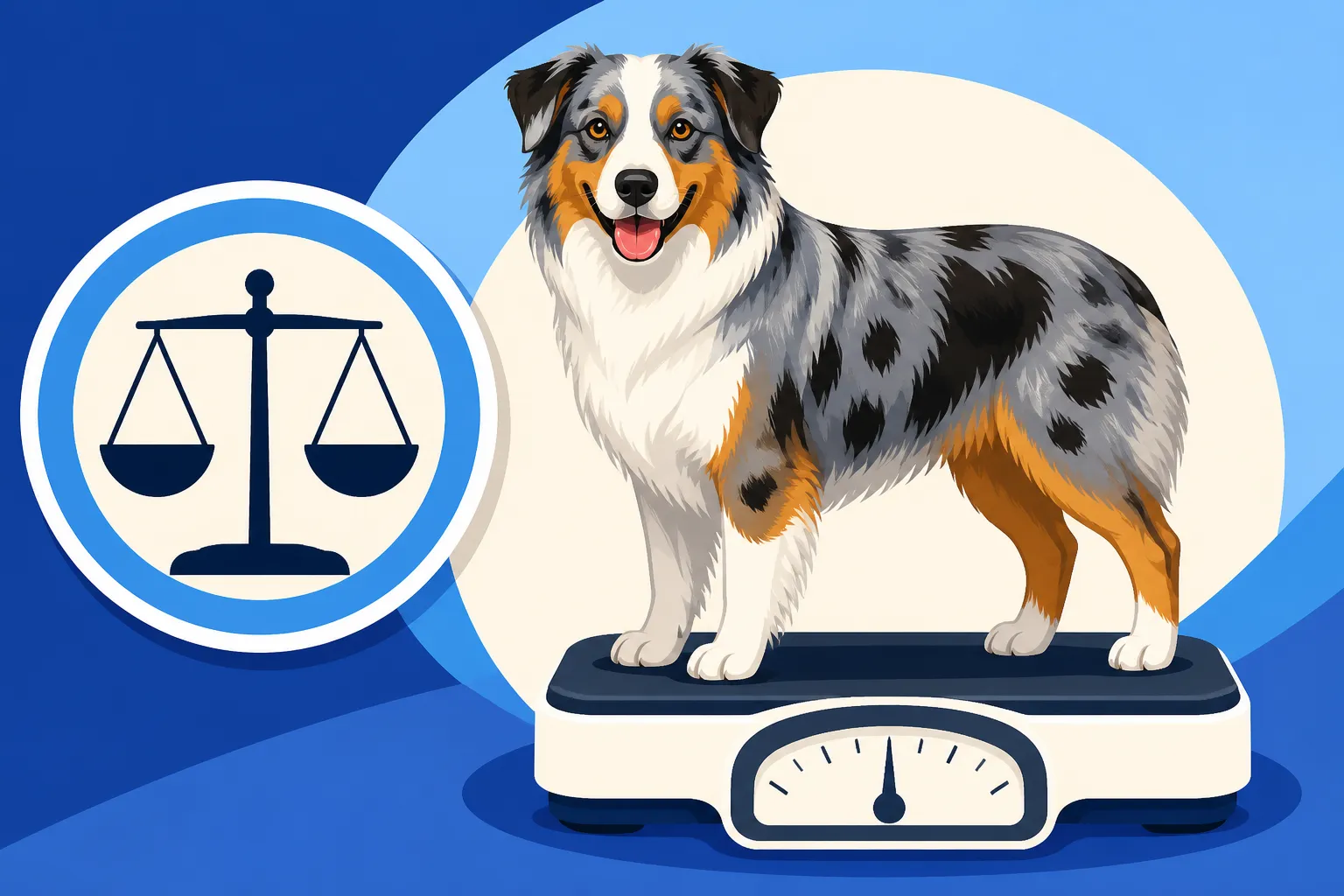
What an Australian Shepherd Should Weigh
It's so easy to get caught up in the numbers, isn't it? You might be looking at your beautiful Australian Shepherd, trying to figure out if they’re just right, a little chunky, or maybe a bit too lean. It’s a common worry for Aussie parents, especially because these dogs come in such a variety of builds, from the lean, athletic working lines to the slightly more substantial show dogs. This guide is here to help you cut through the confusion and understand what a healthy weight truly looks like for your individual Australian Shepherd, focusing on practical assessment methods that go beyond just a number on the scale.
Understanding the Australian Shepherd Weight Standard
When we talk about an "ideal" weight for an Australian Shepherd, it's not a single, hard-and-fast number. Instead, it's a range that acknowledges the natural variations within the breed. The official breed standards provide a general guideline, but it’s crucial to remember that every dog is an individual. A lean, athletic male from a working ranch line might look perfectly healthy at the lower end of the spectrum, while a more heavily boned show-line female could be in prime condition at the higher end. It's about finding the sweet spot for your dog, not just hitting an arbitrary target.
Male Australian Shepherd Weight Range
Typically, an adult male Australian Shepherd will fall into a weight range of about 50 to 65 pounds. Now, don't let those numbers stress you out if your boy is a few pounds outside this. What really matters is his overall condition. A male Aussie built for herding livestock might be incredibly fit and muscular at 55 pounds, boasting powerful hindquarters and a deep chest, without an ounce of excess fat. On the other hand, a male with a slightly thicker frame might carry 68 pounds beautifully, as long as that weight is composed of muscle and not unhealthy fat. It's less about the exact digit on the scale and more about how his body feels and functions, especially given their active nature and potential for joint issues like Australian Shepherd Hip Dysplasia and Working Joints.
Think about it like this: if your male Aussie is regularly hitting the trails, running agility courses, or even just playing vigorous fetch sessions in the yard, his muscles will naturally be more defined, contributing to his weight. A working line dog, for instance, often appears more angular and less "filled out" than a show line counterpart, even if they both fall within the acceptable weight range. It’s all about context and his lifestyle. You can also dive deeper into Australian Shepherd Height and Weight for more context on how these two factors play together.
Female Australian Shepherd Weight Range
For adult female Australian Shepherds, the typical weight range tends to be a bit lighter than males, usually between 40 to 55 pounds. Again, this is a guideline, not a strict rule. A compact, energetic female who spends her days chasing frisbees or participating in dog sports might be perfectly healthy and strong at 42 pounds, a picture of lean athleticism. Meanwhile, a female with a more robust bone structure might carry 58 pounds effortlessly, especially if she's well-muscled.
Just like with males, the key is balance. You want to see a female Aussie who is agile, energetic, and free-moving. If she’s struggling to jump onto the couch or seeming sluggish during playtime, her weight might be a contributing factor, regardless of whether she’s technically "in range." Many female Aussies are absolute powerhouses in a smaller package, and their ideal weight will reflect that power and agility.
Puppy Weight Progression
Watching an Australian Shepherd puppy grow is a whirlwind! They transform from tiny, fuzzy bundles into gangly teenagers in what feels like moments. Their weight will increase rapidly during their first year, and it’s important to ensure they’re gaining steadily but not too quickly. Overfeeding a puppy, especially a large-breed one, can put undue stress on their developing joints and bones, potentially contributing to problems like hip or elbow dysplasia later in life.
A general rule of thumb is steady growth. Your vet will monitor your puppy’s weight at each check-up, and you can track it at home. There isn’t a single, perfect growth chart, as genetics and nutrition play huge roles, but seeing consistent, healthy gains is what you're aiming for. Too fast, and you risk skeletal issues; too slow, and you might not be meeting their nutritional needs. Always check their food bags for appropriate feeding guidelines for their age and expected adult weight, and consult your vet if you have concerns. You can find more specific information in resources like Australian Shepherd Puppy Growth Chart.
More Than Just the Number on the Scale: Body Condition Scoring
While a number on the scale gives you a snapshot, it's like only reading the first sentence of a book. To truly understand your Australian Shepherd's weight, you need to assess their body condition. This involves using your eyes and hands to evaluate their fat reserves and muscle mass, giving you a much clearer picture of their health than just a numerical value. This hands-on approach is invaluable, especially with a breed like the Aussie, whose beautiful, thick coat can easily hide weight fluctuations.
How to Perform a Hands-On Body Condition Assessment
Performing a body condition assessment is simple, and it's a great habit to get into. You're essentially looking and feeling for three key areas: the ribs, the waist, and the spine.
First, let's talk about the ribs. Gently run your fingers along your Aussie's side, behind their front legs. You should be able to feel their ribs quite easily, almost like the knuckles on your hand, without having to press hard. If you can see individual ribs clearly without much effort, especially from a distance, your dog might be too thin. Conversely, if you have to press firmly to feel them, or if there's a definite layer of cushioning over them, your Aussie could be carrying too much weight. This is a common point of confusion, and understanding how to do it right can be a game-changer. You might find it helpful to read Scoring an Aussie Body Condition by Hand for a more detailed approach.
Next, the waistline. Stand above your dog and look down at their back. You should see a distinct "tuck" or narrowing behind their rib cage, where their stomach is. This is their waist. Then, look at them from the side. Their belly should tuck up slightly from their chest toward their hind legs, not hang low or be straight across. If they look like a solid rectangle from above, or if their belly sags, that's often a sign of excess weight.
Finally, the spine. Run your hand down your Aussie's back. You should be able to feel the bumps of their vertebrae, but they shouldn't protrude sharply. They should feel smooth and well-covered. If the spine feels like a ridge with no padding, your dog might be underweight. If you can't feel the spine at all, and it feels like a flat, padded surface, they might be overweight.
What Different Body Condition Scores Mean
Veterinarians often use a 5-point or 9-point body condition scoring (BCS) system. For simplicity, let's think about it in three main categories: too thin, ideal, and overweight.
- Too Thin (BCS 1-2/5 or 1-3/9): Ribs, spine, and pelvic bones are easily visible or very easily palpable with no fat covering. There's a severe abdominal tuck and loss of muscle mass. An Aussie in this condition needs urgent veterinary attention to rule out underlying health issues and to establish a safe weight gain plan.
- Ideal (BCS 3/5 or 4-5/9): This is the sweet spot. Ribs are easily palpable without excess fat cover. The waist is easily noted when viewed from above, and an abdominal tuck is evident from the side. The spine is palpable and feels smooth, not bony. This is the body type that supports their athletic abilities and long-term health.
- Overweight (BCS 4-5/5 or 6-9/9): Ribs are difficult to feel, requiring firm pressure due to moderate to thick fat cover. The waist is absent or barely visible, and there’s little to no abdominal tuck. There may be obvious fat deposits over the lumbar spine and tail base. This extra weight puts strain on joints, organs, and can shorten their lifespan.
Here's a quick table to help visualize these differences:
| Body Condition Score | Ribs | Waist (from above) | Abdominal Tuck (from side) | General Appearance |
|---|---|---|---|---|
| Too Thin | Easily visible/felt, no fat cover | Pronounced hourglass/tuck | Severe tuck-up | Bony, sunken flanks, prominent hip bones |
| Ideal | Easily palpable, slight fat cover | Well-defined tuck behind ribs | Noticeable tuck-up | Athletic, lean, good muscle definition |
| Overweight | Difficult to feel, moderate to thick fat | Absent or barely visible | Straight line or sagging | Rounded, no definition, fat deposits |
| Obese | Very difficult to feel, heavy fat deposits | Broad back, no waist at all | Hanging belly | Massive fat deposits, distended abdomen, no body shape |
The Challenge of the Aussie's Double Coat
One of the biggest hurdles in assessing an Australian Shepherd's weight is their magnificent double coat. That luxurious outer coat and dense, woolly undercoat are fantastic for keeping them warm and protected, but they are also masters of disguise! You might be looking at your Aussie and thinking they look perfectly robust, only to find when you get your hands on them that they're either much leaner or much rounder than you initially thought.
This is why the "hands-on" approach is so critical. You simply cannot rely on visual cues alone with an Australian Shepherd. A dog that looks solid and well-built might, underneath all that fluff, have ribs you can count from a distance, indicating they're underweight. Conversely, a dog that looks only slightly fluffy might actually be carrying a significant amount of excess fat hidden beneath the topcoat. Regularly performing a hands-on assessment ensures you don't miss these subtle but important changes. This is particularly important for pet parents who might not groom their Aussies daily; it's easy to overlook a gradual change in body shape. If you're struggling to feel past the fluff, check out Why a Thick Coat Hides Aussie Weight Gain for more tips.
Factors Influencing Your Aussie's Weight
Your Australian Shepherd's weight is a dynamic thing, not a static number. It's influenced by a multitude of factors, some you can control directly, and others that are part of their unique biological makeup. Understanding these influences is key to proactively managing their health and ensuring they maintain that ideal body condition throughout their lives.
The Role of Diet and Caloric Intake
This is perhaps the most obvious, and often the most controllable, factor. What you feed your Australian Shepherd, how much you feed them, and how often all directly impact their weight. Aussies are naturally energetic dogs, but their caloric needs aren't one-size-fits-all. A working Aussie who spends hours herding sheep or tearing through an agility course will need significantly more calories than a companion Aussie who enjoys daily walks and some vigorous playtime in the yard.
Overfeeding is a very common issue. Many pet parents, myself included, can be a little generous with portion sizes, especially if our dogs give us those soulful Aussie eyes! It's vital to measure your dog's food accurately, using a kitchen scale for precision if possible. Don't just "eyeball" it. Look at the feeding guidelines on your dog food bag, but use them as a starting point. Adjust based on your dog's individual activity level, metabolism, and body condition. High-quality kibble, like those found on sites like Chewy, will have clear guidelines. Treats also count! Those extra biscuits or bits of human food add up quickly. If you're giving a lot of training treats, consider reducing their main meal portion slightly or opting for low-calorie alternatives. For a practical guide, see Daily Calories for a Fifty Pound Australian Shepherd.
Exercise Requirements for a Healthy Weight
An Australian Shepherd without enough exercise is like a coiled spring. Their genetics hardwire them for activity, and if that energy isn't channeled productively, it can manifest in destructive behaviors, anxiety, and, yes, weight gain. Remember, we're talking about more than just a quick stroll around the block. Aussies need purposeful exercise that engages both their bodies and minds.
Think about a good, brisk walk, a long run, a game of fetch that lasts more than five minutes, or even a session of frisbee or flyball. These activities burn calories, build muscle, and keep their metabolism humming. If your Aussie is spending most of their day napping on the couch with only minimal outdoor activity, they will inevitably need fewer calories than a dog who's constantly on the move. Lack of appropriate exercise, combined with even slightly too much food, is a recipe for an overweight Aussie. Conversely, an Aussie who's not getting enough food to fuel their high activity level might struggle to keep weight on, even if they appear well-muscled. Balancing calorie intake with their actual energy expenditure is critical. Keeping a Working Australian Shepherd Lean offers excellent insights into managing their activity and food.
Genetics, Age, and Other Health Considerations
While diet and exercise are in your control, other factors contribute to weight. Genetics play a significant role in an Aussie's natural build and metabolism. Some lines might naturally be leaner, while others tend to be a bit more robust. You can't change your dog's genetic blueprint, but you can be mindful of it and adjust care accordingly.
Age is another big one. As Australian Shepherds get older and move into their senior years, their metabolism often slows down, and their activity levels naturally decrease. A senior Aussie at 10 or 12 years old won't have the same caloric needs as a two-year-old in its prime. It's crucial to adjust their diet as they age to prevent gradual weight gain. A healthy senior Aussie might still enjoy walks, but perhaps shorter ones, and they'll likely spend more time napping. Being aware of these changes and modifying their feeding plan is important for their comfort and health.
Finally, certain health conditions can drastically impact an Aussie's weight. Hypothyroidism, for example, can lead to unexplained weight gain and a dull coat, even with a normal diet. On the other end of the spectrum, digestive issues, parasites, or certain chronic illnesses could lead to weight loss. If you notice any sudden or unexplained changes in your Aussie's weight or appetite, whether gain or loss, it's always best to consult your veterinarian. They can rule out underlying medical conditions and provide tailored advice.
Maintaining a Healthy Weight for a Long, Happy Life
Keeping your Australian Shepherd at a healthy weight isn't just about aesthetics; it's about giving them the best chance at a long, active, and comfortable life. Extra weight puts strain on their joints, exacerbates conditions like hip dysplasia, increases the risk of diabetes, heart disease, and even certain cancers. Being too thin can indicate underlying health problems or insufficient nutrition, impacting their immune system and overall vitality. Proactive management is the name of the game.
Preventing Weight Gain and Obesity
The best defense against obesity is a good offense. Establishing healthy habits from puppyhood and maintaining them throughout their life is paramount.
- Portion Control is King: This cannot be stressed enough. Measure your Aussie's food. Every single meal. Don't free-feed, meaning don't leave food out all day. Divide their daily recommended amount into two meals. Use a measuring cup, or better yet, a digital kitchen scale, especially if you're using high-quality kibble from a brand like Chewy, which can be dense. Regularly re-evaluate the portion size as their activity levels change or as they age.
- Smart Snacking: Treats are wonderful for training and bonding, but they're also calorie bombs. Choose low-calorie treats or use small pieces of their regular kibble as rewards. Factor treats into their daily calorie intake. A good rule is that treats should make up no more than 10% of their daily calories.
- Consistent, Appropriate Exercise: Schedule daily activity. For most adult Aussies, this means at least one to two hours of vigorous exercise a day, split into multiple sessions. This could be a combination of walks, runs, fetch, frisbee, or even dog sports. Mental stimulation, like puzzle toys or training sessions, also burns calories and keeps them engaged.
- Regular Body Condition Checks: Get into the habit of performing a hands-on body condition assessment once a month. This allows you to catch slight weight fluctuations before they become significant problems. This is especially important for Finding Aussie Ribs Under a Winter Coat, as seasonal changes in fur density can trick the eye.
- Routine Vet Visits: Your vet is your best partner in weight management. They can help you assess your dog's body condition accurately, discuss appropriate diets, and address any underlying health concerns that might predispose your Aussie to weight gain.
If you find your Australian Shepherd is starting to tip the scales, don't despair! Gradual weight loss is the safest and most effective approach. Reducing their daily calories by about 10-20% and slowly increasing their exercise is a good starting point. Just like with humans, crash diets are rarely successful or healthy for dogs. For more on this, check out Taking an Australian Shepherd From Sixty to Fifty Pounds and How Slowly a Working Aussie Should Lose Weight.
Addressing an Underweight Australian Shepherd
While obesity gets a lot of attention, an underweight Australian Shepherd can be just as concerning. If your Aussie is too thin, the first step is always to rule out medical issues. A vet visit is essential to check for parasites, digestive problems, dental pain, or other underlying illnesses that might be preventing them from absorbing nutrients or maintaining weight.
Once medical causes are excluded, you can focus on nutrition:
- Increase Caloric Density: You might need to switch to a higher-calorie dog food, often labeled for "active" or "performance" dogs, or "all life stages." These formulas typically have more fat and protein per serving. You can also explore options on Chewy for high-quality, calorie-dense foods.
- Increase Portions Gradually: Don't drastically increase their food overnight, as this can cause digestive upset. Slowly add a small amount (e.g., a quarter cup) to each meal over several days, monitoring their stool.
- Add Healthy Supplements: Your vet might recommend adding certain healthy fats, like fish oil, or other supplements to boost calories and overall health. Cooked plain chicken or lean ground beef, in small amounts, can also be a tempting addition.
- Multiple Meals: If your Aussie struggles to eat large quantities, breaking their daily ration into three or four smaller meals instead of two can help.
- Monitor Progress: Keep a close eye on their body condition. It might take several weeks or even months for an underweight Aussie to reach a healthy weight. Celebrate small gains and continue to work with your vet.
It’s a balancing act, ensuring they get enough to fuel their active lifestyle without overdoing it. Remember, an Australian Shepherd's natural lean build means you should always be able to feel their ribs easily, even at a healthy weight.
When to Consult Your Veterinarian
Knowing when to call in the professionals is a critical part of being a responsible pet parent. While routine check-ups are always recommended, there are specific situations where a vet visit regarding your Aussie's weight is non-negotiable.
- Sudden Weight Change: If your Australian Shepherd experiences a rapid or unexplained weight loss or gain over a short period (a few weeks to a month), this warrants immediate veterinary attention. This can be a symptom of a serious underlying health condition that needs diagnosis and treatment.
- Persistent Weight Issues: If you've been diligently trying to help your Aussie lose or gain weight, following recommended guidelines for diet and exercise, but aren't seeing results, it's time to consult your vet. They can evaluate their metabolism, thyroid function, or other factors.
- Changes in Appetite or Energy Levels: If weight changes are accompanied by a noticeable decrease or increase in appetite, lethargy, increased thirst, or any other behavioral shifts, these are red flags.
- Concerns About Body Condition: If you're unsure how to accurately assess your Aussie's body condition, or if you consistently feel your dog is either too thin or too heavy despite your best efforts, your vet can provide an objective assessment and guidance.
- Aging Aussies: As your Australian Shepherd enters their senior years, their metabolic rate and activity levels will change. Regular vet check-ups become even more important to adjust their diet and monitor for age-related weight shifts or health conditions. Recalculating an Aussie Ration After Neutering can also provide some insight, as this life event often changes caloric needs.
Your veterinarian has the expertise to conduct thorough examinations, run diagnostic tests if needed, and develop a personalized plan to get your Australian Shepherd back on track to their ideal weight and optimal health. Never hesitate to reach out to them with your concerns.
Disclaimer
This article is for general informational purposes only and does not constitute professional advice. Laws, prices and regulations vary by location and change over time. Consult a qualified professional for guidance on your specific situation.