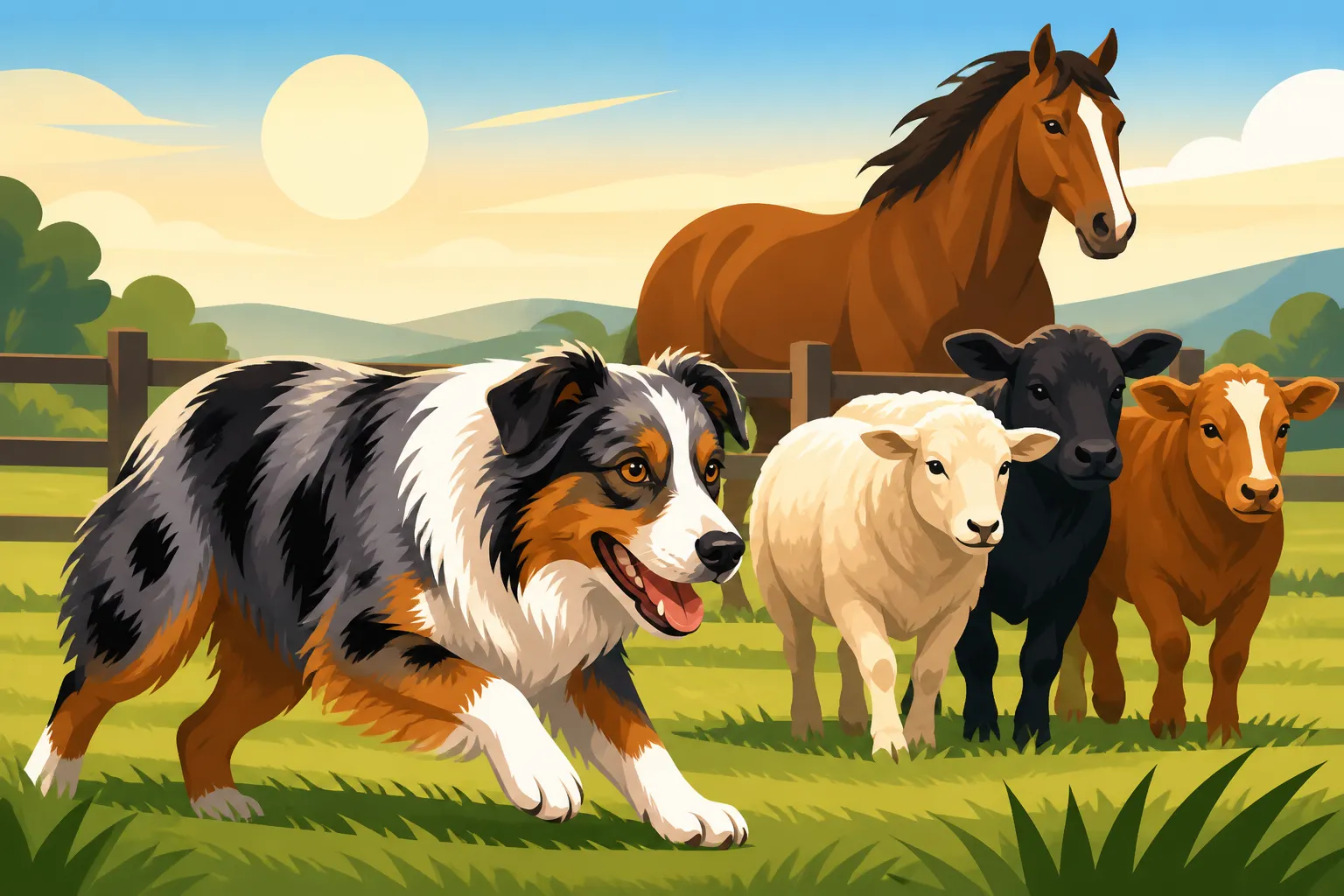
Australian Shepherds Around Horses and Livestock
It's a common scenario: you have an intelligent, energetic Australian Shepherd, and you also have horses, sheep, or other livestock. The dream is often a harmonious farm life where your Aussie helps manage the herd, but the reality can quickly become a chaotic mess of nipping, chasing, and frustrated animals (both canine and equine!). This guide is here to walk you through understanding your Australian Shepherd's innate drive and how to safely and effectively integrate them into a life alongside your horses and other farm animals, turning potential headaches into productive partnerships.
Understanding the Australian Shepherd's Natural Herding Instinct
Let's be real, the Australian Shepherd wasn't bred to sit quietly on the couch. These dogs have generations of selective breeding behind them, hardwired with an incredible instinct to gather, move, and control livestock. It's not just a hobby for them; it's practically their operating system. This deep-seated drive, while amazing in the right context, can be a real challenge when it's misdirected or misunderstood, especially around animals as large and sensitive as horses or as flighty as chickens.
The Deep-Seated Drive to Work
Your Aussie's brain is fundamentally wired for herding. They possess what trainers often call "eye," which is that intense, focused stare they use to control movement. They have an innate understanding of pressure and release, of flanking and gathering. This isn't something you can simply "train out" of them; it's who they are. Instead, our job as Aussie owners is to understand and channel this powerful instinct into appropriate outlets. Ignoring it, or trying to suppress it entirely, usually leads to more frustration for both you and your dog. You'll find that their desire to herd can manifest in unexpected ways, from circling the kids in the yard to trying to "organize" the other dogs at the park. It's truly The Australian Shepherd Herding Drive You Cannot Train Out. This drive means they see the world through the lens of movement and control, and anything that moves is a potential "sheep" to be managed.
Think about a typical day on a ranch. An Aussie might be asked to move a flock of sheep from one pasture to another, gently but firmly guiding them. This requires immense focus, agility, and a strong partnership with their handler. The very behaviors that make them excellent working dogs – the low crouch, the quick changes in direction, the strategic positioning – are exactly what can get them into trouble if applied indiscriminately to your barn cats or, worse, your horses. It's a high-octane drive that needs direction, not suppression.
Recognizing Herding Behaviors Around Large Animals
So, what does this herding instinct look like when it's directed at your horses or other livestock? It's not always as obvious as a full-on chase scene. It can start subtly. You might notice your Aussie fixating on a horse in the pasture, a low body posture, ears perked, tail still or barely wagging. Then, as the horse moves, even slightly, your Aussie might shift their weight, take a step, or even perform a little "nip" at the heel or hock area. This is classic herding behavior, even if it's just a subtle nudge. With smaller livestock like goats, sheep, or poultry, this can escalate quickly into more vigorous circling, barking, and chasing.
It's vital to differentiate between playful curiosity and genuine herding instinct. A puppy might bounce around a horse playfully, but an Aussie puppy with developing herding instinct will show that intense focus, the desire to control movement, and possibly even the famous "eye." They might run wide to "gather" the animals, or they might try to cut off their movement. The concern with horses is obvious: a nip to a sensitive leg could cause a kick, resulting in serious injury to your dog or even to a rider if the horse spooks. With smaller animals, the risk is direct harm to the livestock. Understanding these specific behaviors is the first step in managing them. It’s important to remember that this isn't malice; it's simply your Aussie trying to do their "job" as their instincts tell them.
Preparing Your Australian Shepherd for Livestock Interactions
Integrating your Australian Shepherd safely into a livestock environment requires proactive steps long before you ever allow them unsupervised access. It's about building a solid foundation of manners, respect, and clear communication. You can't just expect them to instinctively know the rules of the barn.
Early Socialization and Desensitization
The groundwork for a well-behaved Aussie around livestock begins with early and thoughtful socialization. This isn't just about meeting other dogs; it's about exposing them to a wide variety of sights, sounds, and smells in a positive and controlled way. For a farm dog, this means gentle, supervised exposure to horses, chickens, cows, and whatever other animals you have, from a young age. This doesn't mean letting your puppy run wild with the herd. It means introducing them to the presence of these animals.
For example, take your puppy on a leash to the edge of the pasture. Let them observe the horses from a safe distance, rewarding calm behavior with high-value treats from a brand like Chewy that your pup loves. The goal is to create positive associations, making the animals a normal, non-threatening part of their environment, rather than something exciting to chase or control. If your puppy shows too much interest or starts to get over-aroused, calmly remove them from the situation. Gradually decrease the distance as they demonstrate consistent calm. This desensitization process is crucial; it teaches them that the animals are part of the scenery, not something to engage with aggressively. For a deeper dive into overall temperament, consider The Temperament the Aussie Standard Requires.
Establishing Clear Boundaries and Commands
Before any direct interaction, your Australian Shepherd absolutely must have a rock-solid foundation of obedience. This means a reliable "come," "stay," "leave it," and "down" command, executed perfectly even with distractions. Their recall, especially, needs to be bulletproof. Imagine your Aussie fixating on a horse or chasing a chicken – you need to be able to call them off instantly, every single time. A long line can be an invaluable tool during this stage, allowing you to practice recall and "leave it" commands in increasingly distracting environments while maintaining control.
These commands create a clear language of boundaries. "Leave it" is paramount around livestock. You need to teach your Aussie that approaching, nipping, or even intensely staring at the animals without permission is off-limits. Practice this with progressively higher levels of distraction, starting with toys and moving up to the actual livestock, always from a distance at first. Reward compliance heavily. Your Aussie needs to understand that you are in charge of when and how they interact with other animals, not their own instinct. This clear hierarchy prevents misunderstandings that can lead to dangerous situations.
Safe and Effective Training for Aussies Around Livestock
Once you've laid the groundwork, it's time to start working on specific behaviors around livestock. This phase is all about controlled exposure, consistent reinforcement, and always prioritizing safety.
Controlled Introductions and Supervision
When it comes to introducing your Aussie to actual working scenarios or even just being in the same space as livestock, supervision is non-negotiable. Always use a leash, preferably a long line, and keep your Aussie close at first. Your role is to be a calm, confident guide, preventing any unwanted herding attempts before they even start. If your Aussie shows signs of fixating or getting too excited – that intense stare, a low crouch, ears forward – interrupt the behavior immediately with a command like "leave it" or a gentle leash correction, then redirect their attention to you.
Start with short, positive sessions. Perhaps walk your Aussie on a leash around the perimeter of the pasture while you do chores. Let them observe the horses, but don't allow them to engage in any herding behaviors. Reward them heavily for calm, appropriate behavior. Gradually, as they prove they can remain calm and focused on you, you can increase the duration and proximity of these sessions. The goal is for your Aussie to learn that horses and other livestock are "off-limits" unless explicitly given a task by you. This is also where a strong Australian Shepherd Recall Around Livestock is tested and proven. Remember, building this trust and understanding takes time and patience, and there will be setbacks.
Redirecting Unwanted Herding with Positive Reinforcement
The key to managing an Australian Shepherd's herding drive isn't to punish the instinct itself, but to redirect it into acceptable channels. When your Aussie starts to show signs of unwanted herding behavior, don't yell or get angry. Instead, calmly interrupt, redirect their attention, and then reward them for engaging in an alternative, appropriate behavior. For instance, if your Aussie starts to eye the chickens, call them to you for a quick "sit" or "down" and reward them with a high-value treat or a quick game of fetch with a designated toy.
One of the most effective strategies is to provide them with a "job" that isn't herding your prize-winning mare. This could be playing fetch, engaging in scent work, or even training for dog sports like agility or Treibball. Many Aussies thrive on having a purpose, and giving them a constructive outlet for their energy and intelligence can significantly reduce their desire to invent their own "jobs" around the farm. Puzzle toys from Chewy that dispense treats can also be a great mental stimulant. This helps them understand that while their instincts are valid, there's a time and a place, and you decide what that is. If you're interested in formal herding, looking into Starting an Australian Shepherd on Sheep can provide a fantastic outlet for this drive.
Here's a quick comparison of approaches:
| Approach | Description | Pros | Cons |
|---|---|---|---|
| Strict Supervision | Always on leash, constant monitoring, short controlled sessions. | Prevents dangerous situations, builds clear boundaries quickly. | Requires constant vigilance, can be time-consuming initially. |
| Redirection/Job | Interrupt unwanted behavior, immediately offer an alternative, rewarding task. | Channels natural drive constructively, reduces frustration. | Needs consistent practice, requires creative "jobs." |
| Desensitization | Gradual, positive exposure to livestock from a safe distance. | Builds positive associations, reduces reactivity. | Very slow process, not suitable for active herding situations. |
| Aversion/Punishment | Scolding, harsh corrections, shock collars for unwanted herding. | Appears to stop behavior quickly (temporarily). | Damages bond, creates fear/anxiety, suppresses but doesn't solve drive, can lead to redirected aggression. |
Managing Challenges and Ensuring Safety on the Farm
Even with the best training, living with an Australian Shepherd on a farm with livestock will present challenges. It's about ongoing management, understanding their limits, and maintaining a proactive approach to safety.
Handling Over-Arousal and Fixation
Australian Shepherds are incredibly intelligent and driven, but this also means they can become easily over-aroused or fixated, especially when their herding instincts kick in. That intense stare, the trembling body, the low growl – these are signs your Aussie is entering a state where their drive is taking over, and logical commands might not get through. When you see these signs, it's critical to intervene before they act. This often means removing them from the situation entirely to allow them to decompress.
Sometimes, despite your best efforts, they might get too excited. If your Aussie does break focus and attempts to herd in an unwanted way, calmly retrieve them, put them on a leash, and move them to a quiet space away from the livestock. Don't scold them harshly, as this can make them more anxious or secretive about their herding. Instead, once they're calm, revisit basic obedience commands in a neutral environment to reinforce that you are still the focus. For long-term mental well-being, remember that Mental Work That Actually Tires an Australian Shepherd is just as important as physical exercise to keep their busy minds engaged and less prone to finding their own (often problematic) entertainment.
Equipment and Environmental Management
Beyond training, smart management of your environment and equipment is crucial for safety. For instance, strong, secure fencing is non-negotiable. An Aussie with a strong herding drive might try to find ways through or under fences to get to the livestock. Ensure gates are always latched and that there are no weak spots in your perimeter. A GPS collar can be a good safety net for those "just in case" moments, helping you locate your dog if they somehow manage to get out.
Consider the role of confinement when you can't actively supervise. A secure crate, a designated dog run, or a fenced yard where they cannot access the livestock are vital. You can't be everywhere at once, and there will be times when your Aussie needs to be safely separated from the animals. This isn't a punishment; it's responsible management. Always have appropriate leashes, long lines, and even muzzles on hand for specific situations or initial introductions where an extra layer of safety is needed. If you're pondering Whether an Aussie Should Live With Livestock, be honest about your ability to provide this level of consistent management and training. It's a significant commitment, but with dedication, your Australian Shepherd can indeed become a valuable and beloved member of your farm team.
Disclaimer
This article is for general informational purposes only and does not constitute professional advice. Laws, prices and regulations vary by location and change over time. Consult a qualified professional for guidance on your specific situation.