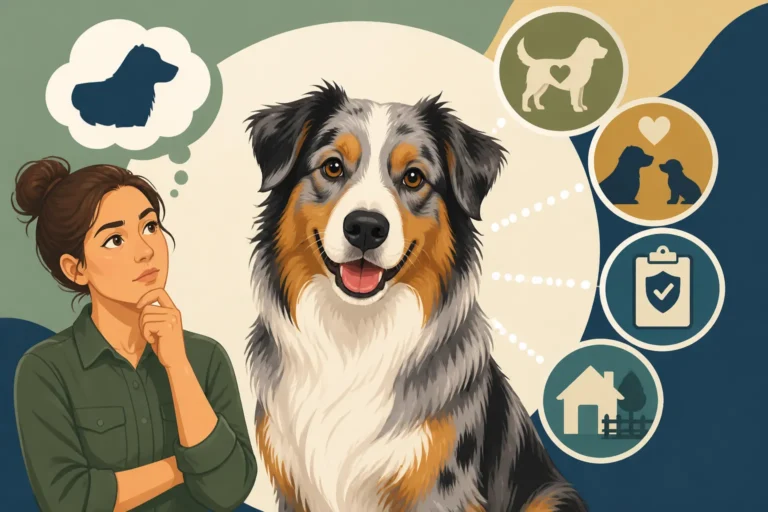
The Temperament the Aussie Standard Requires
You've probably heard that Australian Shepherds are "high energy" or "smart," but what does that really mean for their personality and daily life? Many people fall in love with their stunning looks and vibrant intelligence, only to find themselves completely overwhelmed by the reality of living with a true working dog. This guide will dive deep into the specific temperament traits that the official breed standard values, helping you understand the complex, intelligent, and often intense personality that defines the Australian Shepherd.
Understanding the Australian Shepherd's Core Temperament
Before we even look at the official standard, it's crucial to grasp the fundamental nature of an Australian Shepherd. These aren't just pretty dogs; they are living, breathing, instinct-driven animals originally bred for demanding work on ranches. Their core temperament is a direct reflection of this heritage.
The Herding Instinct: A Deep-Rooted Trait
The herding instinct isn't a hobby for an Australian Shepherd; it's practically their operating system. This is a breed designed to gather, control, and move livestock, often large and stubborn animals, with a combination of eye, presence, and quick bursts of movement. This means they are inherently watchful, responsive to movement, and possess a strong desire to keep things in order – often by gathering them.
In a home environment, this translates into a dog that might try to "herd" children, other pets, or even you, often with gentle nudges, circling, or light nips at heels. It's not aggression; it's their natural drive expressing itself. You'll see them intently watching squirrels in the yard, trying to keep everyone in the family together on a walk, or even organizing toys. Understanding that this instinct is hardwired, rather than a misbehavior to be "trained out," is the first step to successful ownership. You can't remove the herding instinct, but you can redirect it. The Australian Shepherd Herding Drive You Cannot Train Out covers this in more detail.
Intelligence and Trainability: A Double-Edged Sword
Australian Shepherds are incredibly intelligent, often startlingly so. They learn new commands and complex sequences with remarkable speed, which makes them a joy to train for those who enjoy dog sports or advanced obedience. Their desire to please their handler, combined with their sharp minds, means they thrive on mental stimulation as much as physical exercise.
However, this intelligence is a double-edged sword. An Aussie that isn't given enough mental challenges will quickly become bored, and a bored Aussie is a destructive Aussie. They'll invent their own "jobs," which often include counter-surfing, reorganizing your furniture, or developing nuisance barking habits. They can also be masters of problem-solving, figuring out how to open doors, gates, or treat puzzles with alarming efficiency. This means their training needs to be consistent, engaging, and varied to keep them focused and happy. Simple repetition won't cut it for long.
What the Breed Standard Emphasizes
The breed standard for the Australian Shepherd, whether from organizations like the Australian Shepherd Club of America (ASCA) or the American Kennel Club (AKC), is very clear about the desired temperament. It paints a picture of a dog that is functional, intelligent, and a loyal companion, but also with specific reserved traits that are critical to its working heritage.
The Ideal Character: Alert and Animated
The standard typically describes the Aussie as "an intelligent, active, devoted, protective companion." It emphasizes that they should be "alert and animated," reflecting their readiness to work and their keen observational skills. This isn't a dog that naps all day; even when seemingly at rest, an Aussie's ears and eyes are often attuned to their environment, processing sounds and movements that others might miss.
This animation translates to their eager participation in activities. When you pick up the leash, they're not just ready for a walk; they're enthusiastic. When you start a training session, they're fully engaged, their eyes sparkling with focus. This lively spirit is part of their charm, but it also means they require an owner who can match their enthusiasm and provide consistent outlets for that energy.
Reserved with Strangers: Not Shyness, But Caution
Perhaps one of the most misunderstood aspects of the Australian Shepherd temperament, as outlined in the standard, is their reserved nature with strangers. The standard specifies that an Aussie "may be reserved in new situations or around new people without being shy or aggressive." This is a crucial distinction. A truly shy dog will cower, try to hide, or exhibit fear-based aggression. An aggressive dog will display overt hostility.
A reserved Aussie, however, will typically observe new people or situations from a distance. They might not immediately rush up for pets or treats. They are assessing, processing, and deciding if this new entity is part of their "flock" or something they need to keep an eye on. This isn't a flaw; it's a desirable trait for a working dog that needs to be discerning on a ranch, where not every stranger is a friend. Owners should respect this inherent caution and avoid forcing interactions, allowing their Aussie to approach on their own terms. Early and broad socialization is key to ensuring this reservation doesn't tip into shyness or fear. Australian Shepherd Suspicion of Strangers talks more about this.
Avoiding Undesirable Traits
The breed standard explicitly calls out certain temperament faults. Any display of shyness, fear, or unprovoked aggression is considered a serious fault. These traits would hinder a working dog's ability to perform its duties reliably and safely, and they are certainly undesirable in a companion animal.
For instance, a dog that cowers from loud noises or unfamiliar objects might struggle in a busy work environment or even a lively family home. Likewise, a dog that snaps or growls without clear provocation is dangerous, and this is contrary to the breed's intended disposition. Breeders strive to produce dogs with stable, confident temperaments, and avoiding these faults is paramount. When looking for a puppy, observing the parents' temperaments and how the puppies interact is just as important as checking health clearances.
Loyalty and Bonding in an Australian Shepherd
One of the most endearing qualities of the Australian Shepherd is their intense loyalty and the deep bonds they form with their families. They are truly devoted companions, often shadowing their favorite person from room to room.
Devotion to Their People
An Australian Shepherd isn't usually a dog that loves everyone equally. They typically form a very strong, almost singular bond with one or two primary caregivers, seeing them as the center of their world. This devotion is unwavering, and they thrive on being included in family activities. They want to be where their people are, whether that's curled up at your feet while you work, riding shotgun on an errand run, or hiking a mountain trail.
This strong bond means they are highly sensitive to their owner's emotions and body language. They'll often pick up on subtle cues, sometimes even anticipating your next move. This makes them incredibly responsive partners in training and daily life, but it also means they can be prone to separation anxiety if not properly conditioned to be alone. You might find your Aussie resting their head on your lap while you watch TV, gazing up at you with an almost soulful expression – that's their devotion shining through.
Family Dynamics: Herding Instinct and Children
For families with children, an Australian Shepherd's temperament requires careful management. While generally good-natured, their inherent herding drive means they might view children as smaller, faster-moving members of the "flock" that need to be kept in line. This can manifest as playful nips at heels or attempts to circle and gather them.
It's crucial for parents to understand this isn't malicious, but an instinct. Supervision is always necessary, and teaching both children and the dog appropriate boundaries is key. Providing alternative outlets for that herding drive, such as herding balls or flirt poles, can redirect these behaviors positively. Teaching children how to interact respectfully with the dog, and giving the dog a safe space to retreat, are vital for a harmonious household. An Australian Shepherd Herding Children in the Yard explores this topic further.
Energy and Drive: More Than Just "Active"
When people say Australian Shepherds are "active," it often doesn't fully capture the depth of their energy and drive. It's not just about needing a long walk; it's about a constant readiness for engagement.
The Need for a Job: Mental and Physical Engagement
An Australian Shepherd needs a job. This isn't a suggestion; it's a fundamental requirement for their well-being. This job can be actual herding, but for most pet Aussies, it translates into dog sports like agility, obedience, flyball, or disc dog. It could also be scent work, search and rescue, or even complex trick training. The point is, they need a purpose that engages both their body and their incredibly sharp mind.
Simply letting them run in a yard for an hour or taking them on a leash walk around the block usually isn't enough to satisfy an Aussie. They crave interaction, problem-solving, and a sense of accomplishment. Without this, their restless energy can turn destructive or anxious. Think of it this way: their mental engine is always running, and it needs fuel in the form of challenges. Providing high-quality, durable toys, perhaps from a brand like Chewy, that encourage mental puzzle-solving can be a lifesaver on rainy days or when you can't provide intense physical activity.
Impulse Control and Managing Enthusiasm
With such high drive and intelligence, teaching an Australian Shepherd impulse control is paramount. Their enthusiasm for life and work can sometimes bubble over, leading to jumping, frantic barking, or bolting after perceived "prey" (like a squirrel or a passing car). Effective training involves teaching them to settle, wait, and make good choices even when highly stimulated.
This means consistently practicing "stay" in distracting environments, teaching a strong "leave it" command, and reinforcing calm behaviors. For instance, requiring them to sit before getting their food bowl, or waiting patiently at the door before being released for a walk. These small, consistent efforts build a dog that can manage their excitement and channel it appropriately. Without good impulse control, their natural drive can become a source of frustration for both dog and owner. Australian Shepherd Recall Around Moving Things is a valuable resource on this particular aspect of training.
Socialization Beyond the Farm
Proper socialization is absolutely critical for an Australian Shepherd to develop into a well-adjusted companion, especially given their natural reservation with strangers and their keen awareness of their surroundings.
Early Exposure for a Well-Adjusted Aussie
Starting socialization early, during the critical puppy development period, is non-negotiable for an Australian Shepherd. This means safely exposing them to a wide variety of sights, sounds, people, and well-behaved dogs in a positive, controlled manner. Think about all the things they might encounter in daily life: children playing, skateboards, bicycles, different types of flooring, car rides, umbrellas, and people wearing hats or carrying bags.
The goal isn't to make them gregarious with everyone, but rather to teach them that most new experiences are neutral or positive, reducing the likelihood that their natural caution will escalate into fear or reactivity. Puppy classes are an excellent way to provide structured socialization and begin foundational training. Remember, a lack of adequate exposure can lead to a dog that is overly sensitive, fearful, or reactive to novel stimuli later in life. Socializing an Aussie Puppy Off the Farm delves deeper into this.
Managing Reactivity in Urban Environments
For Aussies living in urban or suburban settings, managing their inherent reactivity to movement and noise can be a significant challenge. Their herding eye makes them hyper-aware of everything that moves, from a distant jogger to a flapping flag. This can lead to barking, lunging, or pulling on the leash, particularly if they haven't been adequately socialized or had their needs met.
Working with a qualified professional trainer who understands herding breeds is often invaluable. They can help you teach your Aussie to focus on you rather than the environment, introduce counter-conditioning techniques, and practice working under threshold. This isn't about suppressing their natural instincts, but about teaching them how to exist calmly in a world full of triggers. Training tools like a front-clip harness or a head halter, available at retailers like Chewy, can also be helpful aids in managing a strong puller during walks while you work on training.
The Impact of Breeding on Temperament
While the breed standard sets an ideal, the reality of an individual Australian Shepherd's temperament is also heavily influenced by its genetic background and the specific goals of the breeder.
Working Line Versus Show Line Temperament
There can be noticeable differences in temperament between Australian Shepherds bred primarily for working (herding, performance sports) and those bred for the conformation show ring.
| Trait | Working Line Aussie | Show Line Aussie |
|---|---|---|
| Drive/Intensity | Generally higher; more intense focus, relentless work ethic. | Moderate to high; still active but may have a slightly "softer" edge. |
| Herding Instinct | Very strong, often with natural "eye" and strong desire to control. | Present, but may be less intense; more adaptable to "pet" life. |
| Sensitivity | Often more sensitive to handler cues and environment. | May be a bit more resilient to environmental stressors. |
| Energy Level | Extremely high, requires significant physical and mental exercise daily. | High, but perhaps slightly less frenetic; still needs robust activity. |
| Focus/Trainability | Excellent focus on work; thrives on complex tasks. | Highly intelligent and trainable; enjoys learning new things. |
| Reserved Nature | Present, but often combined with confidence in new situations. | Still reserved, but breeders also prioritize a dog that is comfortable with judging in the ring. |
It's important to note that these are generalizations, and there's a wide spectrum within both lines. However, understanding the breeder's focus can give you a better idea of the temperament you might expect. A working line Aussie will likely require even more dedication to exercise and mental stimulation than a show line Aussie, though both require substantial commitment. Working Line Australian Shepherd Traits offers a deeper dive into these characteristics.
The Importance of Responsible Breeding Practices
A responsible Australian Shepherd breeder prioritizes temperament as much as, if not more than, physical appearance or working ability. They will carefully select breeding pairs with stable, confident, and typical Aussie temperaments, avoiding any dogs that exhibit shyness, fear, or aggression. They also ensure their puppies are raised in a stimulating home environment, receiving early handling and exposure to various sights and sounds.
When you're looking for an Australian Shepherd, ask breeders about the temperaments of their adult dogs, how they socialize their puppies, and what kind of homes they seek for their pups. A good breeder will be transparent and eager to discuss these aspects, providing insight into the genetic and environmental influences on temperament. They understand that a well-bred Aussie isn't just physically sound, but also mentally robust and a joy to live with. You can often find great resources on breed-specific temperament at places like Chewy's informational articles or reputable breed club websites.
Disclaimer
This article is for general informational purposes only and does not constitute professional advice. Laws, prices and regulations vary by location and change over time. Consult a qualified professional for guidance on your specific situation.