Why Physical Exercise Alone Never Settles an Aussie
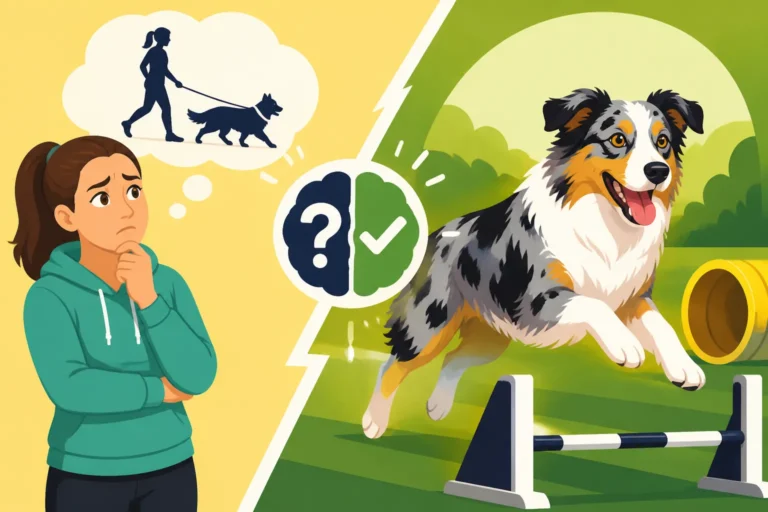
It's a common, often disheartening, scenario for Australian Shepherd owners: you’ve just taken your energetic companion for a long run, a vigorous hike, or an extended session of fetch, and yet, they're still pacing, nipping at your heels, or seemingly bouncing off the walls. This guide is here to shed light on why physical exercise alone often isn't enough to truly "settle" an Aussie and to equip you with the knowledge to provide the holistic stimulation your intelligent dog truly needs.
The Aussie's Innate Drive: More Than Just Legs
When we talk about an Australian Shepherd's energy, it's easy to focus on their boundless physical stamina. But to truly understand an Aussie, you have to look beyond their powerful legs and into their incredible, complex brains. They weren't just bred to run; they were bred to think, problem-solve, and direct.
The Herding Brain in Action
The core of an Australian Shepherd's being is its herding instinct. This isn't just a physical urge to chase; it's a sophisticated mental program designed to control movement, anticipate actions, and manage a flock. This means an Aussie's brain is constantly seeking patterns, evaluating situations, and looking for things to organize or gather. When this instinct isn't channeled appropriately, it manifests in ways that seem chaotic or disobedient, but are actually just the dog trying to do its "job."
You might see your Aussie trying to "herd" your children when they run, circling them and perhaps even giving little nips at their ankles. They might try to gather up the family cat, stare intently at moving cars or bicycles through the window, or even attempt to organize the other dogs at the park. These behaviors aren't just about having too much physical energy; they're about an unfulfilled mental drive. Running around a dog park for an hour might exhaust their body, but it does little to engage the intricate thought processes of their herding brain. In fact, for some, the chaotic environment of a dog park can even heighten their arousal without providing meaningful mental engagement. The Australian Shepherd Herding Drive You Cannot Train Out is an excellent resource for delving deeper into this fundamental aspect of their character.
The Need for Purpose and a "Job"
Australian Shepherds historically lived and worked alongside ranchers, making critical decisions about livestock and responding to subtle commands, often from a distance. Their job required intense focus, quick problem-solving, and a strong partnership with their handler. This deep-seated need for purpose means that simply existing as a beloved pet, with no real "work" to do, can leave an Aussie feeling unfulfilled, regardless of how many miles they've logged.
Imagine being a brilliant chess master, but only ever being allowed to walk around the board. You have the physical capability, but your mind is utterly bored and restless. That's often how an Aussie feels without a job. They crave mental engagement that taps into their problem-solving abilities and allows them to feel useful. This "job" doesn't have to be herding sheep, of course. It can be anything from advanced obedience, scent work, agility, or even complex trick training. What matters is that it provides a mental outlet that satisfies their deep-seated need to work and think. For many Aussies, having an actual purpose helps them feel calm and content in a way that sheer physical exhaustion simply cannot achieve.
Understanding Australian Shepherd Energy: It's Not Just a Battery
Many people think of a dog's energy like a battery: you run it down, and then it's empty. While this applies to physical energy, an Australian Shepherd's mental energy is a whole different beast. Their capacity for intense focus and strategic thinking means their minds can remain revved even when their bodies are tired.
The Difference Between Physical and Mental Fatigue
An Aussie can run miles, fetch until their tongue hangs out, and still come inside and be "wired." This isn't because they're being stubborn or disobedient; it's because their mental battery is still fully charged. Their minds are still looking for stimulation, for problems to solve, for things to organize. This manifests as restless pacing, incessant barking, searching for things to mouth or chew, or an inability to settle down in one spot. They might be physically tired, but their brain is still buzzing, often in overdrive.
Think about a human who has spent a day doing intense physical labor but then tries to sleep with their mind racing over deadlines, worries, or creative ideas. The body is exhausted, but the mind keeps going, preventing true rest. Similarly, a physically exhausted Australian Shepherd whose mind hasn't been engaged can become overstimulated, irritable, and even prone to more frantic or reactive behaviors because they simply can't process or switch off. It's a key distinction that many owners miss, leading to endless rounds of fetch in a fruitless attempt to drain an inexhaustible mental reserve. Mental Work That Actually Tires an Australian Shepherd offers more insights into this specific kind of fatigue.
The "Off Switch" Conundrum
One of the biggest frustrations for Aussie owners is the perceived lack of an "off switch." Unlike some breeds that will flop down after a good run, many Aussies seem to struggle to truly relax and be calm indoors. They might follow you from room to room, remain hyper-alert to every sound, or constantly bring you toys. This isn't necessarily a behavioral flaw, but often a skill they haven't been taught or had reinforced.
In their working past, Aussies needed to be intensely focused during tasks but also capable of periods of calm waiting while the flock moved or the rancher rested. Modern pet life often provides constant stimulation, which, combined with their natural alertness, makes it hard for them to learn to just be. Teaching an Aussie to settle is a crucial part of their training, just as important as teaching them to sit or stay. It involves structured exercises, like "place" training or mat work, where they learn that being calm and still in a designated spot is a rewarding activity. Without this intentional training, they simply don't know how to turn off their busy brains, leaving them in a perpetual state of readiness, even when there's nothing to do. This is where concepts like Mat Settle Training for a Restless Aussie become incredibly valuable.
Enriching the Aussie Mind: The Missing Piece of the Puzzle
Since physical exercise alone won't do the trick, the real key to a well-adjusted and calm Australian Shepherd lies in consistently challenging their intelligent minds. This means incorporating mental enrichment into their daily routine, turning everyday activities into brain games.
Engagement Through Scent Work and Puzzle Games
One of the most effective ways to tire out an Aussie's mind is through scent work. Dogs experience the world largely through their noses, and asking them to use this powerful sense in a structured way is incredibly demanding mentally. Simple nose games, like hiding treats around the house for them to find, can be profoundly fatiguing. You can start small, perhaps with their breakfast kibble scattered in the grass, and gradually increase the difficulty by hiding high-value treats in more obscure locations or incorporating more complex "search" commands. You can find a huge variety of snuffle mats and puzzle toys on Amazon that encourage this natural foraging behavior, making meal times a mental workout rather than a quick gulp-and-go affair.
Moving beyond basic hiding games, you can explore formal scent work classes or even just practice at home using specific odors. This kind of focused mental effort requires immense concentration, problem-solving, and decision-making, far more than just running. It taps into their primal instincts and gives them a legitimate "job" that is utterly exhausting in the best possible way. Scent Games That Tire an Australian Shepherd is a fantastic starting point for exploring this rewarding activity with your dog.
The Power of Training Beyond Basic Obedience
While "sit," "stay," and "come" are vital, an Australian Shepherd craves more intellectual challenges. They thrive on learning new things, and extending their training beyond the basics provides an excellent mental workout. Consider teaching them complex trick routines, advanced obedience sequences, or even engaging in dog sports like agility, rally, or flyball. These activities don't just require physical coordination; they demand intense focus, memory, and the ability to link multiple commands and actions together.
For example, learning a complex trick like "retrieve the specific toy" requires them to identify an object, remember its name, and then execute the action. This kind of cognitive effort can tire them out faster than an hour of running. Online training platforms, such as those offered by BAXTER & Bella, can be incredibly helpful for providing structured curricula and guidance on teaching advanced skills and tricks from the comfort of your home. These programs often break down complex behaviors into manageable steps, keeping your Aussie engaged and challenged. Trick Training as Aussie Mental Work further highlights the benefits of these types of activities.
Structured Play and Impulse Control
Even playtime can become a powerful tool for mental enrichment and teaching an Aussie to regulate their impulses. Instead of endless, unstructured fetch, introduce rules. Make your Aussie sit and wait before you throw the ball, or have them "leave it" before you release them. Engage in structured tug games where they learn to "out" or "drop" the toy on command. These simple additions transform a purely physical activity into one that also demands mental control and patience.
Impulse control exercises are equally crucial. Teaching your Aussie to wait patiently at doors before going outside, to not lunge for dropped food, or to "stay" for extended periods with distractions are all mentally taxing tasks. They force the Aussie to override their natural instincts and make conscious choices, which is incredibly tiring for their brains. This kind of focused, controlled interaction strengthens their bond with you, builds their self-control, and helps them learn that not every impulse needs to be acted upon immediately. When an Aussie learns to control their impulses, they are better equipped to handle novel situations and settle down when asked, creating a much more harmonious household. The article Aussie Impulse Control With Moving Toys provides specific strategies for these kinds of games.
Integrating Mental and Physical Exercise for a Balanced Aussie
The goal isn't to replace physical exercise with mental games, but to integrate them seamlessly into your Australian Shepherd's daily life. A truly settled and happy Aussie benefits from a thoughtful blend of both, catering to their robust bodies and brilliant minds.
Crafting a Daily Routine for Body and Brain
A balanced daily routine for an Australian Shepherd often looks like a combination of physical exertion, mental challenges, and periods of enforced calm. It's about strategic scheduling, not just endless activity. For instance, you might start the day with a vigorous walk or run, followed by a puzzle feeder for breakfast. Midday could involve a short, focused training session where you work on new tricks or obedience commands. The afternoon might bring a "sniffari" walk where your Aussie is allowed to sniff and explore extensively, engaging their nose and brain. In the evening, a calm chew toy or a short, structured game of tug with strict rules can wind them down.
The key is variety and intentionality. Don't just repeat the same walk every day; explore new routes, introduce novel smells, and change the types of games you play. This prevents boredom and keeps their minds engaged. Consistency in applying these methods will yield much better results than sporadic bursts of activity. Remember, an Australian Shepherd thrives on routine and knowing what's expected of them, but also appreciates novelty within that structure. For a deeper dive into structuring your dog's day, consider Building an Australian Shepherd Exercise Routine.
Recognizing Signs of Under-Stimulation
If your Australian Shepherd is still exhibiting a host of troublesome behaviors despite ample physical exercise, it’s a strong indicator that their mental needs aren't being met. These signs are often misinterpreted as "bad behavior" when they are, in fact, calls for more appropriate stimulation.
Common indicators of mental under-stimulation include:
- Excessive Barking: Barking at shadows, at every little sound, or just seemingly "for no reason" can be a sign of boredom or an overactive, unchanneled mind.
- Destructive Chewing: Tearing up furniture, rugs, or inappropriate items, even after a run, often means they're looking for an outlet for their oral fixation and mental energy.
- Obsessive Behaviors: Pacing, tail-chasing, shadow-chasing, or excessive licking can develop when a dog is chronically under-stimulated mentally and creates its own, often unhealthy, form of "job."
- Anxiety and Restlessness: An inability to settle, constant vigilance, or general anxiousness can stem from a brain that's always "on" but has nothing productive to do.
- Hyperactivity and Nipping: Continually seeking attention, nipping at clothing or hands, or constantly bringing toys might be an Aussie's way of asking for engagement they aren't getting.
These behaviors aren't just frustrating; they're a window into your dog's unmet needs. Addressing them requires a shift in approach, focusing on mental enrichment rather than just more physical activity. Understanding these cues is critical for turning a frustrated, wired Aussie into a happy, settled companion. The article Australian Shepherd Behavior Problems From Under-Exercise provides more context on these common issues.
Case Studies and Real-World Scenarios
To really drive home the point, let's look at a couple of scenarios many Aussie owners can relate to, and how incorporating mental work changes everything.
The "Jogging Partner Who Still Chews the Couch"
Meet "Blue," a beautiful blue merle Australian Shepherd who, at 18 months old, was his owner Sarah’s perfect jogging partner. They'd hit the trails for five miles every morning, followed by an hour of fetch in the backyard. Sarah felt she was doing everything right, yet Blue would routinely chew the legs of the coffee table, unravel throw blankets, and destroy expensive dog beds when left alone. Sarah was at her wit's end, thinking Blue was just a "destructive dog."
The breakthrough came when a trainer pointed out that while Blue's body was exhausted, his brilliant herding brain was completely bored. The trainer suggested swapping out some of the endless fetch for structured scent games, puzzle feeders for his meals, and teaching him advanced obedience commands like "find your leash" or "put away your toys." Sarah started hiding his breakfast in different rooms in puzzle toys and spent 15 minutes a day teaching him new tricks. She also introduced a sturdy flirt pole, making him work for the chase, rather than just endlessly retrieving. Within weeks, the couch legs were safe, the blankets unchewed, and Blue started to genuinely settle in the evenings. His mind, now regularly challenged and engaged, was finally content, allowing his body to rest too.
The "Barking at Nothing" Aussie
Then there's "Rusty," a red tri Aussie who lived in a suburban home. His owner, Tom, was diligent, providing two long walks a day and plenty of backyard playtime. Yet, Rusty was an incessant barker, alert-barking at every leaf blowing past the window, every car driving down the street, and often just at thin air. His noise sensitivity was impacting Tom's sanity and Rusty's peace. Tom felt like Rusty was constantly "on edge."
The problem wasn't a lack of physical exercise; it was an overactive, anxious mind that lacked an outlet. Rusty's brain was constantly scanning for "threats" or "movement" to herd, even if there was none. Tom introduced structured "look at that" training, teaching Rusty to look at him rather than react to outdoor stimuli. He started taking Rusty to an introductory agility class, which required Rusty to focus intently on Tom's commands and navigate obstacles. Instead of just walking, Tom began taking Rusty on "decompression walks" in quiet, natural areas where Rusty could explore and sniff freely, processing the world at his own pace. Slowly, Rusty's anxiety lessened. He learned to channel his intense focus into positive tasks, and the constant alert barking subsided, replaced by a much calmer, more focused demeanor. Australian Shepherd Barking at Movement provides great methods for addressing these vocal habits.
The table below illustrates the stark difference between solely relying on physical exertion and incorporating vital mental stimulation for your Australian Shepherd:
| Aspect | Purely Physical Exercise | Integrated Mental & Physical Exercise |
|---|---|---|
| Aussie's State | Physically tired, but often mentally wired and restless | Body and mind are both engaged, leading to true contentment |
| Behavioral Outcomes | Destructive chewing, excessive barking, hyperactivity | Calmer demeanor, less destructive, better impulse control |
| Type of Fatigue Achieved | Muscle fatigue, cardiovascular exertion | Cognitive fatigue, problem-solving weariness |
| Engagement Type | Repetitive actions, instinctual chasing | Strategic thinking, learning, decision-making, pattern recognition |
| Owner's Experience | Frustration, feeling like the dog is "never tired" | Deeper bond, well-behaved dog, quiet evenings |
| Long-Term Impact | Potential for behavioral issues, anxiety, overstimulation | Balanced temperament, enhanced trainability, overall well-being |
Disclaimer
This article is for general informational purposes only and does not constitute professional advice. Laws, prices and regulations vary by location and change over time. Consult a qualified professional for guidance on your specific situation.