Where the Australian Shepherd Was Actually Developed
It’s a funny thing, isn’t it? You hear the name "Australian Shepherd" and your mind immediately jumps to the vast outback, kangaroos, and koalas. But if you’re like many Aussie owners, you’ve probably quickly learned that this isn't the whole story, or even the main one! The truth is, our beloved, intelligent, and fiercely loyal Australian Shepherds didn't actually originate Down Under, and understanding their true roots helps us appreciate their unique characteristics even more. This guide will take you on a journey to uncover the real origins of the Australian Shepherd, tracing their surprising path to becoming the incredible dogs we know today.
The Curious Case of the "Australian" Shepherd
The name alone is one of the biggest mysteries surrounding our Australian Shepherds. It's a geographical misnomer that has confused countless prospective owners and dog enthusiasts for decades. You might wonder, if they're not from Australia, then why on earth are they called Australian Shepherds? It's a valid question, and the answer is rooted in a fascinating historical journey, far from the land of gum trees and wallabies.
Dispelling the Geographical Myth
Let's get this straight right from the start: the Australian Shepherd, despite its name, is an American-bred dog. Their development happened entirely within the United States. This fact often comes as a surprise, because the name suggests a direct lineage from Australia, perhaps having evolved there over centuries. However, the connection to Australia is indirect and comes through the sheep, not the dogs themselves. Why the Australian Shepherd Is Not From Australia explains this in more detail, but the short version is that the breed was developed from dogs that accompanied flocks of sheep imported from Australia to the American West in the 19th century. These sheep, often Merino, were seen as "Australian sheep," and the dogs that worked them eventually became known as "Australian Shepherds." It was more about the cargo than the canine crew!
This misconception is deeply ingrained, and you'll still find people at dog parks or even some less informed vets assuming your Aussie has some kind of exotic, far-off ancestry. It's a classic case of a nickname sticking, much like how "Irish setters" are setters developed in Ireland, but our Aussies are definitely not Australian. The dogs themselves trace their heritage back to Europe, via a stopover in America, which is a much more interesting, albeit convoluted, origin story than a simple geographical label suggests.
The Journey to America
So, if not directly from Australia, then where did these foundational dogs come from? The most widely accepted theory traces the ancestors of the Australian Shepherd back to Europe, specifically the Basque region nestled between Spain and France. These resourceful Basque shepherds, along with their highly capable herding dogs, began migrating to the American West in the 19th century. They came in search of better opportunities, bringing with them their most valuable assets: their flocks of sheep and the dogs crucial for managing them. These initial migrations, often via Australia (hence the sheep's origin), set the stage for the breed's development on American soil.
The dogs accompanying these shepherds weren't a single, uniform breed as we know the Australian Shepherd today. Instead, they were a varied collection of local European herding dogs, chosen for their intelligence, stamina, and innate ability to work livestock. They were robust, adaptable canines that could handle diverse terrains and harsh weather, essential qualities for the challenging life of a shepherd in the burgeoning American West. As these migrations continued, more European dogs, sometimes via a similar route, joined the mix, contributing to the genetic melting pot that would eventually become the Australian Shepherd.
The Basque Influence and Foundation Stock
The narrative of the Australian Shepherd truly begins with the Basque people, a distinct ethnic group with a rich cultural heritage. Their ancient lineage and unique language set them apart, and their historical role as skilled shepherds and navigators meant they traversed vast distances, taking their valuable working dogs with them. Without their migrations, the Australian Shepherd simply wouldn't exist in the form we know it today.
Shepherds and Their Dogs
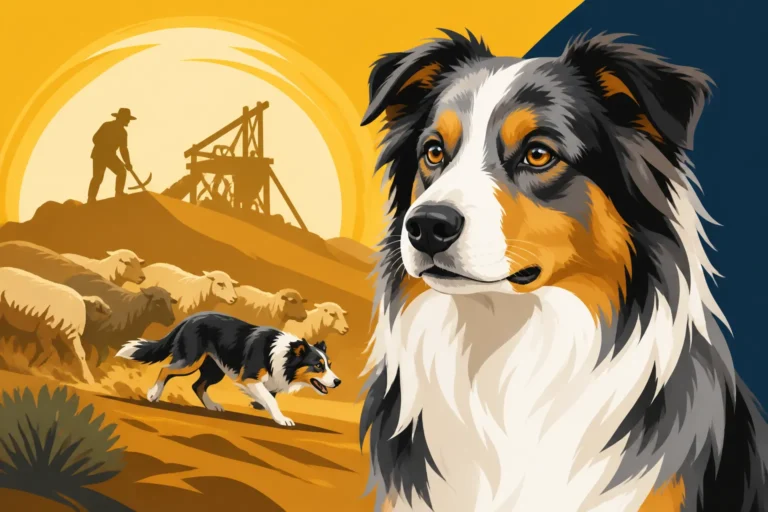
The Basque shepherds were integral to the booming sheep industry in the American West, especially during and after the Gold Rush. They brought with them not just their expertise in sheep husbandry, but also their invaluable herding dogs. These dogs were more than just pets; they were essential tools, partners in a demanding profession. The dogs they brought were likely Pyrenean Shepherds, Berger des Pyrénées, or similar breeds from their native region. The Basque Shepherds Behind the Australian Shepherd provides a deeper dive into these ancestral figures. These dogs were known for their tireless energy, intelligence, and intuitive understanding of livestock. They were quick, agile, and possessed a strong desire to gather and control animals, making them perfectly suited for the open ranges and rugged landscapes of states like California and Nevada.
Life for these shepherds and their dogs was tough. They spent months, sometimes years, out on the range with their flocks, facing predators, extreme weather, and vast distances. A dog that couldn't keep up, couldn't learn, or lacked courage was a liability. Therefore, only the most capable, hardy, and intelligent dogs were bred and passed down. This natural selection, driven by the intense demands of the working environment, forged a strong genetic foundation for the Australian Shepherd, emphasizing traits like resilience, keen observation skills, and an unwavering work ethic. It was a rigorous proving ground that shaped the very essence of the breed.
Mixing Pot of Herding Breeds
As these Basque dogs settled into the American West, they inevitably interbred with other types of working dogs already present, or brought in by different waves of immigrants. This created a fascinating "mixing pot" of herding genetics, crucial for the development of the Australian Shepherd. Early English Shepherds, Scottish Collies, and even some German herding dogs might have contributed to this diverse gene pool. The focus was never on maintaining a pure lineage in the modern sense, but rather on producing dogs that excelled at their job. If a dog proved to be an exceptional worker, its traits were desirable for breeding, regardless of its precise ancestry.
This practical approach to breeding meant that traits like specific coat colors or ear sets were secondary to working ability. Pyrenean Shepherds in the Australian Shepherd Line details how these mountain dogs brought agility and intelligence, while Collie Blood in the Australian Shepherd highlights the classic herding instincts. It was a utilitarian breeding program driven by necessity, where the best working dogs were those that could handle challenging terrain, unpredictable weather, and diverse types of livestock, from stubborn sheep to cattle. This blending of different herding dog types, all selected for performance, created a versatile and highly adaptable dog, a hallmark of the Australian Shepherd we cherish today.
Forging the Breed in the American West
The vast, untamed landscape of the American West wasn't just a backdrop for the Australian Shepherd's development; it was the crucible in which the breed was forged. The unique challenges and specific needs of ranching in this era demanded a truly exceptional working dog, and it was here that the diverse ancestral stock began to coalesce into a recognizable type.
The Gold Rush Era and Ranching Needs
The mid-19th century Gold Rush brought an explosion of population and economic activity to California and beyond. While prospectors searched for gold, a parallel boom occurred in the livestock industry, particularly sheep and cattle ranching, to feed the growing populace. This era created an immense demand for highly capable herding dogs. The Gold Rush Flocks That Made the Aussie discusses how these large, migratory flocks needed dogs that could work vast, unfenced ranges, often for days or weeks at a time, without direct human supervision. The dogs needed to be hardy, able to navigate treacherous terrain, and intelligent enough to make decisions independently, often out of sight of their shepherd.
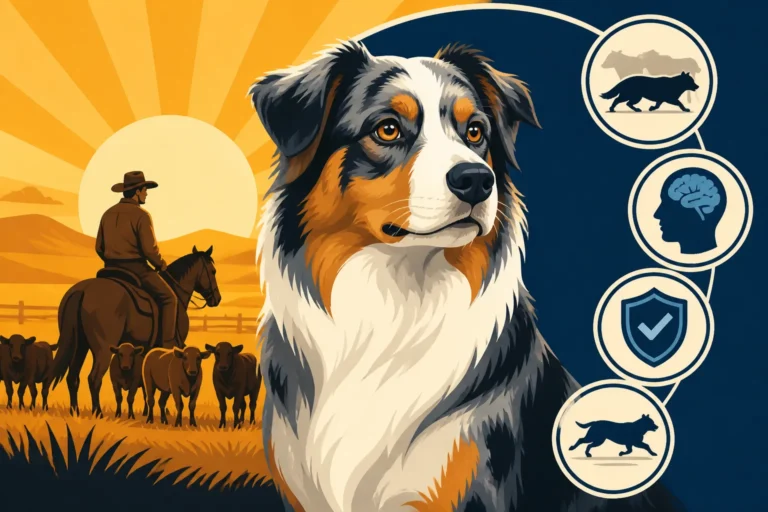
American ranchers sought dogs that could work with a variety of livestock, from nimble sheep that needed careful handling to large, often recalcitrant cattle. They needed dogs with stamina to cover long distances, a strong herding instinct to gather scattered animals, and courage to face down a challenging steer without being overly aggressive. The dogs brought by the Basque shepherds, along with other imported working collies, fit this bill perfectly. Their adaptability to different types of stock and working styles made them indispensable assets on the expanding ranches, quickly earning them a reputation for being reliable and versatile.
Developing Distinct Lines
As the nascent breed began to take shape, distinct regional variations and working lines emerged. Ranchers in different states, with varying types of terrain, livestock, and working styles, selectively bred for the traits most valuable to their operations. California, Idaho, and Colorado became key centers for this development, with generations of dogs bred for their practical working ability. Aussies Bred in California, Colorado and Idaho explores these regional influences. For instance, a rancher working in mountainous terrain might favor a more agile, lighter-boned dog, while someone handling large herds of cattle on flatter plains might prefer a more powerful, robust canine.
The focus during this period was almost exclusively on performance. Appearance was secondary; a good working dog was a good dog, regardless of its exact coat color or eye shade. Breeders prioritized intelligence, trainability, endurance, and that undeniable herding drive. This emphasis on function over form meant that the early Australian Shepherds were a diverse-looking bunch, but they shared an incredible aptitude for their work. They were truly "ranch dogs" – purpose-bred animals whose value was measured in their ability to perform their duties effectively and efficiently, often with minimal fuss.
Rodeo Arenas and Post-War Recognition
While the Australian Shepherd's roots were firmly planted in the rugged world of ranching, it was a very different kind of environment that would propel them into the public eye and cement their place in American dog history: the dazzling, high-energy world of rodeos and Western entertainment.
Making a Name in the Spotlight
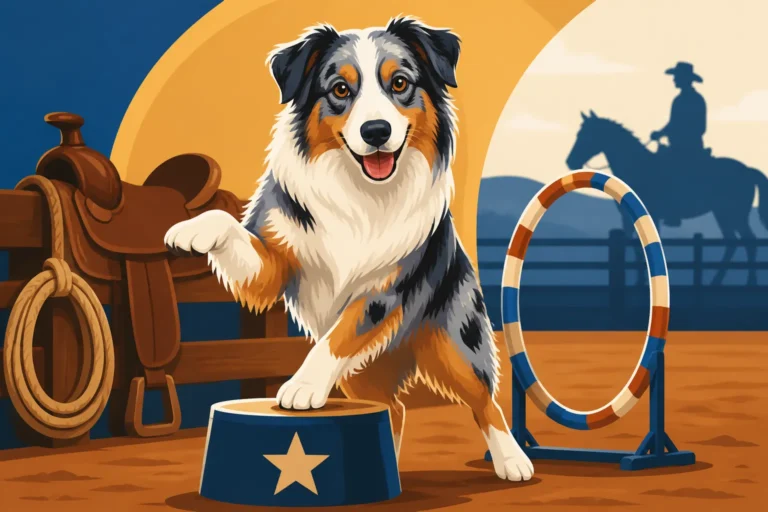
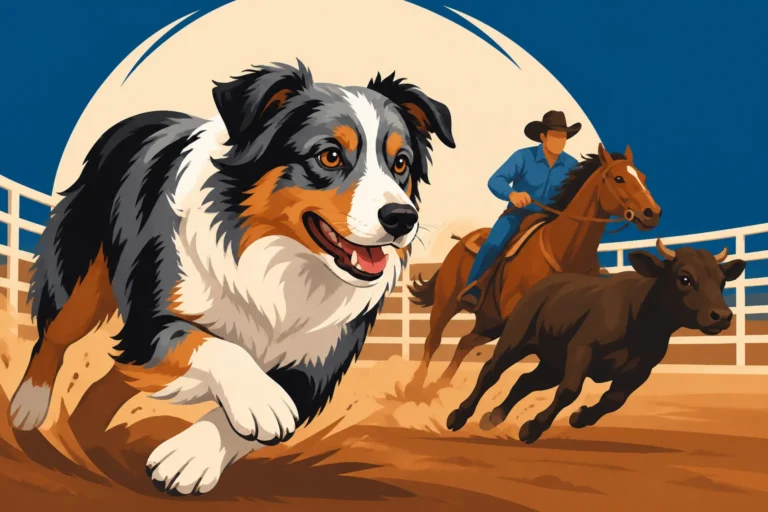
After World War II, America experienced a surge in popularity for Western culture, including rodeos, cowboy shows, and horseback riding. This cultural shift provided a unique platform for the Australian Shepherd to showcase its incredible talents to a broader audience. Cowboys and trick riders, always looking for an edge, discovered that these intelligent, agile, and highly trainable dogs were not just exceptional stock dogs but also incredible performers. They could jump through hoops, walk tightropes, perform complex obedience routines, and even herd livestock within the confines of an arena. Australian Shepherds in Rodeo Arenas beautifully illustrates this era.
One of the most famous proponents was Jay Sisler, a rodeo performer who toured with his Australian Shepherds, showcasing their remarkable abilities to crowds across the country. His dogs were not only expert herders but also masters of intricate tricks, captivating audiences with their intelligence and athleticism. This exposure was instrumental in spreading awareness of the breed beyond the ranching community. People saw these dogs in action, marveled at their skills, and began to seek them out, not just as working partners but as intelligent, active companions. Suddenly, the "Aussie" was a star, and its reputation began to grow exponentially, moving from the dusty back forty to the brightly lit rodeo arena.
Formalizing the Breed
As the breed's popularity grew, so did the desire to preserve its unique characteristics and establish a formal breed standard. Ranchers and enthusiasts, proud of their versatile working dogs, understood the need to organize and protect the breed's future. The first breed club, the Australian Shepherd Club of America (ASCA), was founded in 1957. ASCA dedicated itself to maintaining the working integrity of the breed, emphasizing its heritage as a stock dog. For decades, ASCA was the primary registry for Australian Shepherds, focusing on performance events like herding trials alongside conformation.
Later, in 1993, the American Kennel Club (AKC) recognized the Australian Shepherd, placing it in the Herding Group. The Two Dates That Brought the Aussie Into the AKC marks a significant turning point for the breed. While AKC recognition brought increased visibility and a surge in popularity, it also led to a divergence in breeding philosophies. Some breeders continued to prioritize working ability, staying true to ASCA's foundational principles, while others began to focus more on conformation for the show ring. This dual path has shaped the breed's development in modern times, with both working and show lines coexisting, each with their own distinct emphasis.
| Era/Influence | Key Contribution | Geographic Location | Noteworthy Aspect |
|---|---|---|---|
| Pre-19th Century | Ancestral European herding dogs | Basque Country, Pyrenees | Foundation stock for intelligence and herding drive |
| Mid-19th Century | Basque shepherds migrate with their dogs | Western US (California) | Introduction of versatile herding types |
| Late 19th – Early 20th | Ranching expansion and selective breeding | California, Idaho, Colorado | Development of distinct American working style |
| Post WWII | Rodeo popularity and public exposure | American West | Increased visibility and demand for the breed |
| 1957 (ASCA) | Establishment of breed club and initial standards | USA | Focus on preserving working abilities |
| 1993 (AKC) | American Kennel Club recognition | USA | Broader public awareness, growth of show lines |
The Evolving Australian Shepherd Identity
Today, the Australian Shepherd stands as a testament to its rich and varied history, a blend of rugged ranch dog and dazzling show companion. Its identity continues to evolve, shaped by dedicated breeders, passionate owners, and the enduring legacy of its working ancestors.
Ranch vs. Show Lines
The distinction between "ranch lines" and "show lines" is a significant aspect of the modern Australian Shepherd's identity. Ranch-bred Aussies, often registered with ASCA, are still primarily selected for their working prowess. Breeders in these lines prioritize herding instinct, endurance, biddability, and a sound working temperament above all else. These dogs often have intense drives and require a "job" to be truly fulfilled. Ranch Bred Against Ring Bred Australian Shepherds delves into these differences, highlighting how a working line Aussie might exhibit a more intense stare, a lower, crouched posture when working stock, and a general "no-nonsense" attitude. If you're looking for a dog to work sheep or compete in high-level agility, a ranch line Aussie might be your ideal match, though they definitely need an owner committed to meeting their immense exercise and mental stimulation needs, sometimes with products from Chewy that promote brain games and puzzle solving.
Conversely, show line Aussies, more commonly seen in AKC conformation rings, are bred to meet a specific aesthetic standard. While intelligence and a good temperament are still highly valued, emphasis is placed on coat color, markings, gait, and overall structural conformity to the breed standard. This doesn't mean show Aussies can't work; many excel in various dog sports. However, their drives might be slightly less intense than their ranch-bred counterparts, making them potentially more adaptable to active family life without livestock to herd. Understanding these two distinct types is crucial for anyone considering bringing an Australian Shepherd into their home, as their needs and energy levels can vary considerably. Working Line Australian Shepherd Traits further elaborates on the characteristics you might expect.
Modern Day Popularity and Preservation
The Australian Shepherd's popularity has soared in recent decades, making them a common sight in suburban neighborhoods, dog parks, and various competitive arenas. Their striking looks, often featuring captivating merle coats and piercing blue or heterochromatic eyes, combined with their incredible intelligence and athleticism, make them highly desirable. They excel in dog sports like agility, obedience, flyball, and even dock diving, showcasing their versatility. This popularity, however, comes with its own set of challenges, as it can sometimes attract irresponsible breeders who prioritize profit over health and temperament.
Dedicated breed clubs and responsible breeders continue to champion the preservation of the Australian Shepherd's original working character and overall health. They advocate for rigorous genetic testing, temperament evaluations, and careful selection of breeding pairs to ensure the future of healthy, well-adjusted Aussies. For new owners, this means doing your homework, seeking out breeders who are transparent about health clearances and working titles, and being prepared to commit to the significant exercise and mental engagement these dogs require. Whether you get your training supplies from a local pet store or an online giant like Chewy, remember that a well-exercised, mentally stimulated Australian Shepherd is a happy Aussie. Their loyalty and intelligence are unparalleled, but they thrive when given a purpose, honoring the legacy of those resourceful shepherds who first brought their ancestors to American shores. An Australian Shepherd's life isn't just about their stunning appearance; it's about their vibrant spirit and unwavering desire to be your partner, much as they were for those early shepherds. Australian Shepherd Temperament and Working Character provides a great overview of what makes these dogs tick.
Disclaimer
This article is for general informational purposes only and does not constitute professional advice. Laws, prices and regulations vary by location and change over time. Consult a qualified professional for guidance on your specific situation.