Whether a Long Tail Faults an Aussie in the Ring
It's a common question, and honestly, a source of worry for many prospective Australian Shepherd owners who fall in love with a full-tailed puppy: will that beautiful, flowing tail be a problem if they ever want to venture into the show ring? The breed standard can feel like a rigid set of rules, and the topic of tails often comes with a lot of historical baggage and strong opinions. This guide aims to clear up the confusion about whether a long tail constitutes a fault in an Australian Shepherd in the conformation ring and explore the broader implications for breeders and owners.
Understanding the Australian Shepherd Tail Standard
When we talk about Australian Shepherds, the image that often comes to mind is a dog with a docked or naturally bobbed tail. This isn't just a random preference; it's deeply rooted in the breed's history and has been codified in the official breed standards. But like many aspects of purebred dogs, standards evolve, and interpretation can vary.
The Natural Bobtail Preference
Historically, working Australian Shepherds often had their tails docked for practical reasons—to prevent injury while herding livestock in rough terrain. A long tail could easily get stepped on, caught in machinery, or injured by a protective cow or sheep. As the breed gained popularity and moved from the ranch to the show ring, this working tradition became enshrined in the breed standard.
Many registries, including the American Kennel Club (AKC) and the Australian Shepherd Club of America (ASCA), explicitly state a preference for a naturally bobbed or docked tail. The ideal length is often described as not exceeding four inches. This is important because it sets the expectation for what a judge is looking for in a well-presented Australian Shepherd. A dog that deviates significantly from this ideal could be penalized, but the severity of that penalty is where things get interesting. For a deeper dive into this, you might find The Australian Shepherd Natural Bobtail to be a helpful read.
Historical Context of Tail Docking
The practice of tail docking in Australian Shepherds, as with many working breeds, wasn't originally about aesthetics. It was about function. Imagine an Aussie weaving through a flock of sheep or dodging the hooves of cattle; a long tail could be a liability. The natural bobtail (NBT) gene, which causes some puppies to be born with short tails, was seen as a desirable trait because it meant less intervention was needed.
Over time, as dog shows became more popular, the docked or naturally bobbed tail became part of the "look" of the breed. Even if an individual dog wasn't working, the standard reflected the breed's heritage. This tradition continued even as ethical concerns about cosmetic docking grew. Today, while some countries have banned docking altogether, it remains permissible in others, including the United States, for breeds like the Australian Shepherd where it's part of the historical standard. This ongoing debate about tradition versus modern animal welfare has led to some interesting shifts in how tails are viewed in the ring. You can learn more about this by reading Australian Shepherd Docking and Where It Stands.
The Reality of Long Tails in the Show Ring
This is where the rubber meets the road for owners of beautiful, full-tailed Aussies. The black-and-white wording of a standard can feel daunting, but the application in a real-world conformation ring is often more nuanced.
Fault vs. Disqualification: What's the Difference?
In the world of dog shows, there's a critical distinction between a "fault" and a "disqualification."
- Fault: A fault is a deviation from the breed standard. Faults are typically graded as minor, serious, or major, and they detract from a dog's overall score. A dog with minor faults can still win, especially if it excels in other areas. A serious fault might prevent a dog from winning but won't typically remove it from competition entirely.
- Disqualification: A disqualification is a severe deviation that makes a dog ineligible to compete or win under that specific standard. Disqualifications are usually for traits that are considered detrimental to the breed's health, temperament, or fundamental type.
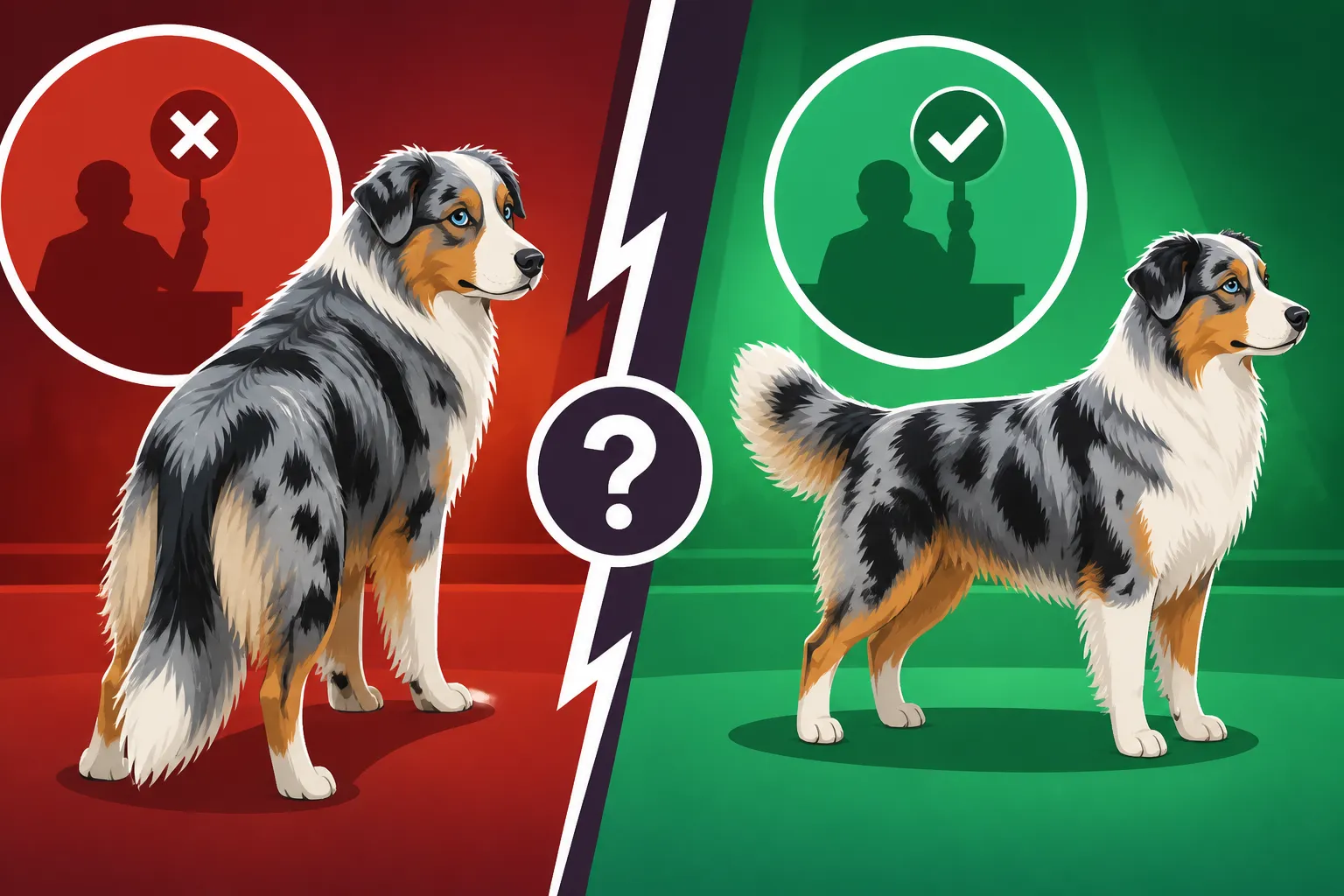
For Australian Shepherds, most breed standards, including the AKC, explicitly state that a tail that is too long is a fault, not a disqualification. The AKC standard, for example, says "Tail is straight, naturally bobbed or docked. If docked, or naturally bobbed, it is not to exceed four inches. Tails otherwise are to have a moderate brush. Faults: Undocked or excessively long tails." Notice it says "faults," plural, encompassing both extremes. This is a crucial detail! It means a long tail will count against the dog, but it won't automatically send it home without being judged.
Consider this table comparing how different tail lengths might be perceived:
| Tail Length/Type | Breed Standard Alignment | Show Ring Impact | Severity |
|---|---|---|---|
| Natural Bobtail (<4") | Ideal | No penalty; aligns perfectly with standard. | N/A |
| Docked Tail (<4") | Ideal | No penalty; aligns perfectly with standard. | N/A |
| Full Tail (Moderate Brush) | Acceptable, but a fault | Judge will note it as a fault; degree of penalty depends on overall quality of the dog. | Minor to Serious Fault |
| Excessively Long/Plumed Tail | Further deviation from standard | Likely a more serious fault due to excessive length or coat. | Serious Fault |
| Kinked/Curled Tail | Not mentioned in standard usually | Could be seen as a structural fault depending on severity and how it affects movement. | Structural Fault (separate from length) |
So, while a long tail is undeniably a fault, it doesn't automatically mean your Aussie can't compete or even earn points in conformation. It simply means the dog needs to be exceptional in other areas to overcome that specific deduction.
Judge's Discretion and Interpretation
This is where the "art" of dog judging comes into play. While standards provide guidelines, judges are human and their interpretation can vary. A well-constructed, beautifully moving, and temperamentally sound Australian Shepherd with a full tail might still place over a dog with a perfect bobtail but other, more significant faults in structure or movement.
A judge will evaluate the dog as a whole. They look at overall balance, health, temperament, gait, and how well the dog embodies the essence of the breed. If your Aussie has a glorious full coat, excellent bone, a striking head, and moves like poetry, a judge might view the long tail as a minor aesthetic flaw rather than a fundamental problem. However, if the dog has several minor faults, the long tail could be the tipping point that prevents it from winning.
It's also worth noting that attitudes are slowly shifting. As more countries prohibit cosmetic docking, judges are becoming more accustomed to seeing breeds that traditionally had docked tails now competing with natural tails. This doesn't change the written standard overnight, but it can subtly influence how heavily a judge weighs such a fault. If you're considering showing an Aussie with a natural tail, it's wise to attend some shows, observe the judges, and perhaps even speak with handlers who show full-tailed dogs in your area. They often have insights into which judges are more forgiving of natural tails versus those who adhere strictly to every letter of the historical standard. The best advice is always to present the best dog you have, regardless of tail length, and let its other qualities shine.
Breeding Considerations and Ethical Implications
The presence of long tails in Australian Shepherds isn't just a matter of show ring aesthetics; it delves into the very core of responsible breeding and ethical practices. When we talk about tails, we're really talking about genetics and the choices breeders make.
Genetics of the Natural Bobtail
The natural bobtail in Australian Shepherds is caused by a dominant gene (T-box transcription factor gene, or T gene). A dog only needs one copy of this gene to have a bobtail. However, here's the critical part: inheriting two copies of the NBT gene is considered lethal, meaning puppies with two copies often don't survive to term or die shortly after birth. This is why ethical breeders never breed two natural bobtail Aussies together, as it dramatically increases the risk of producing non-viable puppies. This genetic reality means that a portion of any litter from an NBT parent will always have full tails, even if one parent is a natural bobtail. It's a fundamental aspect of Australian Shepherd genetics, and understanding it is key to understanding why full-tailed Aussies exist. More details can be found in The Aussie Bobtail Gene and Its Lethal Pairing.
Breeders aiming for the NBT look must carefully manage their breeding pairs. A common pairing might be a natural bobtail dog with a full-tailed dog. This ensures that while some puppies will be NBT, others will inevitably have full tails, and there's no risk of the lethal homozygous pairing. This is a testament to careful genetic management.
The Ethical Debate Around Tail Docking
The practice of tail docking is one of the most contentious issues in the dog world today. On one side are those who advocate for preserving the historical appearance and working functionality, citing tradition and preventing injuries. On the other side are those who argue that it's a painful, unnecessary cosmetic procedure that deprives a dog of a crucial communication tool and should be banned. Many veterinary associations globally consider it unethical, and it has been banned in numerous countries, particularly across Europe and Australia.
For Australian Shepherd breeders, this creates a complex landscape. In regions where docking is illegal, breeders must produce full-tailed puppies unless a natural bobtail occurs. Even in areas where it's legal, many prospective puppy buyers are increasingly seeking undocked dogs due to ethical concerns. Responsible breeders are often caught between adhering to a traditional breed standard and responding to societal shifts in animal welfare.
This debate also highlights the importance of open communication between breeders and potential owners. If you are buying an Australian Shepherd puppy, especially if you have an interest in showing, it's vital to ask about the breeder's stance on tails and their breeding practices. A good breeder will be transparent about the genetics of their lines, whether they dock, and why they make those choices. They understand that not every buyer wants a docked tail, and that a beautiful, healthy Aussie with a full tail is still a wonderful companion and a worthy representative of the breed.
Beyond the Show Ring: Practicalities of a Long Tail
While the show ring is one aspect of an Australian Shepherd's life, for most owners, the day-to-day realities are far more important. A long tail on an Aussie brings its own set of charming quirks and practical considerations, particularly when it comes to grooming and general care.
Grooming and Care for a Full Tail
Australian Shepherds are known for their gorgeous, dense double coats, and a full tail, often referred to as a "brush" or "plume," is an extension of that beauty. However, with beauty comes responsibility! A long, feathered tail can be a magnet for burrs, foxtails, mud, and other debris, especially if your Aussie enjoys romping through fields or hiking trails, as many do.
Here's what you need to know about caring for that magnificent tail:
- Regular Brushing: Just like the rest of their coat, a long Aussie tail needs frequent brushing to prevent mats and tangles. The feathering can become quite dense, and if left unattended, it can form painful mats that pull on the skin. Invest in a good slicker brush and an undercoat rake. Brushing a couple of times a week, and more frequently during coat blow seasons, is essential. You might find excellent grooming tools on Chewy for this purpose, specifically designed for double-coated breeds.
- Checking for Debris: After every outdoor adventure, make it a habit to check your Aussie's tail thoroughly for burrs, twigs, and especially those sneaky foxtails that can burrow into the skin. This is particularly important if you live in an area with a lot of natural foliage. You can read more about dealing with these nuisances in Checking an Australian Shepherd for Burrs and Foxtails.
- Bathing and Drying: When bathing your Aussie, pay special attention to getting the tail clean, but also ensure it's completely dry afterward. Trapped moisture in that thick fur can lead to skin irritation or hot spots. A powerful dog dryer can be a godsend for thoroughly drying an Aussie's double coat, tail included.
- Hygiene Trims: Some owners opt for a slight "sanitary trim" around the base of the tail or underneath to prevent feces from matting in the fur, especially in dogs with very dense or long-haired tails. This is not about docking or altering the natural length, but rather a practical trim for cleanliness.
- Deshedding: During seasonal coat blows, that tail will be a significant contributor to the "Aussie glitter" around your home. Regular deshedding sessions with a good rake will help manage the shedding, just as it does for the rest of their body. Grooming an Australian Shepherd Through Coat Blow offers more tips on this intense shedding period.
Caring for a long Australian Shepherd tail is really just an extension of caring for their beautiful double coat. It requires consistency and the right tools, but it's entirely manageable and part of the joy of owning this breed.
Living with a Long-Tailed Aussie
Beyond the grooming, living with a long-tailed Australian Shepherd is generally no different than living with a bobtailed one, but there are a few nuances that owners often notice.
- Communication: A dog's tail is a crucial tool for communication, both with other dogs and with humans. A full tail provides a much clearer visual signal of a dog's mood and intent. You can see the full range of happy wags, nervous tucks, and curious sweeps. This can actually be a benefit in social interactions, as other dogs (and people) have more information about your Aussie's emotional state.
- Space Awareness: A long, enthusiastic tail can clear a coffee table in a single sweep! Owners of long-tailed dogs quickly learn to be mindful of tail height when their dog is excited, especially around fragile objects. This is often jokingly referred to as the "whip hazard" or "clearance zone."
- Expression of Breed Type: For many, a full, flowing tail adds to the majestic appearance of an Australian Shepherd, showcasing the breed's natural beauty. It allows the dog to fully express its athleticism and grace, with the tail acting as a natural counterbalance during turns and leaps.
- Acceptance: As the ethical landscape around docking shifts, more and more people appreciate and even prefer the natural look of a full-tailed Australian Shepherd. If you love your dog, its tail length is simply part of its unique charm. Whether for show or for a beloved family companion, the most important thing is a healthy, happy, well-adjusted Aussie.
Ultimately, whether your Australian Shepherd has a natural bobtail, a docked tail, or a glorious full plume, the core of the breed remains the same: an intelligent, energetic, loyal companion. The tail is a minor detail in the grand scheme of what makes an Aussie such an incredible dog.
Disclaimer
This article is for general informational purposes only and does not constitute professional advice. Laws, prices and regulations vary by location and change over time. Consult a qualified professional for guidance on your specific situation.