What Happens at an Aussie Herding Instinct Test
It's absolutely fascinating to watch an Australian Shepherd discover its inner ranch dog, isn't it? Many of us get an Aussie because we're drawn to their intelligence and energy, but then wonder if that famous herding instinct is actually there, bubbling just beneath the surface. You might see them try to round up the kids in the yard or stare intently at squirrels, and a little voice in your head asks, "Could they really herd?" This guide is all about pulling back the curtain on what actually happens during an Australian Shepherd herding instinct test, so you can walk in feeling confident and knowing exactly what to expect.
Understanding the Core Purpose of an Instinct Test
Before we dive into the nitty-gritty of the day itself, it’s really important to understand what a herding instinct test is and, perhaps more crucially, what it isn't. This isn't a pass/fail exam in the traditional sense, and it's certainly not a judgment on your dog's overall intelligence or your capabilities as an owner.
What an Instinct Test Is and Isn't
Think of a herding instinct test as a scientific observation rather than a competition. Its primary goal is to determine if your Australian Shepherd possesses the inherent, unlearned drives necessary for herding livestock. It's about seeing if the core software of their breed, Why Herding Instinct Is the Aussie Operating System, is installed and running. These are the natural behaviors that have been selectively bred into Aussies for generations: the desire to control movement, to gather, to drive, and to work with a handler.
What it isn't is a test of training. Your dog doesn't need to know commands like "come by" or "away to me." In fact, often, the less formal training a dog has had around livestock, the better, because you want to see their raw, unadulterated instinct. An instructor won't be looking for perfect manners; they'll be looking for signs of genuine herding aptitude, things that simply can't be taught from scratch. It's truly a baseline assessment, a peek into their genetic blueprint. Many owners feel a mix of excitement and apprehension, wondering if their beloved companion will "measure up." Rest assured, it’s merely an exploration of what makes your Aussie, well, an Aussie!
Why Owners Seek Out These Tests
So, why do people put their Aussies through these tests? The reasons are as varied as the dogs themselves. For many, it's pure curiosity. They've heard about their breed's heritage and want to see if their couch potato, who occasionally attempts to herd the dust bunnies, has a hidden sheepdog inside. It's a way to connect with the deep history of the breed and understand their dog on a different level. There’s a certain thrill in seeing that primal spark ignite.
For others, especially those who might have a working line Australian Shepherd, it's about assessing their dog's potential for formal herding. They might be considering getting into herding sports or even working livestock, and an instinct test is the first, crucial step to determine if their dog has the foundation to succeed. It helps them decide if investing in more intensive training, like the kind discussed in Starting an Australian Shepherd on Sheep, is a worthwhile path. An instinct test can save you a lot of time and money if your dog simply isn't wired for it. It also offers invaluable insight into how your dog processes information, reacts to pressure, and tries to control its environment, which can inform other aspects of their training and daily enrichment.
The Environment and Setup of a Typical Test
When you arrive at a facility for a herding instinct test, you'll find that the environment is specifically designed to elicit and safely observe these natural behaviors. It’s not a chaotic dog park, but a controlled setting with an experienced evaluator.
The Arena and the Livestock
Typically, the test takes place in a round pen or a very small, enclosed arena. The size is important because it allows the dog to engage with the livestock in a manageable space, without being overwhelmed or having too much room to simply run off and play. The fencing is usually solid or closely woven wire, to prevent distractions and ensure the safety of both the dog and the animals.
The livestock used for these tests are almost always a small group of sheep or ducks, sometimes even goats. These animals are chosen specifically because they are "dog-broke" – meaning they are accustomed to working with dogs, are generally calm, and won't panic or run wildly, which could be dangerous for everyone involved. They're usually well-versed in the routine, moving in a predictable manner that helps showcase the dog's innate responses. The instructor, known as a "flagger" or "handler," plays a vital role in this setup, guiding the stock if needed and ensuring the dog's experience is safe and productive. You might find a good long line on Amazon invaluable for your first few training sessions after the test if you decide to pursue herding further.
The Initial Introduction to the Stock
When it’s your Aussie's turn, you'll typically bring them into the round pen on a leash. The instructor will have a "flagger" or a long stick, sometimes with a plastic bag on the end, which they use to help direct the livestock or safely block the dog if it gets too excited or tries to nip. You, as the owner, will often be asked to stay at the edge of the pen, allowing the instructor to work with your dog.
The initial moments are crucial for observation. The instructor will release your dog off-leash (or sometimes keep a long line dragging for safety, especially with very keen dogs) and watch its immediate reaction to the livestock. Does your Aussie show intense interest, a low stalk, or "eye" the animals? Does it try to chase them directly, or does it try to gather them? Or does it seem completely indifferent, perhaps sniffing the ground or trying to greet the instructor? All these reactions provide valuable clues. It’s common for dogs to be a little unsure at first, especially if they've never seen sheep or ducks up close. The instructor is there to gently encourage interaction and observe the dog's natural problem-solving instincts as they navigate this new situation.
Observing Your Aussie's Natural Herding Behaviors
Once your Australian Shepherd is introduced to the stock, the instructor will be watching for a specific set of behaviors that indicate true herding instinct. It's a fascinating dance between dog, stock, and handler, revealing the deep-seated drives of the breed.
Key Instincts the Evaluator Looks For
The evaluator isn't just looking for whether your dog chases the stock. Many dogs will chase, but true herding involves control and purpose. Here are some of the key instincts they're trying to identify:
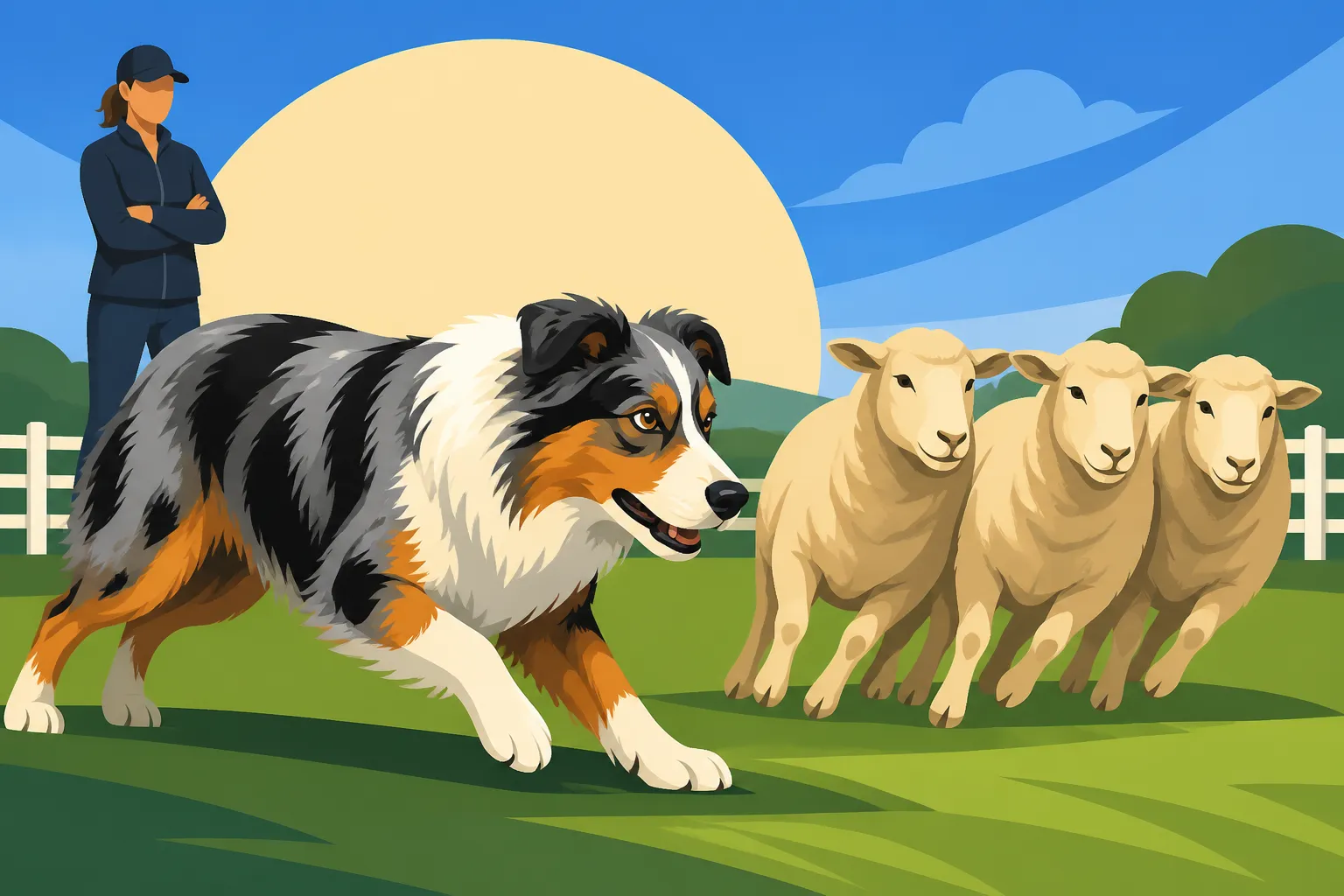
- Eye: This is perhaps the most famous herding trait. Does your Aussie fixate on the stock with an intense, unwavering gaze? This "eye" is a powerful tool for controlling the movement of the animals, and a dog with strong eye will often move low and deliberately, using its stare to influence the flock. It's about mental pressure, not just physical.
- Balance: A dog with good balance will naturally position itself opposite the handler, creating a "bubble" around the stock. If the handler moves to the left, the dog moves to the right, maintaining pressure on the stock to keep them contained or move them in a desired direction. It's an intuitive understanding of geometric positioning.
- Power/Drive: This refers to the dog's willingness to engage and apply pressure to the stock. Some dogs might be a bit soft, while others have an undeniable "push" that shows their determination to move the animals. It's the inherent assertiveness to take control of the situation.
- Gathering vs. Driving: Does your Aussie naturally try to bring the stock to you (gathering instinct), or does it try to push them away from you (driving instinct)? Both are valid herding behaviors, but understanding which one is dominant helps guide future training. Most Aussies lean towards gathering.
The instructor will subtly manipulate the situation, perhaps moving themselves or the stock slightly, to see how your dog reacts and whether these natural instincts kick in. It’s an art form, really, watching an experienced instructor draw out these deep-seated traits.
What Happens During the "Work" Segment
Once the initial reactions are observed, the instructor will actively try to facilitate some "work." They might use their flagger or their own body position to encourage your Aussie to move the sheep or ducks. Often, they'll have your dog on a long line to gently guide them, not to teach commands, but to help them understand how to apply their natural instincts more effectively. They want to see if the dog can maintain its focus, if it tries to circle the stock to keep them together, and if it responds to the movement of the animals.
You’ll observe your dog circling, sometimes wide, sometimes tight, attempting to collect or push the stock. They might try to grip at a heel or nose, which is a natural herding behavior for some breeds (though often undesirable in formal trials and something a good trainer will redirect). The instructor will continuously interpret your dog's actions, noting the strength of its eye, its balance, and its overall desire to manage the flock. This is where you might see the full glory of The Australian Shepherd Herding Drive You Cannot Train Out come alive. It's not about perfect execution, but about the intent and the presence of these core behaviors.
Common Reactions and What They Mean
Dogs have a spectrum of reactions during an instinct test, and none of them are "wrong," they just indicate different levels of herding aptitude.
- Enthusiastic Engagement & Strong Eye: This is the ideal scenario. Your Aussie quickly engages, shows strong eye, tries to balance the stock, and exhibits clear intent to move and control them. This dog likely has excellent potential for formal herding training.
- Mild Interest & Some Chasing: The dog might be interested, chase the stock a bit, but lack the intense focus or the natural "balance." They might be playing more than trying to control. This dog might still benefit from some foundational training, but formal herding might not be their calling. Other dog sports might be a better fit.
- Disinterest or Fear: Some Aussies, despite their lineage, simply aren't interested. They might ignore the stock, prefer to interact with the handler, or even show signs of fear or avoidance. This is perfectly fine! It just means their drive lies elsewhere. Not every Aussie needs to be a working dog. It doesn't diminish their worth as a companion one bit. Sometimes, fear or uncertainty can be overcome with gentle introductions, but true herding instinct usually presents itself fairly readily.
Your instructor will provide feedback based on these observations, helping you understand where your Aussie falls on this spectrum and what their natural tendencies suggest for future activities.
Interpreting the Results and Next Steps
Once the session is over, the instructor will debrief you, providing an assessment of your Aussie’s performance. This isn't a pass/fail in the academic sense, but rather a gauge of their inherent aptitude for herding work.
What a "Pass" or "Fail" Really Means
When an instructor says your dog "passed" an instinct test, it simply means they demonstrated a clear presence of the core herding behaviors: eye, balance, drive, and the desire to control stock movement. It means your dog has the ingredients to be a herding dog. It doesn't mean they're ready for a trial, or that they're a "better" Australian Shepherd than one who didn't show much interest.
Conversely, if your Aussie "fails" or doesn't show much instinct, it simply indicates that those strong herding drives aren't dominant in their personality. It doesn't mean your dog is flawed or untrainable. It just means their talents and inclinations lie elsewhere. Remember, Whether a Pet Aussie Can Learn to Herd is a common question, and this test helps answer it. Sometimes a dog has some instinct but needs more confidence or exposure, and a good instructor will be able to tell you the nuance. This is about discovering your dog's unique wiring, not judging it.
Beyond the Instinct Test: What Comes Next
What you do after the instinct test largely depends on the results and your own goals.
- Strong Instinct: If your Aussie showed a strong, natural instinct, the next step might be to enroll in formal herding lessons. These lessons will build upon that raw instinct, teaching your dog how to use its natural abilities more effectively and respond to commands. You'll learn handler skills, how to read your dog, and how to work as a team. This could lead to trialing in various herding organizations, if that's your ambition. Consider researching different Australian Shepherd Herding Trial Levels to see what the path could look like.
- Mild Instinct/No Interest: If your dog showed mild interest or none at all, don't be disheartened! This simply opens the door to exploring other amazing activities your Australian Shepherd might excel at. Their intelligence and energy still need an outlet. Think about dog sports like agility, obedience, rally, or nose work. These activities are fantastic for mental and physical stimulation. You could even explore fun alternatives like Treibball as an Aussie Alternative to Sheep, which channels herding-like behaviors with large exercise balls instead of live stock. Many online platforms, like BAXTER & Bella, offer comprehensive training programs for general obedience and various dog sports, which can be a fantastic way to engage your Aussie's mind even if herding isn't their passion. You can find excellent books on these topics on Amazon too.
- Appreciating the Heritage: Even if you don't pursue formal herding, simply understanding that your dog does or doesn't have that innate drive can deepen your appreciation for the breed. It helps explain why they might be so attentive to movement, why they might try to gather toys, or conversely, why they're perfectly content just being a family companion. Every Aussie is an individual, and the test just helps you understand your individual Aussie a little better.
Gear and Preparation for Future Herding Activities
If you decide to continue on the herding path, a few simple pieces of gear will be essential. For the test itself, you'll generally just need a sturdy leash and a flat collar for your dog. Make sure your dog is well-hydrated, and bring some water, especially if it's a warm day.
For ongoing training, you'll definitely want comfortable, practical footwear for yourself, as you'll be doing a lot of walking and moving in the arena. A good long line will be invaluable for practice sessions, allowing your dog some freedom while still maintaining control. You can find a variety of durable long lines on Amazon. Always prioritize safety for both your dog and the livestock. Listen carefully to your instructor's advice on specific equipment, as they know the best tools for their particular training style and the animals they work with. Remember, the goal is always safe, clear communication and a positive experience for everyone.
Here's a quick comparison of what an instinct test looks for versus what formal training teaches:
| Feature | Herding Instinct Test | Formal Herding Training |
|---|---|---|
| Purpose | Assess natural, unlearned drives for herding. | Teach dog to apply instincts to specific tasks/commands. |
| Dog's Knowledge | No prior herding training expected or desired. | Requires foundation of instinct; introduces commands. |
| Handler's Role | Mostly observational, ensuring safety. | Active participation, giving commands, directing dog. |
| Focus | Raw behavior: eye, balance, drive, gathering/driving. | Controlled movement: fetches, flanks, stops, sheds. |
| Outcome | Indication of aptitude; baseline for future work. | Skill development; preparation for trials/ranch work. |
Disclaimer
This article is for general informational purposes only and does not constitute professional advice. Laws, prices and regulations vary by location and change over time. Consult a qualified professional for guidance on your specific situation.