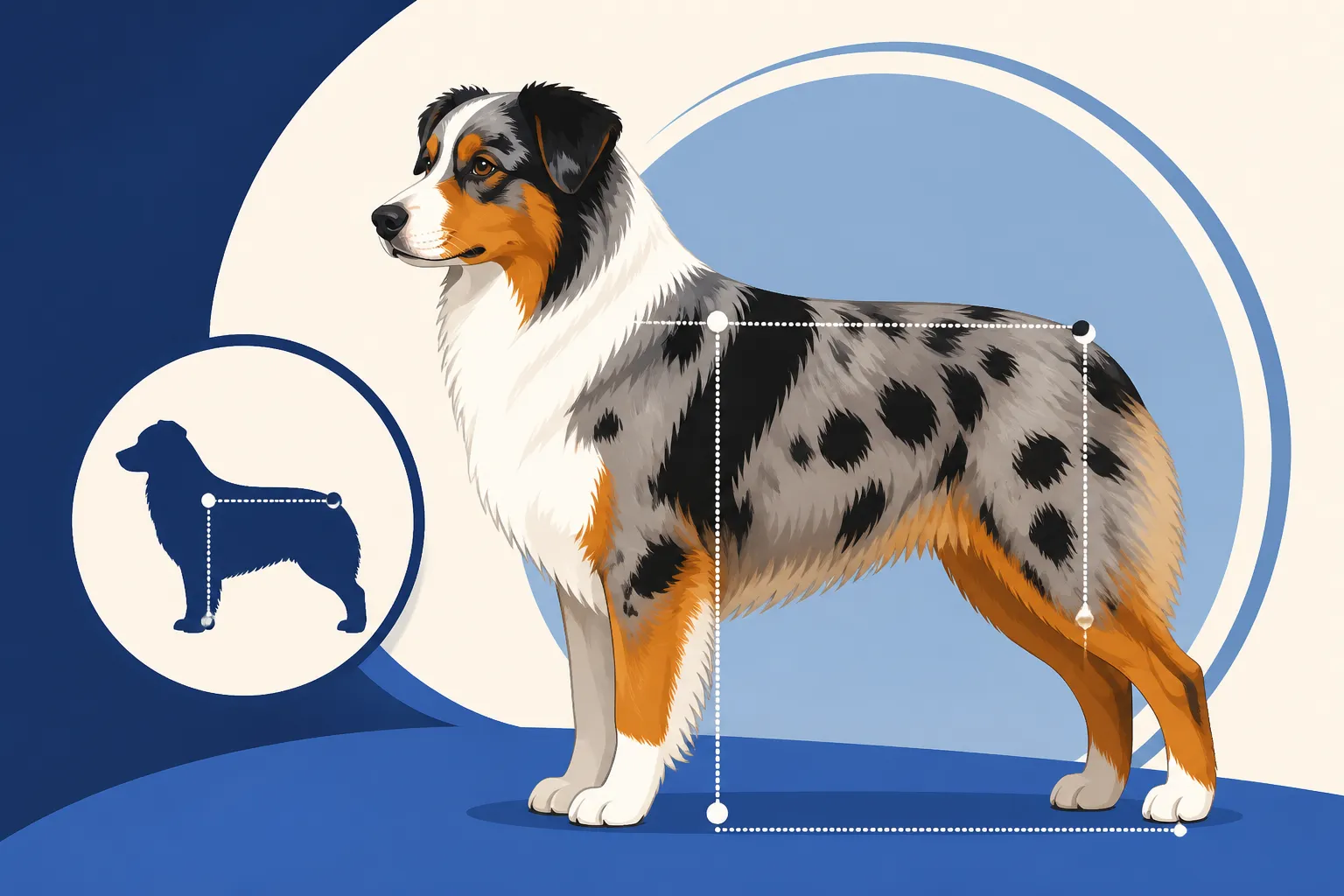
Australian Shepherd Proportions in the Standard
It can be incredibly confusing to look at the official Australian Shepherd breed standard and try to visualize what it actually means for a living, breathing dog. Many aspiring owners and even some seasoned enthusiasts struggle to understand the nuances of terms like "slightly longer than tall" or "moderate bone." This guide aims to demystify the Australian Shepherd's ideal proportions as laid out in the breed standard, explaining why these specific measurements and balances are crucial, not just for showing, but for the health and working ability of our beloved Aussies.
Why Proportions Matter: More Than Just Looks
When we talk about an Australian Shepherd's proportions, we're not just discussing superficial aesthetics. There's a deep, functional reason behind every line and angle described in the breed standard. These aren't arbitrary rules created to make dogs look a certain way for the show ring; they are specifications born from generations of working dogs on ranches, where efficiency, endurance, and soundness were paramount.
Form Follows Function: The Working Dog Ideal
Think about what an Australian Shepherd was originally bred to do: herd livestock all day, often over rough terrain, making quick turns, sudden stops, and long stretches of steady movement. Every aspect of their physical build needed to support these strenuous tasks. A dog that is too long-backed might struggle with quick directional changes or be prone to spinal issues. One with overly short legs might not have the stamina for long drives, while one with too much bone might lack the necessary agility. The ideal proportions describe a dog built for athletic performance, with a balance that allows for both power and grace. This connection between form and function is truly the cornerstone of the Australian Shepherd standard.
For instance, the specific angles of the shoulder and rear assembly, detailed in the standard, directly affect how efficiently an Aussie can move. Correct angulation allows for a smooth, powerful stride, conserving energy over many hours of work. If these angles are off, the dog has to work harder, leading to quicker fatigue and potential strain. This is why a well-proportioned Aussie often moves with such effortless beauty – it’s a reflection of their genetic design for a demanding job. A dog with excellent proportions will exhibit a gait that is fluid and balanced, showcasing its inherent athleticism.
Avoiding Structural Faults and Health Concerns
Deviations from the ideal proportions aren't just cosmetic flaws; they can predispose an Australian Shepherd to significant health problems. A dog with an incorrect length-to-height ratio, for example, might place undue stress on its joints, contributing to conditions like Australian Shepherd Hip Dysplasia and Working Joints or Aussie Elbow Dysplasia From Hard Turning. Similarly, improper bone structure or poor angulation can lead to a less efficient gait, causing premature wear and tear on cartilage and ligaments over a lifetime of activity.
Responsible breeders understand this critical link between structure and health. They strive to produce Aussies that not only conform to the standard but, more importantly, are built to live long, active, and comfortable lives. By adhering to the proportional guidelines, they aim to minimize the risk of inherited structural issues that could impact a dog’s well-being. This attention to detail in breeding means fewer vet visits for orthopedic problems and a happier, healthier dog for families. It’s a commitment to the breed's future, ensuring that future generations of Aussies can continue to display the vigor and soundness for which they are known.
Decoding the Australian Shepherd Standard: Ideal Proportions
The breed standard is a blueprint for the ideal Australian Shepherd, outlining not just size and color, but the precise relationships between different body parts. Understanding these proportional mandates helps us recognize a truly well-built Aussie.
The Body's Length-to-Height Ratio
One of the most defining proportional characteristics of the Australian Shepherd is its body length compared to its height. The standard dictates that an Aussie should be "slightly longer than tall." What exactly does this mean? It means that when you measure from the prosternum (the prominent bone at the front of the chest) to the rear of the pelvis (the ischial tuberosity), the dog's body should be slightly longer than its height measured from the ground to the top of the highest point of the shoulder blade (the withers).
This isn't a call for a long, low-slung dog, nor a perfectly square one like some other breeds. It's a subtle elongation that provides flexibility and agility. A square dog might be less flexible in tight turns, while an overly long dog might lack power in its hindquarters. The "slightly longer" allows for powerful, ground-covering strides needed for herding, combined with the ability to coil and spring, changing direction with lightning speed. This balance is crucial for a dog that needs to be both enduring and explosive.
An easy way to visualize this is to imagine a box around the dog. The top of the box would be the withers, the bottom the ground, and the sides the prosternum and the rear of the pelvis. For an Aussie, that box would be just a touch wider than it is tall. This slight rectangularity is what contributes to their signature agile and balanced movement. When you see an Aussie moving fluidly, covering ground effortlessly, you're seeing those ideal proportions at work. Understanding this ratio is fundamental to appreciating the breed's physical design and its historical purpose.
Head and Muzzle Balance
The head of an Australian Shepherd is often described as intelligent and keen, and its proportions are key to this expression. The standard specifies a balanced head, where the length of the muzzle is equal to the length of the skull. This ratio creates a pleasing and functional symmetry. A muzzle that is too short or too long in relation to the skull can disrupt the dog's bite and overall facial expression, potentially impacting its ability to hold and move objects or even breathe effectively. The skull itself should be flat or slightly domed, neither too broad nor too narrow, giving the impression of strength without heaviness.
Furthermore, the stop (the indentation between the eyes where the muzzle meets the forehead) should be moderate, clearly defined but not abrupt. This moderate stop, combined with the balanced muzzle and skull, contributes to the overall intelligent and alert expression that is so characteristic of the breed, as detailed in The Australian Shepherd Head and Expression. The eyes, set obliquely, add to this keen look, conveying an impression of watchful readiness. Everything about the head, from the eye shape to the ear set, works in concert to present a picture of an alert, intelligent, and capable working dog.
A proper head structure also contributes to dental health and efficient jaw function. A well-proportioned muzzle provides ample space for strong, healthy teeth, essential for a dog that might occasionally need to grip and control livestock. When breeders select for these traits, they are ensuring that the dog can perform its tasks effectively and maintain its health throughout its life. It's not just about a pretty face; it's about a functional one that aligns with the breed's heritage.
Leg Length and Bone Structure
The legs of an Australian Shepherd are built for endurance and agility. They should possess moderate bone, meaning they are sturdy and strong but not overly heavy or coarse. Fine bone might suggest fragility, while excessively heavy bone could hinder the dog's quickness and stamina. The front legs should be straight, perpendicular to the ground, and the elbows should be close to the body, allowing for an efficient, ground-covering stride. This straightness provides a solid foundation, crucial for absorbing the impact of continuous movement.
The hindquarters are equally important, designed for power and propulsion. They should be well-angled at the stifle (knee) and hock (ankle), allowing for a powerful push-off. These angles, often compared to springs, enable the dog to propel itself forward, jump, and change direction effectively. The feet should be oval-shaped with well-arched toes, providing good traction and durability, particularly on varied terrain. This combination of moderate bone, straight front legs, and well-angled hindquarters defines the Aussie's athletic frame.
When considering the Australian Shepherd Height and Weight, these proportions are vital. An adult male Australian Shepherd typically stands between 20-23 inches at the withers, while females are 18-21 inches. These height ranges, combined with a proportionate bone structure and balanced musculature, contribute to a dog that usually weighs between 35 and 70 pounds, ideally lean and fit. A dog with too short or too long legs relative to its body, or with incorrect angulation, would struggle to maintain the characteristic smooth, free, and easy gait described in Australian Shepherd Movement in the Ring. The balance in leg length ensures that the dog's center of gravity is appropriate for both stability and dynamic movement.
Assessing Proportions in a Real-Life Australian Shepherd
Understanding the standard on paper is one thing, but applying it to a living, moving dog is another entirely. This is where observation and a keen eye come into play, whether you're evaluating a puppy, an adult dog, or even your own beloved Aussie.
The Visual Assessment: What to Look For
When assessing an Australian Shepherd's proportions, start with the overall silhouette. Does the dog appear balanced? Does it look slightly longer than it is tall? You can often get a good sense of this by standing a few feet back and observing the dog in a natural stack. Imagine drawing those lines: from prosternum to ischial tuberosity for length, and from withers to ground for height. It's a subtle difference, not an extreme one.
Next, look at the head. Is the muzzle approximately the same length as the skull? Is the stop well-defined but not overly dramatic? Observe the ears – are they set high enough to convey alertness but not so high as to look disproportionate? Then, move to the legs and body. Are the front legs straight? Do the hindquarters show good angulation, indicating powerful drive? A useful trick is to watch the dog move. A well-proportioned Aussie will move with an easy, fluid gait, without any choppiness or awkwardness, demonstrating its inherent athleticism and soundness. Don't forget to consider What an Australian Shepherd Should Weigh in relation to its height and bone structure; an overweight dog will naturally appear disproportionate.
The Role of Responsible Breeders
Reputable Australian Shepherd breeders are deeply committed to upholding the breed standard, not just for show success but for the health and longevity of their dogs. They carefully select breeding pairs based on conformation, temperament, and extensive health testing. They understand that correct proportions are a key indicator of a dog's functional soundness. When you approach a breeder, they should be able to discuss their dogs' proportions in detail, explaining how they align with the standard and why certain pairings were chosen.
A good breeder will also provide transparency regarding the health of their breeding stock, offering The Test Results an Aussie Breeder Must Produce for conditions like hip and elbow dysplasia, as well as eye certifications. They prioritize producing dogs that are healthy, structurally sound, and true to the breed's working heritage. You'll find that these breeders are happy to answer all your Questions an Aussie Breeder Should Answer about their dogs' lineage and physical attributes. They often have years of experience Reading an Australian Shepherd Pedigree to understand the potential genetic contributions to a puppy's adult structure. They understand that a visually appealing dog is only truly beautiful if it is also sound and healthy. When shopping for dog food or supplies, reputable companies like Chewy often provide educational resources that align with these values, helping owners choose products that support their dog's overall well-being.
Common Misconceptions and Variations
The world of dog breeds can be a confusing place, with various interpretations and trends impacting how dogs are bred and perceived. It's important to differentiate between the established standard and other popular ideas.
The "Miniature" vs. Standard Debate
One common area of confusion arises with the various sizes of "Aussies" available today. While this article focuses on the Australian Shepherd, it's worth noting the existence of the Miniature American Shepherd. This breed, though sharing a similar look and heritage, split off from the Australian Shepherd precisely because of a desire to breed for a consistently smaller size. They have their own distinct breed standard, which naturally includes different proportional requirements for height and length, as well as How Tall a Male Australian Shepherd Stands and The Height Range for a Female Aussie for the standard Aussie.
It’s crucial for potential owners to understand that a "miniature Australian Shepherd" is typically a Miniature American Shepherd, a separate and distinct breed with its own standard. Breeding simply for smaller size within the Australian Shepherd breed can sometimes inadvertently lead to undesirable proportional deviations or health issues if not done carefully and with a focus on soundness. The standard Australian Shepherd proportions are specifically for the larger, traditional Aussie, developed for its particular working role. The original Australian Shepherd breed has a specific size range, and deviations from this range, especially without a separate breed standard, can compromise the integrity of the breed's inherent working structure.
Aesthetic Trends vs. Functional Health
Like any popular breed, the Australian Shepherd can sometimes fall victim to aesthetic trends that prioritize certain "looks" over functional soundness. For example, some might prefer a dog that is overtly stocky or, conversely, exceptionally leggy, moving away from the "moderate bone" and "slightly longer than tall" ideal. However, true connoisseurs and working dog enthusiasts understand that exaggerating any feature to an extreme can compromise the dog's ability to perform its original duties or lead to long-term health problems.
The breed standard, with its emphasis on balanced proportions, is a safeguard against these trends. It encourages breeders to maintain the functional integrity of the Australian Shepherd, ensuring that the dogs produced are capable of the strenuous activities they were designed for. A dog with ideal proportions embodies a perfect blend of beauty and athleticism. When we admire an Aussie that conforms to the standard, we are seeing a dog that is built efficiently, powerfully, and gracefully, a testament to generations of thoughtful breeding that valued form for its function. Prioritizing functional health means acknowledging that a dog's beauty lies not just in its appearance, but in its ability to live a full, active, and pain-free life.
Disclaimer
This article is for general informational purposes only and does not constitute professional advice. Laws, prices and regulations vary by location and change over time. Consult a qualified professional for guidance on your specific situation.