Knee Repair After an Aussie Tears a Cruciate
Finding out your beloved Australian Shepherd has torn a cruciate ligament can feel like a punch to the gut. These active, intelligent dogs rely so much on their strong legs, and a sudden lameness from a knee injury can leave you feeling helpless and worried about their future. This guide will walk you through the details of cruciate ligament tears in Aussies and delve deep into the various surgical repair options available, helping you understand what to expect during diagnosis, surgery, and the critical recovery period.
Understanding the Cruciate Ligament in Your Aussie's Knee
Before we dive into fixing a torn knee, let's talk a little about what's actually happening in there. Just like humans, dogs have a stifle joint – what we commonly call the knee – that's crucial for their movement. Inside this joint are two main ligaments: the cranial (anterior in humans) and caudal (posterior) cruciate ligaments. Their job is to stabilize the knee, preventing the shin bone (tibia) from sliding forward relative to the thigh bone (femur) and controlling rotation.
In Australian Shepherds, especially those that are highly active in sports like agility, herding, or even just intense fetch sessions, these ligaments are under a lot of stress. A cruciate tear, often specifically the cranial cruciate ligament (CCL) which is the most commonly injured, can happen suddenly with a misstep, a hard landing, or a quick turn. However, it’s not always a dramatic event. Often, the ligament can degenerate over time, becoming weaker until even a normal movement is enough to cause it to partially or fully rupture. This is why you might notice your Aussie experiencing Cruciate Tears in a Working Australian Shepherd without a clear traumatic incident.
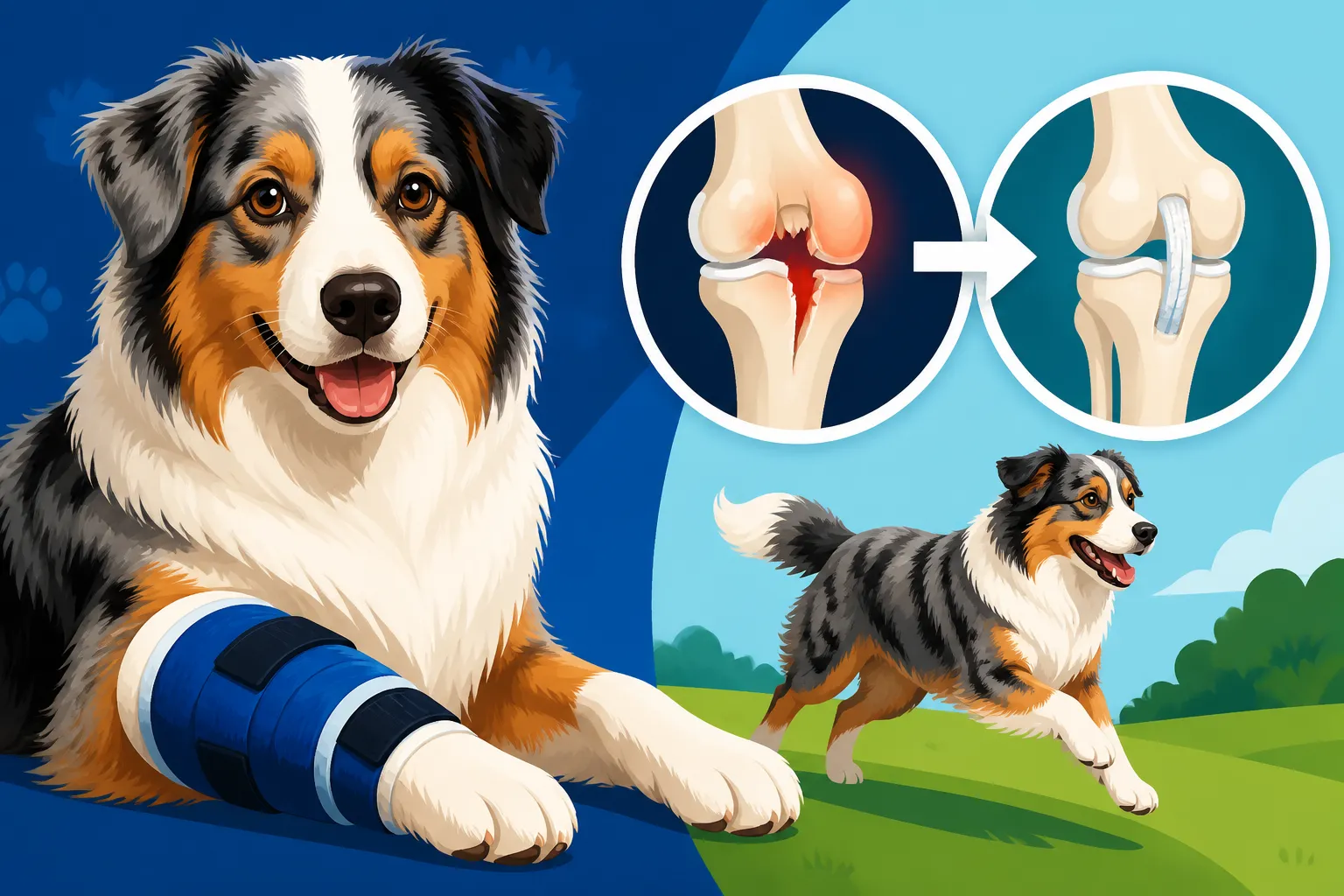
When a cruciate ligament tears, it creates instability in the knee. The shin bone can now slide forward, causing pain, inflammation, and preventing the leg from bearing weight properly. This instability also leads to abnormal wear and tear within the joint, eventually contributing to arthritis if not addressed. It’s a progressive problem, so understanding the mechanics helps you grasp why intervention is so important.
How Australian Shepherds Suffer Cruciate Ligament Injuries
Australian Shepherds are athletes. They are built for speed, agility, and quick changes in direction, whether they're rounding up sheep, flying over agility jumps, or darting after a frisbee. This very athleticism, while a hallmark of the breed, also predisposes them to certain orthopedic injuries. A torn cruciate ligament is unfortunately high on that list.
Picture your Aussie launching themselves off a dock after a toy, or making a sharp, pivot turn in a herding trial. All that force and torque goes straight through their knee joints. While a single, traumatic event can certainly cause a tear, it's more common in Aussies for the ligament to weaken gradually over time. Imagine tiny micro-tears accumulating from years of high-impact activity. Then, one day, a seemingly innocuous jump or run is the straw that breaks the camel's back, and the ligament completely ruptures.
Factors contributing to this include genetics, body weight, and even conformation. An overweight Australian Shepherd, for example, puts far more strain on its knee ligaments with every step, increasing the risk. Sometimes, it's not just the cruciate itself. Issues like Australian Shepherd Hip Dysplasia and Working Joints or Aussie Elbow Dysplasia From Hard Turning can subtly alter a dog's gait, placing uneven stress on other joints, including the knees, leading to eventual injury. It's a cascade effect in some cases, where one joint issue can predispose another.
Recognizing the Signs of a Torn ACL in Your Aussie
Identifying a cruciate tear early is key to effective treatment. The most obvious sign is sudden, acute lameness. Your Aussie might completely refuse to bear weight on the affected leg, holding it up. They might only "toe-touch," meaning they gingerly place the very tips of their toes on the ground but put no actual weight through the limb.
Other common signs include:
- Limping: Persistent limping that doesn't improve with rest.
- Pain: Whining, reluctance to move, sensitivity when the leg is touched.
- Swelling: You might feel some swelling around the knee joint.
- Stiffness: Especially after rest, your Aussie might struggle to get up.
- Muscle Atrophy: Over time, if the leg isn't used, the thigh muscles will start to waste away, appearing thinner than the healthy leg.
- "Sitting Sideways": Instead of sitting squarely with both rear legs tucked under them, an Aussie with a torn cruciate might sit with the injured leg extended out to the side to avoid bending the knee.
If you notice any of these symptoms, especially if your Aussie has been active, it’s time for a vet visit. Early diagnosis means faster intervention and a better chance for a full recovery.
Diagnosing a Cruciate Tear and Weighing Treatment Options
When you bring your Aussie to the vet with suspected knee pain, the first thing they'll do is a thorough physical examination. They’re looking for specific indicators of a cruciate tear. This usually involves two key diagnostic tests, performed carefully to minimize discomfort for your dog.
The Cranial Drawer Test and Tibial Thrust
The Cranial Drawer Test is the gold standard for diagnosing a torn CCL. Your vet will stabilize the femur with one hand and try to move the tibia forward with the other. If the CCL is torn, the tibia will "draw" forward like a drawer opening, indicating instability. In some large, strong, or tense dogs, this movement might be subtle or require sedation to get an accurate reading.
The Tibial Thrust Test is another important diagnostic tool. This test involves flexing the ankle and applying pressure to the bottom of the foot, which causes the gastrocnemius muscle to contract and push the tibia forward. If the CCL is torn, the tibia will thrust forward. This test can sometimes be easier to perform on an awake dog than the cranial drawer test.
Beyond these manual tests, your vet will likely recommend X-rays. While X-rays don't show the ligaments directly, they are crucial for several reasons:
- Ruling out other issues: X-rays can identify fractures, tumors, or other bone abnormalities that might be causing lameness.
- Assessing arthritis: Over time, joint instability leads to arthritis. X-rays can show signs of degenerative joint disease, which helps in planning long-term management and understanding the chronicity of the injury.
- Surgical planning: For certain surgical procedures like TPLO, specific measurements from X-rays are essential for accurate planning.
Your vet will also examine the meniscus, which is a C-shaped cartilage in the knee. The instability from a torn CCL can often lead to tears in the meniscus, which need to be addressed during surgery for a successful outcome.
Non-Surgical vs. Surgical Approaches to Repair
Once a cruciate tear is confirmed, you'll be faced with a decision: non-surgical management or surgical repair. For most active, medium-to-large breed dogs like Australian Shepherds, especially if the tear is complete, surgery is almost always the recommended path for the best long-term outcome.
Non-surgical management typically involves strict rest, anti-inflammatory medications, pain relief, and possibly joint supplements or bracing. This approach might be considered for very small, sedentary dogs, or for partial tears if the instability is minimal. However, for an Aussie, particularly one with a high drive, conservative management often leads to continued instability, chronic pain, and progression of arthritis. The knee never truly stabilizes, and the risk of re-injury or tearing the other cruciate ligament remains high. For an active breed like an Aussie, this path rarely provides a satisfactory quality of life.
Surgical repair aims to stabilize the knee joint, reduce pain, and slow the progression of arthritis. There are several surgical techniques, each with its pros and cons, which we will explore in detail. The goal is always to get your Australian Shepherd back to a functional, pain-free life, allowing them to enjoy their natural athleticism once again. It's a significant undertaking, but for many Aussie owners, it's worth the investment for their dog's future comfort and activity levels.
Unpacking the Surgical Repair Options
When it comes to fixing a torn cruciate ligament in an Australian Shepherd, veterinarians typically recommend one of three primary surgical techniques. Each aims to stabilize the knee in a slightly different way, and the choice often depends on the dog's size, activity level, the surgeon's preference, and your budget.
Tibial Plateau Leveling Osteotomy TPLO
The Tibial Plateau Leveling Osteotomy (TPLO) is one of the most common and highly recommended surgeries for medium to large breed dogs, including active Australian Shepherds. It's a more advanced procedure that addresses the biomechanics of the knee.
Instead of trying to repair the torn ligament directly (which often fails because ligaments have poor blood supply and are under constant strain), the TPLO procedure changes the angle of the top part of the tibia (the tibial plateau). The surgeon makes a curved cut in the tibia, rotates the tibial plateau, and then reattaches it with a bone plate and screws. This rotation essentially neutralizes the "tibial thrust" – the force that causes the tibia to slide forward during weight-bearing – making the knee stable without needing an intact cruciate ligament.
Why TPLO is often preferred for Aussies:
- Excellent Stability: TPLO provides very stable results, allowing for a quicker return to full function for active dogs.
- Good for Large/Active Dogs: It's particularly effective for larger, athletic breeds that put a lot of force through their knees.
- Reduced Arthritis Progression: By eliminating instability, it can significantly slow down the development of secondary arthritis.
The downside: It's an invasive procedure, requiring precise bone cutting and implantation of hardware. Recovery is still lengthy, demanding strict activity restriction for several weeks.
Tibial Tuberosity Advancement TTA
Another popular surgical option, the Tibial Tuberosity Advancement (TTA), is also a bone-cutting procedure, but it differs from TPLO in its approach. Instead of changing the angle of the tibial plateau, TTA modifies the angle of the patellar tendon (the tendon that connects the kneecap to the tibia).
In a TTA, the surgeon cuts a section of the tibia where the patellar tendon attaches (the tibial tuberosity) and moves it forward. A cage or wedge is then placed to hold this section in its new, more advanced position, and a plate and screws secure it. This advancement changes the angle of pull of the quadriceps muscle, which, similar to TPLO, effectively neutralizes the tibial thrust and stabilizes the knee.
TTA advantages for Aussies:
- Less Invasive Bone Cut: The bone cut is generally considered less complex than TPLO by some surgeons.
- Rapid Initial Recovery: Some studies suggest dogs may bear weight more quickly in the immediate post-operative period.
- Good Outcomes for Active Dogs: Like TPLO, it generally offers excellent stability for active breeds.
Considerations: While often effective, the choice between TPLO and TTA can sometimes come down to surgeon preference and the specific anatomy of your dog's knee. Both are major surgeries and require specialized equipment and expertise.
Lateral Suture Extracapsular Repair
The Lateral Suture (Extracapsular Repair), sometimes referred to as a "fishing line" technique or a "fascial strip," is a less invasive and often less expensive option compared to TPLO or TTA. This procedure doesn't involve cutting bone but instead uses an artificial ligament placed outside the joint capsule to mimic the function of the torn cruciate ligament.
The surgeon uses a strong, non-absorbable suture material (often made of nylon or similar synthetic material) or a strip of the dog's own fascia (tough connective tissue) to connect the lateral fabella (a small bone behind the femur) to a hole drilled through the tibia. This suture material helps to prevent the cranial drawer movement and stabilizes the knee while scar tissue forms around it, providing long-term support.
When Lateral Suture might be considered for an Aussie:
- Smaller, less active Aussies: While still an active breed, if your Aussie is on the smaller side or has a lower activity level, this might be an option.
- Cost: Generally less expensive than TPLO or TTA.
- Less Invasive: No bone cutting involved, potentially leading to a shorter surgical time.
Limitations:
- Less Robust Stability: For highly active or larger Aussies, the lateral suture may not provide the same long-term stability as TPLO or TTA, with a higher risk of the suture breaking or stretching over time.
- Higher Re-injury Risk: There's a greater chance of the dog re-injuring the knee or tearing the other cruciate, especially if activity restrictions aren't meticulously followed during recovery.
- May Not Be Suitable for All Cases: If there's significant meniscal damage or extreme instability, a more aggressive approach might be necessary.
It’s crucial to have an open discussion with your veterinary surgeon about which option is best for your individual Australian Shepherd, considering their age, weight, activity level, and the specific nature of their injury.
Here's a quick comparison of these surgical techniques:
| Feature | TPLO (Tibial Plateau Leveling Osteotomy) | TTA (Tibial Tuberosity Advancement) | Lateral Suture (Extracapsular) |
|---|---|---|---|
| Mechanism of Action | Changes tibial plateau angle | Advances tibial tuberosity | Places artificial ligament outside joint |
| Bone Cutting | Yes | Yes | No |
| Cost | Higher | Higher | Lower |
| Ideal Candidate (Aussie) | Active, medium-large, athletic dogs | Active, medium-large, athletic dogs | Smaller, less active Aussies |
| Stability Achieved | Excellent, biomechanical | Excellent, biomechanical | Good, relies on scar tissue |
| Return to Function | Typically excellent, good long-term outcomes | Typically excellent, good long-term outcomes | Variable, potentially higher re-injury risk |
| Invasiveness | More | Moderate | Less |
The Road to Recovery After Aussie Knee Surgery
No matter which surgical path you choose, the recovery period after a cruciate ligament repair is extensive, demanding, and absolutely critical to your Australian Shepherd's long-term success. This isn't a quick fix; it's a marathon.
Immediate Post-Operative Care and Confinement
The first few days and weeks after surgery are all about strict rest and managing pain. Your Aussie will come home with pain medication, anti-inflammatory drugs, and possibly antibiotics. Administer these exactly as prescribed. Don't skip doses, even if your dog seems to be feeling better, as breakthrough pain can lead to increased activity and potential injury.
Key aspects of immediate post-op care:
- Crate Rest: This is non-negotiable. Your Aussie must be confined to a crate or a very small, secure room to prevent jumping, running, or twisting. This isn't just about pain; it's about allowing the surgical site to heal without disturbance. This can be challenging with a high-energy breed, but imagine the potential costs of re-injury if you don't adhere to the strict rest guidelines, especially if you have Australian Shepherd Insurance at $35 to $55 a Month that might not cover re-injuries due to negligence.
- Leash Walks Only: For bathroom breaks, your Aussie should be on a short leash, gently guided outside and immediately back inside. No off-leash time, no running, no stairs.
- Incision Care: Keep the incision site clean and dry. Watch for any signs of infection: redness, swelling, discharge, or foul odor. Your vet will instruct you on how to clean it. An Elizabethan collar (cone) will likely be necessary to prevent your Aussie from licking or chewing the incision, which can lead to serious complications.
- Cold Compresses: Your vet might recommend applying cold compresses to the knee for the first few days to help reduce swelling and discomfort.
This initial phase usually lasts for 2-4 weeks. It's tough, especially with an Aussie who thrives on activity, but it’s foundational for successful healing.
Rehabilitation and Gradual Return to Activity
Once the initial healing has occurred, typically around 4-6 weeks post-op, you'll begin the rehabilitation phase. This is where you gradually reintroduce controlled movement to help rebuild muscle, improve joint flexibility, and restore proper gait.
Components of rehabilitation:
- Physical Therapy: Often, a referral to a certified canine rehabilitation therapist is invaluable. They can guide you through specific exercises, such as passive range of motion, gentle massage, balancing exercises, and controlled leash walks on varied surfaces. Hydrotherapy (underwater treadmill) is often a fantastic option for Aussies, allowing them to exercise without putting full weight on the healing joint.
- Controlled Exercise Progression: This means slowly increasing the duration and intensity of walks. For example, starting with 5-minute leash walks and gradually extending to 10, then 15 minutes, over several weeks. Avoid any sudden movements, jumping, or rough play.
- Strength Training: As healing progresses, your rehab therapist will introduce exercises to strengthen the muscles around the knee, which are crucial for long-term stability. This might include gentle inclines, figure-eights, or specific balancing activities.
- Home Exercise Program: You'll be given exercises to do at home daily. Consistency is key here.
The entire rehabilitation process can take 4-6 months, and for some high-performance Aussies, it might be even longer before they are cleared for their previous activities. Rushing this process is one of the biggest mistakes owners make and can lead to re-injury or chronic lameness. Remember, a common issue like An Aussie Stiff After a Career in Agility can be exacerbated by insufficient post-op care.
Long-Term Management and Preventing Re-Injury
Even after a successful surgery and rehabilitation, vigilance is important for the rest of your Australian Shepherd's life. The other cruciate ligament has a significant risk of tearing, with some studies suggesting up to 50% of dogs will tear the opposite cruciate within 1-2 years.
Long-term considerations:
- Weight Management: Keeping your Aussie at a lean, healthy weight is paramount. Excess weight puts immense strain on all joints, including the repaired knee and the intact contralateral knee. This is why How Weight Multiplies the Load on Aussie Joints is such a critical factor.
- Joint Supplements: Glucosamine, chondroitin, MSM, and omega-3 fatty acids can help support joint health and manage inflammation, especially to combat the onset of Australian Shepherd Arthritis After Years of Work.
- Regular, Controlled Exercise: Continue with a consistent exercise routine that builds strength without excessive impact. Avoid activities that involve sharp turns, sudden stops, or high jumps, unless specifically cleared by your vet or rehab specialist. Think long, steady hikes or swimming rather than intense, unpredictable games of fetch.
- Monitoring for Lameness: Pay close attention to any subtle signs of lameness in either leg. Early detection of issues can lead to faster intervention.
- Routine Vet Checks: Regular check-ups with your vet will help monitor joint health and address any emerging concerns.
The goal is to keep your Aussie active and comfortable for many years to come. With proper care, most Australian Shepherds can return to a very high quality of life after cruciate surgery, though high-impact competitive sports might require careful consideration and management.
Potential Complications and Prognosis
While cruciate ligament surgery has a high success rate, it’s a major orthopedic procedure, and like any surgery, it comes with potential risks and complications. Understanding these can help you be better prepared during your Aussie's recovery.
Common and Serious Complications
- Infection: Any surgery carries a risk of infection at the incision site or around the implants (plate and screws). Signs include excessive redness, swelling, warmth, discharge, or fever. Antibiotics are usually prescribed to minimize this risk, but severe infections may require further intervention.
- Implant Failure: Although rare with modern techniques and materials, plates or screws can loosen, bend, or break. This usually necessitates another surgery to remove or replace the hardware.
- Meniscal Tears: Even if the meniscus was inspected and found healthy during the initial surgery, the continued altered biomechanics of the joint, even after stabilization, can sometimes lead to a secondary meniscal tear months or years later. This often results in a sudden onset of lameness again and may require a second, less invasive surgery (arthroscopy) to remove the damaged piece of cartilage.
- Anesthetic Risks: While generally safe, any anesthesia carries a small risk, especially for older dogs or those with underlying health conditions. Your vet will conduct pre-operative blood work to assess these risks.
- Continued Lameness or Arthritis Progression: Despite a successful surgery, some dogs may not regain 100% function, or may develop significant arthritis in the long term. This is often more pronounced if rehabilitation wasn't diligent or if the tear was chronic before surgery.
- Tearing the Contralateral Ligament: This is a very real and disheartening complication. As mentioned, many dogs will tear the cruciate in their other leg, often due to altered weight bearing and increased stress on the "good" leg during recovery. This is why rehabilitation and weight management for both legs are so important.
Prognosis and Life After Surgery
The good news is that the overall prognosis for Australian Shepherds undergoing cruciate ligament repair is generally very good to excellent, especially with TPLO and TTA procedures. Most Aussies regain significant function and can lead active, pain-free lives. Many return to their previous activities, though competitive sports may require careful discussion with your veterinary team and potentially some modifications.
Studies show that between 85% and 95% of dogs return to good or excellent function after TPLO or TTA. Lateral suture techniques also have good success rates, especially in appropriate candidates.
Factors influencing the prognosis include:
- Age and Weight: Younger, leaner dogs generally recover better.
- Severity of Injury: Dogs with meniscal damage or severe arthritis at the time of surgery may have a slightly longer or more challenging recovery.
- Adherence to Post-Op Instructions: This is perhaps the single most critical factor. Strict rest and diligent rehabilitation are paramount.
- Quality of Surgical Technique: Choosing an experienced, board-certified veterinary surgeon can make a significant difference.
It's a long journey, but seeing your Australian Shepherd running, playing, and enjoying life again after a knee repair is incredibly rewarding. Planning for these potential issues, and having a good pet insurance plan like those offered by Healthy Paws, can certainly alleviate some of the financial stress should complications arise, allowing you to focus on your dog's recovery.
The Role of Pet Insurance in Managing Costs
Cruciate ligament repair surgery is expensive, often ranging from $3,000 to $7,000 per knee, sometimes even higher in specialty centers. This cost typically includes the surgery, anesthesia, hospitalization, medications, and initial follow-up X-rays. Then, you have the added costs of physical therapy and long-term joint support. This is where pet insurance can be an absolute lifesaver.
Many pet insurance providers, including Healthy Paws, offer coverage for accidental injuries and illnesses, and cruciate ligament tears typically fall under this. If your Australian Shepherd is enrolled in a policy before the injury occurs, a significant portion of the veterinary bills can be reimbursed, dramatically reducing your out-of-pocket expenses.
However, it's crucial to understand the nuances of pet insurance:
- Waiting Periods: Most policies have waiting periods (e.g., 14 days for illness, 6 months for orthopedic conditions like cruciate tears). If you enroll your Aussie and they tear their cruciate during this waiting period, it won't be covered. This underscores the importance of getting insurance before problems arise.
- Pre-existing Conditions: If your Aussie had any signs or symptoms of knee instability before you enrolled them or before the waiting period expired, it would likely be considered a pre-existing condition and excluded from coverage. This is a common pitfall for owners.
- Deductibles and Reimbursement Rates: You'll typically pay a deductible each year or per incident, and then the insurance company will reimburse a percentage (e.g., 70%, 80%, or 90%) of the covered costs.
Knowing that you have financial support from a reliable provider like Healthy Paws can make the decision-making process for the best possible surgery and rehabilitation less stressful. It allows you to prioritize your Australian Shepherd's health and well-being without being solely driven by cost. If you're considering a working Australian Shepherd, or one active in sports, insuring them early is a very smart move to prepare for the unexpected.
Disclaimer
This article is intended for informational purposes only and does not constitute veterinary advice. Always consult with a qualified veterinarian for any health concerns or before making any decisions about your Australian Shepherd's medical care, especially regarding complex orthopedic procedures.