Group Class Against Private Aussie Training
Many Australian Shepherd owners find themselves at a crossroads when it comes to training, wondering whether the bustling environment of a group class or the focused attention of private sessions will best serve their intelligent, high-energy companion. It's a real dilemma, trying to figure out which approach will effectively harness that intense herding drive and ensure your Aussie grows into a well-adjusted, mannerly member of the family. This guide will meticulously break down the benefits and challenges of both group class and private training, helping you navigate these choices to find the perfect training path for your unique Australian Shepherd.
The Core Dilemma: Group Classes Against Private Training for Your Aussie
When you first bring home an Australian Shepherd puppy, or even an adult rescue, the sheer volume of training advice can feel overwhelming. You’ll hear enthusiastic recommendations for puppy kindergarten, followed by equally passionate arguments for one-on-one sessions with a certified professional. The truth is, there's no single "best" answer that fits every Aussie or every family. What works wonders for one dog might prove counterproductive for another, especially with a breed as complex and driven as the Australian Shepherd. Understanding the fundamental differences in these training environments is your first step toward making an informed decision.
Understanding Your Australian Shepherd's Unique Learning Style
Australian Shepherds are incredibly intelligent, eager to please (when motivated), and possess a strong work ethic. They thrive on structure, consistency, and having a "job" to do. Their natural herding instinct means they are keenly observant of movement, quick to react, and can be sensitive to their environment. This combination of traits means they often excel in training when the conditions are right, but can also quickly develop undesirable behaviors if their needs aren't met or if they become overstimulated. For instance, a highly reactive Aussie might find a busy group class overwhelming rather than beneficial for Socializing an Australian Shepherd Beyond the Farm, while a more laid-back dog might thrive on the varied distractions.
Their quick minds also mean they can pick up bad habits just as easily as good ones. If you're struggling with issues like Australian Shepherd Heel Nipping and How to Redirect It or an unreliable Australian Shepherd Recall Around Moving Things, the environment you choose for training can either exacerbate or resolve these tendencies. A successful training program acknowledges these inherent breed traits and is flexible enough to adapt to your individual dog's personality and any specific challenges they present.
Initial Considerations Before Choosing a Path
Before you even start looking for trainers, take a moment to honestly assess your Australian Shepherd and your own circumstances. What are your primary training goals? Are you looking for basic obedience, or do you need to tackle more complex behavioral issues like fearfulness or reactivity? How does your Aussie generally react to new people, dogs, and environments? Some Aussies are naturally more confident and outgoing, while others can be reserved or even anxious in unfamiliar settings.
Consider your personal availability and budget, too. Private training often comes with a higher per-session cost, but might offer faster, more targeted results. Group classes are generally more affordable and provide built-in socialization opportunities, but might move at a pace that doesn't suit your Aussie's individual learning speed. Think about where your Aussie is in their development, too. An Aussie puppy needs a different approach than an adolescent going through The Aussie Teenage Months and What Changes or a seasoned adult dog with ingrained habits.
Group Training Classes: Benefits, Challenges, and When They Shine
Group training classes are often the first recommendation for new puppy owners, and for good reason. They offer a structured environment where dogs and their handlers can learn basic obedience cues, practice manners, and, perhaps most importantly for a young Aussie, engage in controlled socialization. From puppy kindergarten to advanced obedience, these classes are a staple in the dog training world.
The Socialization Advantage and Controlled Environments
One of the biggest advantages of a well-run group class is the opportunity for controlled socialization. For an Australian Shepherd puppy, exposure to different sights, sounds, smells, people, and other puppies is absolutely crucial during their critical developmental window. In a group class, this exposure happens in a safe, supervised setting, which helps build confidence and appropriate social skills. Your puppy learns that other dogs aren't just playmates, but also exist as part of a learning environment. They learn to focus on you even with other dogs around, which is a foundational skill.
For an older Aussie, group classes can help maintain social skills or provide continued exposure to distractions. This is particularly valuable for a breed prone to being reserved with strangers, allowing them to gain comfort in busy settings. It teaches them that the world isn't just about herding everything that moves; it's also about calmly coexisting. Many group classes incorporate elements of The Aussie Puppy Curriculum Month by Month, ensuring a broad range of skills are covered.
Potential Drawbacks and Management Strategies
While socialization is a huge plus, it can also be a significant drawback if not managed correctly. An Australian Shepherd with a strong herding drive might become overly fixated on other dogs or people, trying to "collect" them rather than focusing on the handler. Some Aussies, especially those prone to Australian Shepherd Reactivity and Overarousal, might find the constant presence of other dogs and people too stimulating, leading to barking, lunging, or shutting down. In these cases, a group class can actually worsen reactive tendencies rather than improve them. You'll often see these dogs struggling to settle, constantly scanning the room, unable to relax.
Another challenge is the pace of group classes. They are designed to cater to a diverse group of dogs and owners, which means the instruction might move too quickly for some or too slowly for others. If your Aussie is a lightning-fast learner, they might get bored, leading to misbehavior. If they're a bit slower to grasp concepts, they might fall behind, causing frustration for both you and your dog. You, as the owner, also need to be prepared to actively manage your Aussie in a distracting environment, which can be a lot of pressure.
What to Look for in an Effective Group Class
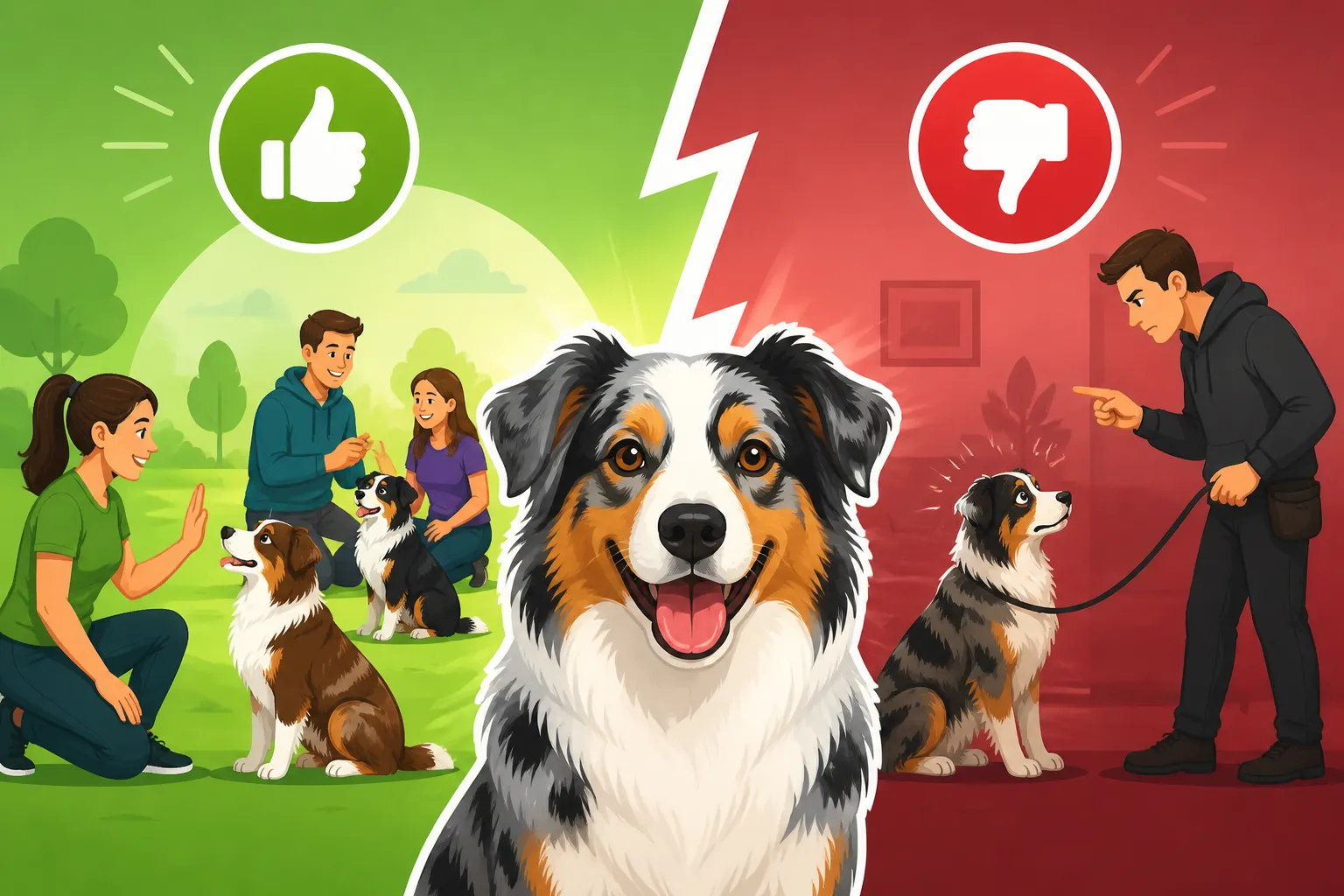
If you're considering a group class, vetting the trainer and the class structure is paramount. Look for small class sizes, ideally with a low student-to-instructor ratio, allowing for more individualized attention. The trainer should use positive reinforcement methods, focusing on rewarding desired behaviors rather than punishing mistakes. They should also be knowledgeable about breed-specific behaviors, especially the unique quirks of herding breeds like Australian Shepherds.
A good group class will prioritize safety and control, ensuring that all dogs are comfortable and not overwhelmed. They should offer clear boundaries and management strategies for dogs that are struggling. Don't be afraid to observe a class before enrolling your Aussie. Watch how the instructor interacts with the dogs and owners, how they manage distractions, and how they handle any behavioral issues that arise. Many reputable training facilities, often found with a quick search on Amazon for local dog training books, will allow this.
Private Training Sessions: Tailored Solutions and Focused Progress
For many Australian Shepherd owners, especially those dealing with specific behavioral issues or requiring a flexible schedule, private training sessions offer a highly effective alternative or supplement to group classes. These one-on-one sessions provide unparalleled personalized attention and a tailored approach that can address the nuanced needs of your Aussie.
The Power of Personalized Attention for Specific Issues
The standout benefit of private training is the ability to customize every aspect of the session to your Australian Shepherd. Instead of a generic curriculum, the trainer can focus entirely on your specific goals and your dog's individual learning pace and challenges. If your Aussie is particularly prone to Australian Shepherd Puppy Biting and Herding Nips that are getting out of control, a private trainer can work with you in your home environment, identifying triggers and teaching precise redirection techniques. They can observe your dog's behavior in its natural setting, which often reveals insights that wouldn't be apparent in a classroom.
This personalized approach means faster progress on targeted behaviors. You're not waiting for other dogs to catch up, nor is your Aussie getting overwhelmed by distractions. The trainer can break down complex tasks into smaller, manageable steps, providing immediate feedback and adjusting their methods based on your Aussie's real-time responses. This can be invaluable for building a strong foundation of skills or troubleshooting stubborn issues.
Addressing Reactivity and Complex Behavioral Patterns
For Australian Shepherds struggling with reactivity, fear, or anxiety, private training is often the more appropriate starting point. A reactive Aussie that barks or lunges at other dogs or people in a group setting won't learn effectively; they'll simply be over their threshold, reinforcing the negative associations. A private trainer can work with you to understand the root cause of the reactivity, implement desensitization and counter-conditioning protocols, and build your Aussie's confidence in a controlled, low-stress environment. They can teach you strategies like working your Aussie "under threshold," gradually exposing them to triggers at a distance where they remain calm and responsive.
Complex issues such as separation anxiety, resource guarding, or significant noise phobias are also best addressed in private settings. These behaviors often require a deep dive into the dog's daily routine, home environment, and specific triggers, which a group class simply isn't equipped to provide. A trainer can develop a comprehensive behavior modification plan, guiding you through each step and adjusting as needed. This type of intensive support can be life-changing for both you and your Australian Shepherd. Programs like BAXTER & Bella, for example, offer extensive online resources and personalized coaching that can mimic aspects of private training, giving you access to expert guidance from home.
Cost Considerations and Long-Term Value
There's no denying that private training sessions typically come with a higher per-hour cost than group classes. A single private session might cost as much as a multi-week group course. However, it's essential to consider the long-term value. With focused, personalized instruction, many owners find they achieve their training goals more efficiently, potentially requiring fewer total sessions to see significant improvement. This can actually save money in the long run by preventing escalation of behavioral problems that would eventually require more extensive and costly intervention.
Furthermore, the skills you learn in private training are often more transferable to real-world situations because they're taught in context. You're not just learning how to make your dog sit in a quiet classroom; you're learning how to manage their impulses during a walk in the park or how to settle them when guests arrive. This investment in foundational skills and problem-solving techniques empowers you as an owner to continue training and addressing new challenges independently. When considering private training, asking about package deals or online support (like those offered by BAXTER & Bella) can sometimes make the cost more manageable.
| Feature | Group Training Classes | Private Training Sessions |
|---|---|---|
| Environment | Structured, public setting with other dogs/people | One-on-one, often in home or quiet public spaces |
| Socialization | Built-in (if managed well), exposure to distractions | Limited direct interaction, focused on handler engagement |
| Curriculum | Standardized, covers basic to advanced obedience | Highly customized, targets specific behaviors/goals |
| Pace | Set by instructor for the group | Flexible, adapts to individual dog's learning speed |
| Cost | Generally lower per session | Higher per session, but potentially fewer total sessions |
| Ideal For | Basic obedience, confident puppies, general manners | Reactivity, complex behavior, fear, specific problem-solving |
| Distractions | High, beneficial for proofing behaviors | Controlled, gradually introduced |
| Owner Support | General advice, Q&A sessions | Intensive coaching, detailed plans, follow-up |
Making the Right Choice for Your Australian Shepherd and Your Lifestyle
Ultimately, the decision between group classes and private training, or perhaps a blend of both, depends on a careful evaluation of your Australian Shepherd's personality, your training goals, and your family's practical considerations. There's no shame in admitting one approach might be better suited than the other, and often the most successful training plans are dynamic, evolving as your Aussie grows and develops.
Assessing Your Aussie's Temperament and Needs
Start by taking an honest look at your Australian Shepherd. Is your Aussie a social butterfly who thrives on the energy of other dogs and people? Do they get overly excited or easily distracted? Do they show signs of fear or aggression in novel situations? For a naturally confident and outgoing Aussie puppy, a well-structured group class can be a fantastic way to develop manners and build social skills. They learn how to exist politely around other dogs, how to focus on you amidst commotion, and they get that crucial exposure to different stimuli.
However, if your Aussie is more reserved, anxious, or exhibits reactive behaviors – perhaps lunging at dogs on leash or barking excessively at strangers – a group class might be overwhelming and even detrimental. For these dogs, private training offers the safety and control needed to build confidence and address underlying issues without triggering a meltdown. A private trainer can help you understand Australian Shepherd Reactivity and Overarousal and give you the tools to manage it effectively before attempting a more stimulating environment. Sometimes, a series of private sessions can provide the foundation needed for an Aussie to eventually thrive in a group setting.
Evaluating Your Own Time and Budget
Your personal schedule and financial situation are also crucial factors. Group classes typically have fixed schedules, requiring you to commit to specific days and times for several weeks. This can be challenging for busy households, but the lower cost often makes it a more accessible option. Many people find the camaraderie with other dog owners in a group setting to be an added bonus, creating a supportive community.
Private training, while more expensive per session, offers unparalleled flexibility. You can often schedule sessions around your availability, and the trainer might even come to your home, saving you travel time. This can be particularly beneficial if you have a demanding job or an unpredictable schedule. Remember, investing in private training for specific, challenging behaviors can prevent bigger, more expensive problems down the road. If you are struggling with The First Year Mistakes Aussie Owners Make, a private trainer can provide rapid course correction.
Combining Approaches for Comprehensive Training
Don't feel limited to choosing just one path! For many Australian Shepherd owners, the most effective strategy is a combination of both group and private training. You might start with private sessions to address foundational obedience, work through specific behavioral quirks, or build confidence in a shy dog. Once your Aussie has a solid understanding of cues and is comfortable in various situations, you can then transition to group classes for continued socialization, proofing behaviors amidst distractions, and exploring advanced skills or even dog sports like agility.
For example, you could work with a private trainer to address Australian Shepherd Recall Around Moving Things in your local park, then enroll in a group class to generalize that recall around other dogs. Or, if your Aussie needs extensive work on polite greetings with strangers, private sessions could lay the groundwork before you introduce them to a more public setting. Think of it as building a strong foundation with private support, then expanding and solidifying those skills in a group dynamic. Using resources like online courses or trainers (such as BAXTER & Bella) in conjunction with hands-on classes or private sessions can also offer a robust and flexible training program tailored to your unique Aussie.
Disclaimer
This article is for general informational purposes only and does not constitute professional advice. Laws, prices and regulations vary by location and change over time. Consult a qualified professional for guidance on your specific situation.