Indoor Enrichment for a Housebound Aussie
Oh, the sheer challenge of having an Australian Shepherd with all that boundless energy and brilliant mind, only to find yourselves stuck indoors! Whether it's a stretch of brutal winter weather, an unexpected injury sidelining your active pup, or simply living in a situation where daily vast open spaces aren't an option, seeing your Aussie pace with that restless glint in their eye can be truly heartbreaking and frustrating. This guide is all about transforming that indoor confinement into an opportunity for rich, engaging mental stimulation, ensuring your housebound Aussie remains happy, well-behaved, and fulfilled, even when the great outdoors is temporarily off-limits.
Understanding the Australian Shepherd's Need for Mental Stimulation
Let's be real: an Australian Shepherd isn't just a pretty face with striking eyes. They are a powerhouse of intelligence, bred for centuries to work alongside humans, herding livestock with keen observation and lightning-fast decisions. This isn't a breed content to simply chew a bone and nap all day, even on a rainy afternoon. Their minds are constantly seeking problems to solve, and without appropriate outlets, that mental energy can quickly turn into destructive behaviors, incessant barking, or anxiety. It's a fundamental part of who they are, woven into their very DNA.
Why Physical Exercise Alone Never Settles an Aussie
Many Aussie owners, bless their hearts, try to wear their dogs out with endless games of fetch or long runs. And yes, physical exercise is absolutely crucial for their well-being. But if you've ever come home from an hour-long dog park session only to find your Aussie still pacing, pushing a toy into your lap, or looking like they haven't run a step, you've witnessed the truth: physical exertion is only half the equation. It's like trying to exhaust a brilliant human by making them run laps without ever engaging their brain – they'll be physically tired, but mentally wired and probably quite bored.
An Australian Shepherd's heritage as a working dog means their brain is built for complex tasks. They thrive on challenges that require problem-solving, focus, and decision-making. Simply running around doesn't tap into those deeper cognitive needs. Without mental work, they can become overstimulated, anxious, and even more energetic because their minds are still buzzing. It’s a common misconception that a tired dog is a good dog, but for an Aussie, it needs to be mentally tired, too. In fact, sometimes too much unstructured physical exercise can actually make them more wired, not less. For more on this, check out Why Physical Exercise Alone Never Settles an Aussie.
The Herding Instinct That Demands a Job
That unwavering gaze, the low crouch, the sudden burst of speed – these are all manifestations of the deeply ingrained herding instinct in your Australian Shepherd. They were designed to move and manage livestock, often anticipating movements and reacting swiftly without direct command. This isn't just a physical trait; it's a cognitive imperative. When they don't have sheep to "manage," they'll often find other things: your children, the cat, the vacuum cleaner, or even you. And while it might be adorable for a moment, constantly trying to "herd" household members can become a nuisance, or even unsafe.
Providing indoor mental enrichment channels this instinct into acceptable and fulfilling activities. Instead of trying to suppress it – which is largely impossible, as you cannot train out their core nature – we can redirect it. Imagine their brain as a powerful computer designed for complex calculations; if it's left idle, it might start running background processes that cause errors or freeze the system. Giving them a "job" indoors, even if it's just figuring out a puzzle, satisfies that innate drive to engage and control their environment in a productive way. Without it, you’ll see manifestations like constant heel nipping, or rounding up family members. Read more about The Australian Shepherd Herding Drive You Cannot Train Out.
The Mental Toll of Under-Stimulation
Living with an under-stimulated Australian Shepherd can feel like navigating a minefield. You might come home to chewed furniture, scratched doors, or a house that smells vaguely of "doggy boredom." Barking, digging in forbidden places (like your couch cushions), frantic pacing, or even showing signs of anxiety like excessive licking are all common symptoms. It's not defiance; it's distress. Your Aussie isn't trying to be naughty; they're genuinely suffering from a lack of appropriate mental outlets.
Think about how you feel when you're bored stiff and have nothing challenging to do. Now imagine you also have boundless energy and the cognitive capacity of a canine genius. It's a recipe for chaos. The mental toll impacts their overall well-being, leading to stress, poor sleep, and a general state of unease. Investing in indoor enrichment isn't just about saving your furniture; it's about safeguarding your dog's mental health and fostering a calm, happy companion. When an Aussie finds their own "job," it's rarely one you appreciate.
Engaging the Aussie Brain with Puzzle Toys and Interactive Feeders
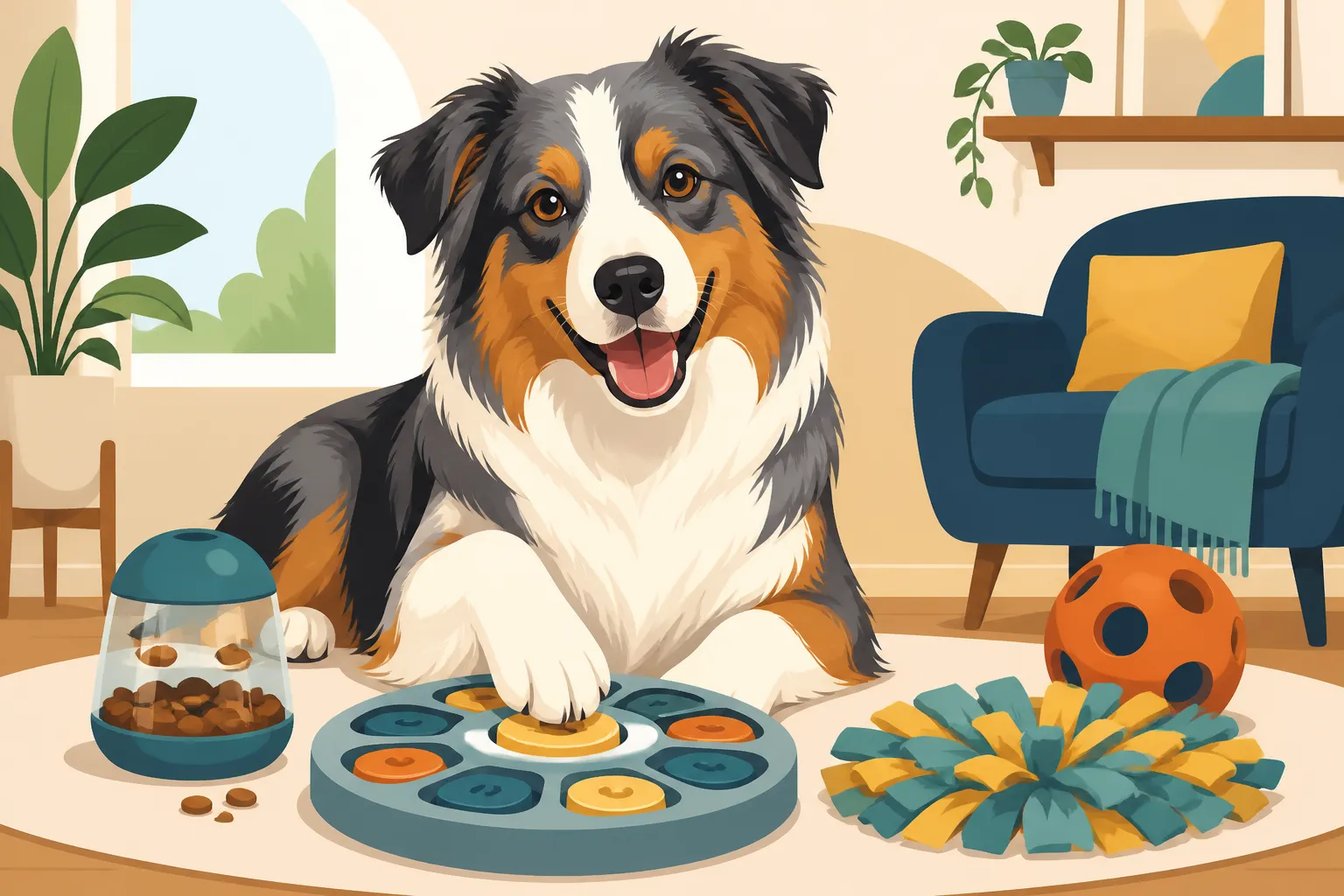
One of the most effective and accessible ways to engage your Australian Shepherd's brain indoors is through puzzle toys and interactive feeders. These aren't just toys; they're tools that turn mealtime and treat time into mental scavenger hunts, forcing your Aussie to think, strategize, and work for their reward. The satisfaction they get from "solving" the puzzle and getting the food is immensely gratifying and genuinely tiring in a way that running a mile often isn't.
Types of Puzzle Toys and Their Benefits
The world of puzzle toys for dogs has exploded, offering a fantastic range of options to suit different challenge levels and dog personalities. You'll find everything from simple treat-dispensing balls to multi-stage puzzles requiring multiple steps to unlock the goodies.
- Dispensing Balls/Kongs: These are often the entry point. A classic Kong, stuffed with kibble or peanut butter, can keep an Aussie occupied for a good while. Similarly, a treat-dispensing ball, where kibble falls out as it's rolled, encourages movement and persistent problem-solving. These are great for solo play and can easily be found on sites like Chewy or Amazon.
- Slider Puzzles: These often feature compartments that your dog has to slide, lift, or rotate to reveal hidden treats. Brands like Nina Ottosson (available on Amazon) make a wide variety, from beginner levels to advanced brain teasers. They require more fine motor skill and strategic thinking than a simple rolling toy.
- Snuffle Mats: These fabric mats with many folds and pockets are perfect for hiding dry kibble or small treats. Your Aussie has to use their nose and paws to "snuffle" out every piece, engaging their powerful sense of smell and providing a satisfying foraging experience. Puzzle Feeders That Slow an Australian Shepherd offers more insights into why these are so effective.
The key benefit here is that these toys demand patience and perseverance. An Aussie can't just gobble down their food; they have to earn it. This process not only tires them out mentally but also slows down their eating, which can be beneficial for digestion and helps prevent issues like bloat.
Incorporating Mealtime into Enrichment
Don't just pour your Aussie's kibble into a bowl! Every meal is an opportunity for mental enrichment. Instead of a two-minute chow-down, turn it into a fifteen to twenty-minute brain game.
- Spread the Kibble: Instead of a bowl, scatter your Aussie's entire meal across a clean floor, especially in a room with rugs or textured surfaces. This forces them to sniff out and pick up each piece, turning dinner into a natural foraging activity.
- Use All the Puzzles: Rotate through your collection of puzzle toys. Some days, their breakfast goes into a KONG Wobbler. Other days, their dinner is carefully placed into a complex slider puzzle. If you use a fresh food service like Ollie, portions can often be broken up and hidden in these same toys, though ensure they are easy to clean.
- "Find It" Games: Hide small piles of kibble or individual pieces around the house, starting in obvious spots and gradually making them harder. Use a "find it" cue and let your Aussie hunt. This leverages their incredible scenting ability and gives them a purposeful task. This engages their natural hunting and seeking drive in a safe, controlled way.
By making mealtime a challenging activity, you're not only providing mental stimulation but also teaching patience and self-control. It makes food more valuable and the act of eating more engaging.
DIY Puzzle Ideas for Quick Solutions
You don't need to spend a fortune on fancy toys to provide enrichment. Many household items can be repurposed into engaging puzzles with a little creativity. These are great for when you need a quick activity or want to introduce your Aussie to the concept of working for food.
- Towel Roll-Up: Lay out a towel, sprinkle some kibble or small treats on it, then roll it up tightly. You can even tie a loose knot in the middle for an extra challenge. Your Aussie will have to unroll and manipulate the towel to get the food.
- Muffin Tin Game: Place kibble or treats in the cups of a muffin tin, then cover each cup with a tennis ball or a robust dog toy. Your Aussie has to figure out how to remove the obstacle to get the reward. This is a classic that many dogs adore.
- Cardboard Box Shredding: Place treats or a favorite chew toy inside an empty cardboard box (remove all tape and labels!). Let your Aussie tear it apart to get to the prize. This satisfies their natural urge to shred and chew in a constructive way. Supervise closely to ensure they don't ingest large pieces of cardboard.
These DIY options are fantastic because they use materials you likely already have and offer a unique texture and challenge compared to store-bought plastic toys. They prove that enriching your Aussie's life doesn't always require an elaborate setup or a big budget.
Scent Work and Nose Games to Tap Into Instinct
If there's one sense an Australian Shepherd relies on heavily in their work, it's their nose. While primarily sight-herders, their ability to gather information through scent is profound. Engaging this powerful sense can be incredibly taxing and rewarding for them, turning your home into a fascinating landscape of smells to explore. Scent work is surprisingly tiring for dogs, far more so than you might imagine. It demands intense focus and mental energy.
The Power of Scent for an Aussie's Brain
Think about how much information we gather visually. For a dog, especially an Australian Shepherd, their world is largely defined by scent. Every object, person, and animal has a unique olfactory signature. When they use their nose to track or locate something, they are processing a vast amount of data, piecing together a complex puzzle of smells. This is not just a casual sniff; it's a deep, concentrated mental effort.
Forcing your Aussie to engage their nose actively for a purpose fulfills a deeply instinctual drive. It grounds them, focuses their energy, and provides an immense sense of accomplishment. It's an activity that naturally calms and concentrates them, often leading to a truly relaxed state afterward, a kind of mental exhaustion that is profoundly satisfying. This is why Scent Games That Tire an Australian Shepherd are so effective. It gives their brain a meaningful "job" that leverages their evolutionary strengths.
Starting with Simple Hide-and-Seek Games
You don't need fancy equipment to begin scent work. You can start with simple games using their favorite treats or toys.
- Treat Toss and Find: In a quiet room, show your Aussie a highly valued treat. Then, toss it just a few feet away into some grass, behind a curtain, or under a chair, and say "find it!" Encourage them to use their nose to locate it. Start easy, making the hiding spots obvious, then gradually increase the difficulty.
- "Which Hand?" Game: Hold a treat in one hand, keep both hands behind your back, then present your closed fists. Let your Aussie sniff to tell you which hand holds the treat. When they indicate correctly (usually by touching or pawing the hand), open it and reward them. This builds focus and communication.
- Object Search: Use a favorite toy. Let your Aussie see and sniff it, then hide it in an easy spot while they watch. Give a "find it" cue. Once they understand the game, you can increase the hiding difficulty and eventually have them wait in another room while you hide the object.
These initial games build confidence and teach your Aussie that their nose is a powerful tool for getting rewards. They learn to trust their olfactory senses and enjoy the process of discovery.
Progressing to Formal Scent Work
Once your Australian Shepherd enjoys simple nose games, you can delve into more structured scent work, also known as K9 Nose Work or Scent Detection. This discipline teaches dogs to identify and locate specific target odors, much like police or military detection dogs.
- Target Odors: You can buy scent kits (often available on Amazon or Chewy) that contain essential oils like birch, anise, or clove, along with cotton swabs or Q-tips. The goal is to teach your dog that finding these specific scents leads to a reward.
- Container Searches: Start by hiding a scented Q-tip in one of several identical boxes or containers. Your dog learns to systematically search the containers until they locate the target odor, at which point you mark and reward them.
- Interior and Exterior Searches: As they progress, you can move to searching entire rooms, looking for the hidden scent source. Eventually, this can expand to vehicle searches or even outdoor areas, if appropriate.
Formal scent work is incredibly engaging and provides a profound mental workout. It's a fantastic way to bond with your Aussie, build their confidence, and provide an immense sense of purpose, especially when you can't get out for long, strenuous physical activities. Australian Shepherd Scent Work Titles discusses the potential for advanced training in this area.
Structured Training and Trick Sessions Indoors
Your Australian Shepherd is a highly intelligent breed that thrives on learning. Training isn't just about obedience; it's a mental gym for their brains. Short, frequent training and trick sessions indoors can be just as tiring, if not more so, than a long walk, especially when you're focusing on new behaviors or refining old ones. It uses their cognitive abilities, memory, and problem-solving skills, all while strengthening your bond.
Short, Frequent Training Bursts
Forget long, tedious training sessions that bore both you and your dog. For an Australian Shepherd, especially when housebound, short and frequent bursts of training are far more effective. Aim for 5-10 minute sessions, scattered throughout the day. This keeps them engaged, prevents mental fatigue, and allows for better retention.
- Focus on Fundamentals: Even if your Aussie knows "sit," "stay," and "down" perfectly, practice them in new ways. Ask for a "down-stay" for a longer duration, or practice "sit" from a distance. The challenge isn't just the command, but the context.
- Proofing Behaviors: Work on behaviors they already know but under distraction. Can they "stay" while you walk around the room? Can they "leave it" when a tempting toy rolls past? These seemingly simple adjustments require significant mental effort.
- Use High-Value Rewards: Keep their motivation high with treats they truly adore. Small pieces of cheese, cooked chicken, or even their favorite kibble (if they're very food motivated) can make a huge difference. For more ideas on how to make training effective, consider Trick Training as Aussie Mental Work.
These micro-sessions not only provide mental stimulation but also reinforce your leadership and communication, making your Aussie a more responsive and well-mannered companion. It's a wonderful way to connect when outdoor adventures are limited.
Teaching New Tricks for Mental Workout
Beyond basic obedience, teaching your Australian Shepherd new tricks is a fantastic way to challenge their intellect and keep them entertained. Aussies are often quick learners and love to show off their skills, making trick training a rewarding experience for both of you.
- "Spin" and "Twirl": These are simple but fun. Lure your Aussie in a circle with a treat, adding the verbal cue.
- "Bow": Lure their nose to the ground while keeping their rear up, rewarding the distinct "bow" posture.
- "Weave Through Legs": With practice, you can teach them to weave between your legs as you walk, a great indoor activity that incorporates movement and coordination.
- "Find Your Leash/Toy": Teach them to retrieve specific items by name. Start by naming the item as they pick it up, then gradually introduce a "find [item]" cue.
There are countless tricks you can teach, from opening doors to putting toys away. The process of learning, figuring out what you want, and performing the behavior uses multiple cognitive functions, leading to genuine mental fatigue. Sites like Chewy or Amazon have plenty of books and videos on trick training to inspire you. Plus, teaching tricks builds a repertoire of fun ways to show off their smarts and keeps their brains sharp as they age.
Cooperative Care and Calm Handling Training
Training isn't just about flashy tricks; it's also about fostering a cooperative and calm attitude towards routine care. Many Aussies can be sensitive to handling, and building positive associations indoors can be incredibly beneficial. This is a unique form of mental work that focuses on trust and self-control.
- Paw Handling: Practice touching their paws, spreading their toes, and even mock nail trimming with nail clippers (without actually clipping). Reward for calm acceptance. This can significantly reduce stress during actual nail trims.
- Brushing Sessions: Turn brushing into a positive experience. Use a soft brush and offer treats for calmly standing or lying still. Focus on short sessions, especially for sensitive areas like their legs or tail. Australian Shepherd Ear Cleaner and Grooming Supplies can be useful here.
- Mouth and Ear Checks: Practice looking in their ears and gently opening their mouths, rewarding heavily for their cooperation. This makes vet visits and dental care much less stressful.
These cooperative care sessions teach your Aussie to tolerate and even enjoy handling, which is crucial for their long-term health and your peace of mind. It's a mental exercise in patience and trust, helping them learn that good things happen when they are calm and still. This type of training is essential for the comfort and safety of both you and your Aussie.
Incorporating Calmness and Relaxation into the Day
While Australian Shepherds are known for their high energy, it's equally important to teach them how to be calm. For a housebound Aussie, simply providing high-energy mental games isn't enough; they also need to learn to switch off and relax. This skill is vital for preventing overarousal and ensuring they truly settle down after their enrichment activities. It's about balance, teaching them that quiet time is also a valued part of their day.
Mat Settle Training for a Restless Aussie
"Mat settle" or "place" training is an invaluable skill for an Australian Shepherd, especially one with a tendency to constantly seek action. It teaches them to go to a designated spot (a mat, bed, or crate) and calmly remain there, even amidst activity. This isn't just obedience; it's an exercise in impulse control and self-regulation.
- Introduce the Mat: Start by luring your Aussie onto their mat with a treat. As soon as all four paws are on it, mark (with a verbal cue like "yes" or a clicker) and reward. Repeat many times.
- Duration and Distance: Once they willingly go to the mat, start asking for short durations (a few seconds) before rewarding. Gradually increase the time they need to stay, then the distance you can move away from them.
- Add Distractions: Once they are solid on the mat in a quiet room, introduce mild distractions: you walking by, someone else moving in the room, a dropped item. Reward heavily for maintaining their calm "stay."
A solid mat settle is a lifesaver for managing an Aussie indoors. It provides them with a clear "off switch," giving them a designated place to chill out instead of pacing or demanding attention. Mat Settle Training for a Restless Aussie provides a deeper dive into this beneficial training. When an Aussie can settle, they’re truly resting, rather than just waiting for the next thing.
Enforced Naps for an Overtired Aussie Puppy
Just like human toddlers, Aussie puppies (and even some adolescents) can become overtired and cranky, leading to nipping, zoomies, and general mischief. They often don't know how to self-regulate their energy, especially when their environment is constantly stimulating. Enforced naps are a crucial tool to teach them how to rest.
- Recognize Overtiredness: Look for signs like increased nipping, frantic energy, ignoring commands, or a glazed-over look. These often mean they're past their prime and need a break, not more play.
- Crate as a Sanctuary: If your Aussie is crate-trained, use the crate as their designated nap space. It's a quiet, safe haven where they can decompress without sensory overload. Cover the crate with a blanket to make it den-like.
- Scheduled Downtime: Build enforced naps into your daily schedule. For puppies, this might mean an hour or two in their crate after an active play or training session. For older dogs, it might be a structured "quiet time" on their mat.
Don't feel guilty about enforced naps. You're not punishing them; you're teaching them a vital life skill: how to relax and recharge. This helps prevent them from becoming overstimulated and anxious, fostering a calmer demeanor overall. More details on this can be found in Enforced Naps for an Overtired Aussie Puppy.
The Role of Chews and Lick Mats in Relaxation
Sometimes, the simplest things are the most effective for promoting calm. Long-lasting chews and lick mats provide a wonderfully satisfying and quiet form of enrichment that can occupy an Aussie for extended periods and tap into their natural soothing behaviors.
- Long-Lasting Chews: Offering a durable chew toy can be a fantastic way for an Aussie to de-stress. Chewing is a natural canine behavior that releases endorphins, making it inherently calming. Look for safe, species-appropriate chews (rawhides are often not recommended; opt for dental chews, bully sticks, or durable rubber toys that can hold paste). Many excellent options for Chew Toys That Last With an Australian Shepherd are available from retailers like Chewy.
- Lick Mats: These textured silicone mats (easily found on Amazon) are designed to have soft foods spread on them, like peanut butter (xylitol-free!), plain yogurt, pumpkin puree, or even canned wet dog food. The act of licking is incredibly soothing and can keep an Aussie happily engaged for quite a while, reducing anxiety and boredom.
These activities are perfect for times when you need your Aussie to be quietly occupied – perhaps while you're working, eating dinner, or just need a moment of peace. They provide low-impact mental stimulation and allow your dog to self-soothe through natural behaviors.
Creative Indoor Activities Beyond Toys
While puzzle toys, scent work, and training are cornerstones of indoor enrichment, there's a whole world of other creative activities you can explore to keep your Australian Shepherd engaged and happy. These often require a bit more direct interaction from you but can be incredibly rewarding and help strengthen your bond.
Indoor Agility or Obstacle Courses
You don't need a sprawling backyard or professional equipment to set up a fun, engaging agility course indoors. Your living room or hallway can become a challenging playground with a little imagination. This is a fantastic way to burn off some physical and mental energy without ever stepping outside.
- Household Item Obstacles: Use cushions for jumps (keep them very low to protect joints, especially for young or older Aussies). Create tunnels with blankets draped over chairs. Weave poles can be made from broom handles or even just your legs.
- Short, Fast Runs: The key is to keep the "course" short and allow for fast, precise movements, rewarding accuracy and enthusiasm. Work on sending your Aussie around objects, over low barriers, and through designated spaces.
- Focus on Body Awareness: Indoor agility can help improve your Aussie's body awareness and coordination. Teach them to back up, circle around objects, and navigate tight spaces, all of which are excellent mental exercises.
Remember to prioritize safety. Keep jumps extremely low, avoid slippery surfaces, and always supervise closely. The goal isn't speed or height, but mental engagement and controlled movement. Even a few minutes of navigating a small course can leave an Aussie feeling accomplished.
Supervised Playdates with Compatible Dogs
Sometimes, the best enrichment comes from social interaction, even if it's limited to one-on-one play indoors. If your Australian Shepherd has a trusted, compatible canine friend (another well-mannered dog whose owner you know and whose vaccination status you trust), a supervised indoor playdate can be a wonderful mental and social outlet.
- Choose Wisely: Not all dogs are suited for indoor playdates. Both dogs need to be polite, calm, and have good impulse control. Avoid dogs that play too rough indoors or have resource guarding tendencies.
- Safe Space: Ensure you have enough clear space for them to play without bumping into furniture or causing damage. Pick up anything valuable or fragile beforehand.
- Short and Sweet: Keep playdates relatively short, perhaps 30-45 minutes. Supervise constantly and intervene if play becomes too boisterous or one dog seems overwhelmed. Provide breaks as needed.
Social interaction, even limited, can be incredibly enriching for an Aussie. It taps into their social instincts, requires them to read canine body language, and provides a different kind of mental engagement than solo activities. Just make sure the play is positive and controlled.
Rotating Toys and Activities to Maintain Interest
One of the biggest pitfalls of indoor enrichment is predictability. Australian Shepherds are smart; they'll quickly figure out the "puzzle" of a toy or game if it's always the same. To keep things fresh and engaging, you need to rotate your toys and activities.
- Create a Toy Library: Don't leave all your Aussie's toys out all the time. Instead, have a "toy library" where only a few are accessible at any given moment. Every few days or once a week, swap them out for different ones. This makes old toys feel new and exciting again.
- Vary the Routine: Don't stick to the exact same schedule or order of activities every day. Mix up when you do training sessions, when you offer puzzle toys, or when you play scent games. Variety keeps their minds active and prevents boredom.
- Introduce Novelty: Every now and then, introduce a truly new item or activity. This doesn't have to be a big purchase; it could be a new DIY puzzle, a new scent for nose work, or a novel way to use an existing toy. Even letting them play with a crinkly paper bag (under supervision!) can be a novel experience.
This rotational strategy is crucial because it leverages your Aussie's intelligence. By constantly presenting new challenges or reintroducing "forgotten" ones, you keep their brains actively working, anticipating, and solving, ensuring that their housebound days are filled with interesting mental work rather than dull repetition. Remember, An Aussie That Cannot Be Left With Nothing to Do will find its own (often destructive) ways to entertain itself if you don't provide structure.
Disclaimer
This article is for general informational purposes only and does not constitute professional advice. Laws, prices and regulations vary by location and change over time. Consult a qualified professional for guidance on your specific situation.