The Cost of Keeping a High-Energy Australian Shepherd Busy
It’s a common scenario: you bring home that adorable Australian Shepherd puppy, full of boundless energy and intelligence, only to realize a few months down the line that daily walks and a few tossed toys just aren't cutting it. Your furniture might start looking a little chewed, your yard might have new "landscaping" features, or your once-quiet evenings are now punctuated by insistent nudges for attention. The truth is, managing the incredible drive of an Australian Shepherd requires a significant investment, not just of time and effort, but also financially. This guide will walk you through the various costs associated with keeping your high-energy Aussie happy, healthy, and constructively busy, helping you budget for a truly fulfilling life together.
The Daily Exercise Debt: Beyond the Backyard Romp
Many new Aussie owners quickly learn that "a walk around the block" is barely a warm-up for these dynamic dogs. Australian Shepherds were bred to work all day, covering miles of varied terrain, making quick decisions, and intensely focusing on their tasks. This inherent drive doesn't simply disappear because they now live in a suburban home. Ignoring this need can lead to a host of behavioral issues, costing you more in the long run than simply meeting their exercise demands.
Fueling the Endless Energy Bank
When we talk about the cost of keeping an Australian Shepherd busy, a significant portion goes into literally fueling their engines. Active dogs burn more calories and require higher-quality nutrition to sustain their energy levels, support their joints, and maintain their incredible double coats. A generic kibble might seem cheaper upfront, but it often falls short in providing the dense nutrition an active Aussie needs, potentially leading to health issues or a dull coat that requires more costly supplements or veterinary care later.
Consider a brand like Ollie, which offers fresh, human-grade food tailored to your dog's specific caloric needs based on their activity level, age, and weight. While the monthly cost might be higher than traditional kibble, typically ranging from $60 to $120 or more depending on your dog's size and the plan, it can significantly contribute to their overall health and vitality, preventing costly health issues down the line. Beyond food, don't forget the endless supply of treats needed for training and reward during their busy day. These aren't just for pleasure; they're essential tools for shaping behavior and providing mental stimulation. Factor in another $20-$50 per month for quality training treats and dental chews to keep those busy mouths healthy.
Structured Exercise vs. Free Play
While a fenced yard is certainly a bonus, simply letting your Australian Shepherd out to "play" for an hour isn't the same as structured exercise. An Aussie needs a job, a purpose, and a chance to engage both their body and their mind. For a comprehensive look into what truly counts, check out our guide on Australian Shepherd Exercise at One to Two Hours a Day. This means dedicating specific time, often an hour or two daily, to activities that challenge them.
This might involve long, brisk hikes on varied terrain, sustained games of fetch or disc, or runs alongside a bicycle (once they're fully grown and conditioned). If you're hitting local trails, consider the cost of sturdy leashes, harnesses (like those from Ruffwear or Kurgo, often $40-$80), and even protective paw balm for rough surfaces. For cycling, a bicycle leash attachment can run another $50-$100. Even simple games of fetch can add up if your Aussie is a super chewer; investing in durable, high-quality balls and frisbees that won't disintegrate after a few sessions is key. Brands found on Chewy often have robust options, but expect to pay $10-$30 per item for toys designed to withstand an enthusiastic Aussie. Without this structured approach, you might find your Aussie inventing their own "jobs," which often involve herding your children, barking at everything that moves, or rearranging your garden.
Training and Socialization: Investing in a Well-Adjusted Aussie
Australian Shepherds are incredibly intelligent and eager to please, making them highly trainable. However, this intelligence also means they need consistent guidance and mental engagement from a young age. Training isn't just about teaching "sit" and "stay"; it's about building a strong relationship, channeling their natural instincts, and preventing common behavioral pitfalls. The initial investment in training pays dividends for their entire Australian Shepherd Lifespan Across Twelve to Fifteen Years.
Puppy Classes and Foundation Skills
The moment you bring home an Aussie puppy, the clock starts ticking on their socialization and foundational training. Puppy classes are invaluable for exposing your pup to new environments, people, and other dogs in a controlled setting. These classes typically cost between $150 and $250 for a 6-8 week course. Beyond basic obedience, these classes often introduce positive reinforcement techniques that are crucial for a sensitive and smart breed like the Aussie. Learning to communicate effectively with your dog early on can prevent frustration for both of you.
After puppy class, many owners move on to basic obedience, often another 6-8 week course costing a similar amount. These sessions help solidify commands, improve leash manners, and begin to address specific challenges like Australian Shepherd Puppy Biting and Herding Nips. Investing in a good long line (20-50 feet, $20-$50) is also essential for practicing recall in a safe, open area, especially as their prey drive and herding instincts begin to mature. Without this early, consistent investment, you risk developing an Aussie who is overwhelmed by new situations, leash reactive, or simply too headstrong for daily life.
Advanced Training and Addressing Specific Challenges
For an Australian Shepherd, foundational training is just the beginning. Their minds thrive on learning, and continuing education is not a luxury but a necessity for many. Advanced obedience, trick training, or even specialized classes like canine good citizen preparation can cost another $150-$300 per course. These further challenge their intellect and strengthen your bond.
If you encounter specific behavioral challenges, such as reactivity to other dogs, excessive barking, or resource guarding, you might need to consult a professional behaviorist or a certified positive reinforcement trainer. These specialized sessions can range from $75-$150 per hour for private lessons, or package deals might cost $400-$800. Some owners, realizing the immense energy their Aussie possesses, opt for "board and train" programs, which can be much more expensive, often starting at $1,500 and going up to $4,000+ for a several-week stay. While effective for some, it's crucial to research these programs thoroughly and ensure they align with positive, force-free training philosophies. Remember, finding a trainer who understands an Aussie's unique drive and working style, as discussed in Finding a Trainer Who Understands an Aussie, is paramount.
Dog Sports and Activities: Tapping into Instincts
For many Australian Shepherd owners, simply meeting their dog's energy needs through walks and fetch isn't enough. These dogs excel in a wide array of dog sports, which provide an invaluable outlet for their physical prowess and keen intelligence. Engaging in these activities isn't just fun; it's often essential for their mental well-being, providing a "job" that satisfies their innate desires.
Herding, Agility, and Beyond
It's impossible to talk about an Australian Shepherd's activities without acknowledging their powerful herding drive. This instinct is their operating system, and for many, giving them an outlet to express it is profoundly satisfying. Even if you don't live on a farm, there are opportunities to engage this instinct. Initial herding instinct tests or introductory lessons can cost $50-$100 per session. If your Aussie takes to it, ongoing lessons can be $30-$70 per session, with trials and competitions incurring entry fees of $20-$50 per class. This truly taps into The Australian Shepherd Herding Drive You Cannot Train Out.
Beyond herding, Australian Shepherds are stars in various other dog sports. Agility is a fantastic outlet for their speed, coordination, and problem-solving skills, with classes typically ranging from $150-$250 for a session and trial entry fees adding up quickly. Disc dog, flyball, dock diving, obedience, rally, and even scent work are all popular options. Each sport comes with its own set of costs, from specialized equipment to class fees and competition expenses. For more on these activities, check out Australian Shepherd Agility and Disc Sports. This isn't just about ribbons; it's about building confidence, focus, and a truly happy, fulfilled dog.
Equipment and Event Costs
Participating in dog sports isn't just about the training fees; it also involves investing in specific equipment. For agility, you might eventually want to purchase tunnels, weave poles, or jumps for home practice, which can be a significant upfront cost, ranging from a few hundred to over a thousand dollars for a full set. For disc dog, you'll need durable, dog-safe discs (around $10-$20 each, and you'll lose a few!). Scent work might require essential oil kits ($30-$80) and various hides.
Furthermore, if you decide to compete, the costs accumulate rapidly. There are entry fees for each class you enter, travel expenses if events are out of town, and potential overnight stays. Membership in various dog sport organizations (like AKC, ASCA, USDAA) can also incur annual fees of $30-$75. While these costs can seem substantial, the benefits to your Aussie’s mental and physical health, and the joy you both derive from working as a team, are often considered priceless by dedicated owners. It’s an integral part of Australian Shepherd Training and Sport Costs.
| Activity Type | Initial Setup Cost (Estimate) | Ongoing Monthly/Session Cost (Estimate) | Notes |
|---|---|---|---|
| Puppy/Basic Obedience | $150 – $250 (per course) | N/A (one-time course fee) | Essential foundation; includes basic manners & socialization. |
| Advanced Obedience | $150 – $300 (per course) | N/A (one-time course fee) | Builds on basics, prepares for CGC or more complex work. |
| Herding Instinct Test | $50 – $100 | $30 – $70 (per session) | Gauge natural talent, introduction to livestock. |
| Agility Classes | $150 – $250 (per course) | $150 – $250 (per course) | Excellent physical & mental outlet; requires coordination. |
| Scent Work/Nose Work | $150 – $200 (per course) | $150 – $200 (per course) | Utilizes natural sniffing ability; low physical impact. |
| Durable Toys | $50 – $150 (initial) | $10 – $30 (replacements) | Essential for daily enrichment and chewing; includes brands from Chewy. |
| Long Lines/Harnesses | $40 – $100 | N/A (durable) | Crucial for safe off-leash practice and control. |
Note: These are estimated costs and can vary significantly based on location, trainer reputation, and specific equipment choices.
Mental Enrichment: The Brain Work that Truly Tires an Aussie
Many people mistakenly believe that physical exercise alone is enough to wear out an Australian Shepherd. They'll run their Aussie for miles, only to find the dog still pacing the house, looking for "something to do." The truth is, mental work is often far more tiring for an Aussie than physical exertion. As our article Why Physical Exercise Alone Never Settles an Aussie points out, their brains need as much, if not more, stimulation than their bodies.
Puzzle Toys and Interactive Feeders
One of the most effective ways to provide mental enrichment is through puzzle toys and interactive feeders. These aren't just for fun; they make your Aussie use their brain to "hunt" for their food or treats, mimicking their natural foraging behaviors. Instead of gobbling down their meal in 30 seconds, a good puzzle feeder can extend mealtime to 15-20 minutes of engaging problem-solving. These can range in price from $15 for simpler models to $60 or more for complex, multi-stage puzzles. You'll likely need a few different types to keep things novel and challenging for your intelligent Aussie.
Brands like Kong, Nina Ottosson (available on Chewy), and Planet Dog offer a wide variety of durable puzzle toys. While the initial outlay might seem a bit much, these toys are an investment in your dog's mental health and can prevent destructive behaviors born out of boredom. Imagine the cost of replacing a chewed couch leg versus a $30 puzzle toy that keeps them happy. Rotate these toys regularly to maintain interest and challenge your Aussie's problem-solving skills. Don't underestimate the power of these tools to tire out a busy mind.
Scent Work and Trick Training
Beyond toys, structured mental activities like scent work and trick training are phenomenal for Aussies. Scent work, where dogs learn to identify and locate specific odors, is a natural fit for their keen noses and problem-solving abilities. You can start simply at home by hiding treats around the house, then progress to more advanced "nose work" classes or kits. Introductory scent work kits, including essential oils and scent vessels, might cost $30-$80.
Trick training, while seemingly just for fun, engages an Aussie’s brain in profound ways. Learning a new trick requires focus, patience, and a deep understanding of communication between you and your dog. You can find countless free resources online, or invest in trick training books or online courses (from $20-$100). The satisfaction your Aussie gets from mastering a new behavior is immense, and it uses up mental energy far more efficiently than just another game of fetch. This kind of brain work is truly what our article on Mental Work That Actually Tires an Australian Shepherd emphasizes. It's about giving them productive ways to engage their powerful intellect.
Professional Support: When You Need an Extra Hand
Life happens, and sometimes, even the most dedicated Australian Shepherd owner needs a little help. Whether it's a long workday, a busy schedule, or a behavioral hurdle that feels too big to tackle alone, professional support can be an invaluable part of keeping your high-energy Aussie well-adjusted and happy.
Daycare, Walkers, and Boarding Options
For those days when you simply cannot provide the intense stimulation your Aussie needs, doggy daycare or a professional dog walker can be a lifesaver. However, not all daycares are created equal, especially for a breed like the Australian Shepherd. You need a facility that understands and can handle their high energy and herding instincts, offering structured play and mental enrichment, not just a free-for-all. Quality daycares often charge $30-$50 per day, with package deals sometimes bringing the cost down. Look for places that offer activities like agility equipment, puzzle feeders, or individual training sessions. For more on finding appropriate care, refer to Daycares That Can Tire an Aussie Out.
Professional dog walkers can also be a great option, especially for a mid-day energy release. Rates typically range from $20-$35 for a 30-60 minute walk, depending on your location and the walker's experience. If you travel, finding appropriate boarding for an Aussie can be challenging. A standard kennel might not offer enough mental or physical exercise, leading to stress and behavioral setbacks. Look for boarding facilities that offer specialized programs for active breeds, often with higher rates ($45-$80 per night) but providing peace of mind that your Aussie is engaged and happy.
Behaviorists and Specialized Consultations
Despite all your best efforts, some Australian Shepherds develop behavioral issues that require expert intervention. This might stem from under-stimulation, past trauma, or simply an individual dog's temperament. Issues like intense reactivity, separation anxiety, or aggression need more than just basic obedience; they need a certified professional dog behaviorist.
These specialists have advanced education and experience in addressing complex canine behaviors. Initial consultations can range from $150-$300 for a detailed assessment, with follow-up sessions or training packages costing hundreds to thousands of dollars, depending on the severity and duration of the problem. While expensive, addressing these issues proactively can save your dog's quality of life and your sanity. It's often the last resort before considering rehoming, and a necessary investment to correct Australian Shepherd Behavior Problems From Under-Exercise. Choosing a reputable behaviorist who uses positive, science-based methods is crucial.
Gear and Gadgets: Essential Tools for an Active Lifestyle
Keeping an Australian Shepherd busy isn't just about activities; it's also about having the right tools for the job. From durable toys that withstand intense play to safety equipment for adventures, these items are essential investments for an active Aussie lifestyle.
Durable Toys and Training Aids
Let's be real: an Australian Shepherd can chew through an alarming number of "indestructible" toys. Investing in truly durable toys from the get-go will save you money (and frustration) in the long run. Brands like Kong, Nylabone, and Goughnuts offer lines specifically designed for power chewers. Expect to pay $15-$40 for individual toys, but they'll last significantly longer than cheaper alternatives. Rubber fetch toys, tug toys made from strong fabrics (like those found on Chewy), and puzzle feeders are staples. A good selection of these can easily run $100-$200 initially, and you'll need to replenish them as they wear out or get lost. For more insights on this, read Chew Toys That Last With an Australian Shepherd.
Beyond toys, various training aids can enhance your Aussie's busy life. A clicker ($5-$10) is a small but mighty tool for precise communication. High-quality training pouches ($15-$30) make it easy to carry treats on walks and during training sessions. A sturdy, well-fitting harness (rather than just a collar) is essential for comfortable and safe walks, especially if your Aussie has a strong pull, costing $30-$80. A long line, as mentioned earlier, is indispensable for recall practice in open spaces without sacrificing safety.
Safety and Tracking Equipment
For an active Australian Shepherd, safety is paramount, especially if they enjoy exploring off-leash in appropriate areas or have a tendency to bolt after moving objects. A reliable GPS tracker, such as those from Tractive or Fi Collar, can be a worthwhile investment, typically costing $50-$150 for the device plus a monthly subscription fee of $5-$15. This provides immense peace of mind, allowing you to track your dog's location in real-time, especially considering how easily an Aussie can get distracted by movement and disappear in pursuit.
Furthermore, a well-stocked first-aid kit designed for dogs is a must-have, especially if you're frequently hiking or participating in sports. This can cost $30-$70 to assemble with essentials like bandages, antiseptic wipes, and paw protection. Carrying water bottles and collapsible bowls ($10-$25) on every outing is crucial for preventing dehydration, particularly for a double-coated breed like the Aussie during warmer months. These items aren't just conveniences; they're essential for ensuring your adventurous Aussie stays safe and healthy through all their activities.
Long-Term Budgeting for an Active Australian Shepherd
Owning an Australian Shepherd is a long-term commitment, and the costs associated with keeping them busy evolve over their lifetime. It’s not just about the puppy years; their needs will shift as they age, and understanding these changes is vital for responsible ownership.
Anticipating Age-Related Activity Shifts
A young Australian Shepherd, between one and five years old, is typically at the peak of their physical and mental energy. This is often when the investment in dog sports, advanced training, and vigorous daily exercise is highest. As they mature, their needs might transition from high-impact sports to more thoughtful activities. A senior Australian Shepherd, typically after the age of ten, will still need mental stimulation and gentle exercise, but the type and intensity will change. Our guide on Senior Australian Shepherd Care After Ten delves into this in more detail.
While an older Aussie might not be competing in agility, they’ll still benefit from puzzle toys, scent games, and short, leisurely walks. However, new costs might emerge. Joint supplements (glucosamine, chondroitin, MSM) can run $20-$50 per month, and regular veterinary check-ups might become more frequent, with costs for managing arthritis or other age-related conditions. This means your "busy budget" shifts from high-energy activities to maintenance and comfort, which are equally important for their quality of life. Regular vet visits are important for early detection of issues like Australian Shepherd Arthritis After Years of Work. This proactive approach can help manage conditions before they become severely debilitating and expensive.
The Hidden Costs of an Under-Stimulated Aussie
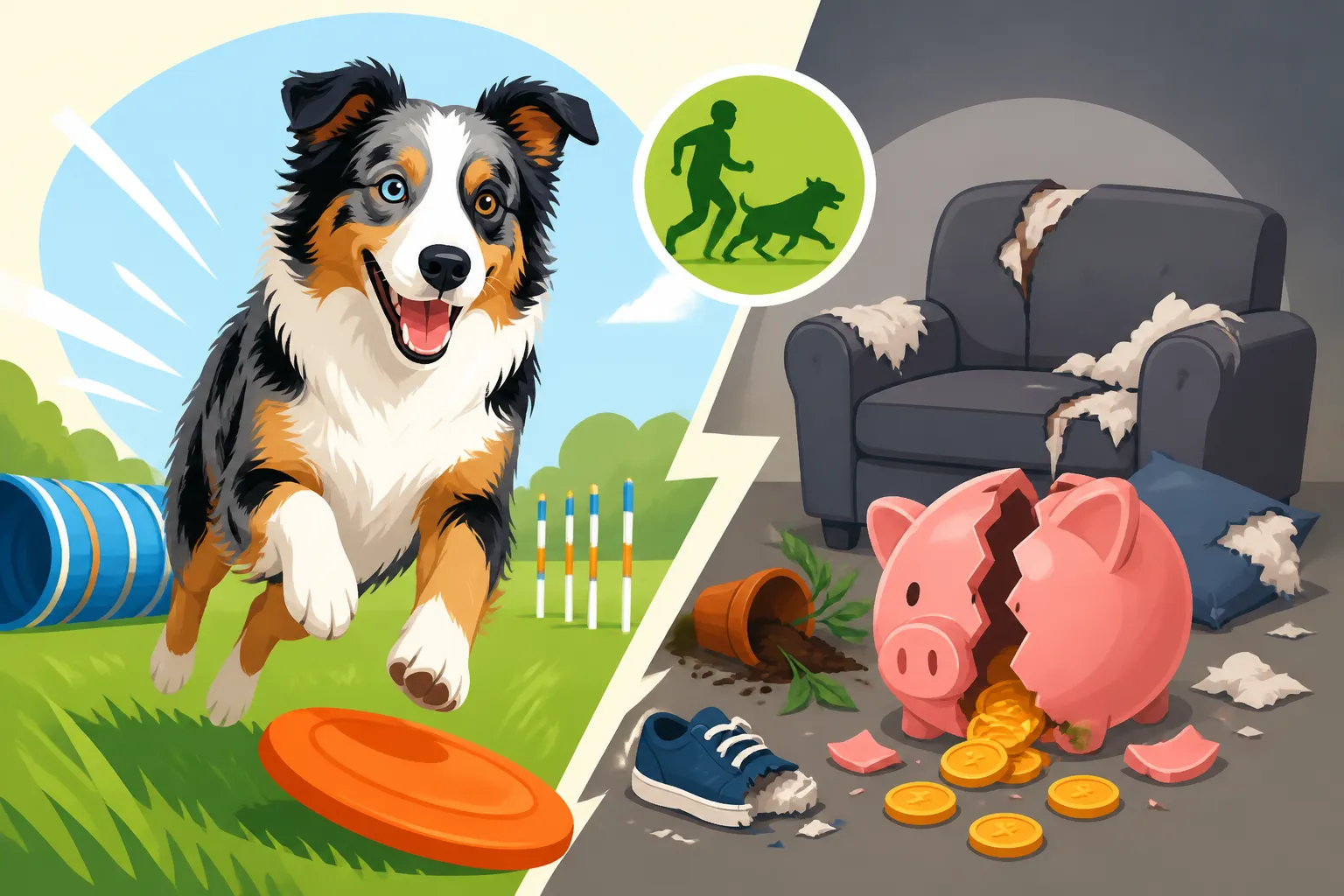
Perhaps the most significant long-term cost of owning a high-energy Australian Shepherd comes from not keeping them busy enough. An under-stimulated Aussie is a recipe for disaster, and the financial implications can be staggering. We've discussed this in An Aussie That Cannot Be Left With Nothing to Do. This can manifest as:
- Destructive Chewing: Replaced furniture, chewed shoes, damaged baseboards, or even destroyed carpets can quickly add up to hundreds or thousands of dollars.
- Excessive Barking: This can lead to complaints from neighbors, potential fines, or even the need for expensive behavioral modification to address the underlying anxiety or boredom.
- Escaping/Wandering: An Aussie driven by boredom or their herding instinct might find ways to escape fences, leading to costly vet visits for injuries, impoundment fees, or even the tragic loss of your beloved pet.
- Aggression/Reactivity: A frustrated, over-aroused Aussie can develop aggression towards other dogs or people, necessitating expensive behaviorist consultations, management tools like muzzles, and potentially even legal fees if an incident occurs.
- Vet Bills for Stress-Related Illnesses: Chronic stress and anxiety from under-stimulation can weaken an Aussie's immune system, leading to skin issues, digestive problems, or other stress-related conditions that require veterinary intervention.
In contrast, investing in activities, training, and enrichment, though seemingly costly, is often a preventative measure against these far more expensive and heartbreaking problems. It’s about more than just money; it's about giving your Australian Shepherd the life they were truly bred for. And when accidents do happen, or unexpected illnesses arise, having pet insurance from a provider like Healthy Paws can be a real financial buffer, helping with those unforeseen vet bills. While it adds to your monthly outgoings (typically $35-$55/month), it can save you thousands if your active Aussie sustains an injury or develops a chronic condition.
Disclaimer
As a veteran lifestyle blogger focused on Australian Shepherds, the information provided in this article is for general informational and educational purposes only and is not a substitute for professional veterinary advice. Always consult with a qualified veterinarian or certified dog trainer for any health concerns or before making any decisions related to your pet's care, diet, or training. Individual costs and needs can vary greatly.