Reading an Australian Shepherd Pedigree
When you're looking for an Australian Shepherd, or even just trying to understand your own dog's background, the sheer volume of information (or lack thereof) can feel incredibly overwhelming. Many new owners feel lost navigating breeder websites or dog databases, wondering what all those cryptic letters and numbers actually mean. This guide will walk you through how to properly read and interpret an Australian Shepherd pedigree, turning that confusing document into a valuable roadmap of your dog's heritage.
Decoding the Basics of an Australian Shepherd Pedigree
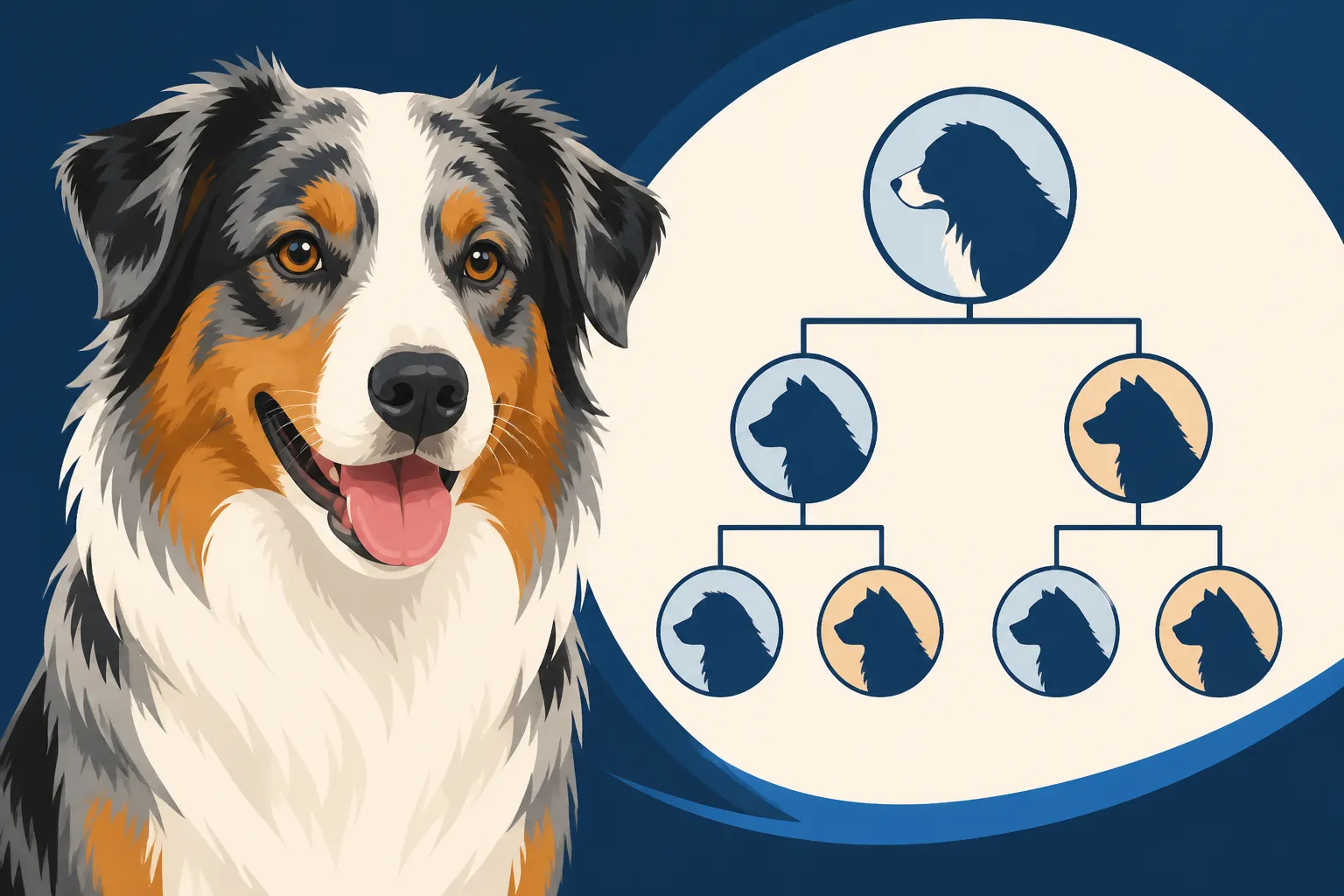
A pedigree, at its core, is simply a family tree for your dog. It traces back generations of ancestors, giving you a glimpse into the genetic contributions that shaped your Aussie. It’s far more than just a list of names; it’s a record of lineage, a key tool for responsible breeders, and an invaluable insight for any owner. Without understanding the fundamental structure, however, it can look like a jumble of random information.
Understanding the Generations Listed
Most standard pedigrees will display at least three to five generations, but some can go back even further, revealing distant relatives. Each horizontal line typically represents a generation. Your dog, the 'proband,' is at the far left. To its right, you'll see its parents (sire and dam), then its grandparents, great-grandparents, and so on. The further back you go, the more common ancestors you might find, which can highlight both the strengths and potential genetic bottlenecks within a particular line.
For example, imagine seeing a particular name pop up multiple times in different parts of the fourth or fifth generation. This could indicate a foundational dog in that line, a dog whose traits were highly valued and bred for. It's a double-edged sword: while consistency of desirable traits is great, it also means any inherent weaknesses that dog carried are more widely distributed. You're looking for patterns, for the individuals who were consistently used because they produced exceptional offspring. Knowing this can help you understand why your Australian Shepherd has certain strong instincts or physical characteristics.
Identifying Key Registration Information
Beyond the names, each entry on a pedigree will usually include vital registration numbers and sometimes birth dates. These numbers, often from registries like the American Kennel Club (AKC) or the Australian Shepherd Club of America (ASCA), are unique identifiers for each dog. Think of them like a social security number for canines; they link that specific dog to its official record.
The registration number is crucial because it's what you'd use to verify the dog's identity and its listed lineage with the respective registry. Reputable breeders will always provide these numbers, or at least be able to access them readily. If you're considering a puppy, asking for the parents' registration numbers allows you to independently confirm their identities and officially recorded heritage. Sometimes, you'll also see a 'call name' in addition to their registered name. The registered name is often a long, formal string of words that includes kennel names, while the call name is what the dog is affectionately known by at home. For instance, a dog might be registered as "Sunny Creek's Wild West Showdown" but go by "Maverick."
Beyond Names: Health Clearances and Genetic Results
The real meat of a valuable Australian Shepherd pedigree lies in its health information. Australian Shepherds are prone to certain genetic conditions, and a well-maintained pedigree will openly display the results of tests aimed at identifying these. This section is arguably the most critical for any prospective owner.
Locating Crucial Health Test Data
Responsible breeders don't just breed dogs; they breed healthy dogs. This means extensive health testing on all breeding stock, and these results should be documented on the pedigree. You'll typically find abbreviations or symbols next to a dog's name indicating various clearances.
Look for clearances from organizations like the Orthopedic Foundation for Animals (OFA) for hip and elbow evaluations, and the Canine Eye Registry Foundation (CERF), now often replaced by the Orthopedic Foundation for Animals (OFA) Eye Certification Registry, for eye examinations. For instance, an OFA "Good" or "Excellent" hip rating means that particular dog has hips that meet stringent health standards. "Normal" or "Clear" for eyes, often accompanied by a date, shows they've been checked for Hereditary Cataracts Clouding an Aussie Eye or Collie Eye Anomaly in an Australian Shepherd. The date of the eye exam is important, as some conditions can develop later in life. Always ask for these specific certifications. Australian Shepherd Hip Dysplasia and OFA Scoring can shed more light on these critical evaluations. If a breeder cannot provide proof of these clearances for multiple generations, that's a significant red flag.
Interpreting Genetic Panel Results Like MDR1 and CEA
Beyond structural and ocular health, Australian Shepherds are known for carrying certain genetic mutations that can profoundly impact their health and drug sensitivities. The pedigree should ideally reflect results from a comprehensive genetic panel.
The most famous of these is the Multi-Drug Resistance 1 (MDR1) mutation. This gene mutation affects how certain drugs are processed in the brain, and dogs with even one copy of the gene can be sensitive to common medications. On a pedigree, you might see "MDR1 N/N" (clear), "MDR1 N/M" (carrier), or "MDR1 M/M" (affected). Knowing this information for the parents, grandparents, and even further back helps you understand the likelihood of your puppy inheriting this sensitivity. The MDR1 Mutation Half of Australian Shepherds Carry explains this in more detail. Similarly, you'll look for Collie Eye Anomaly (CEA) results (e.g., "CEA N/N," "CEA N/M," or "CEA M/M"), as this is another inherited eye condition prevalent in Aussies. Other genetic tests often included are Hereditary Cataracts (HSF4), Progressive Retinal Atrophy (PRA-PRCD), and Degenerative Myelopathy (DM). The Genetic Panel Every Australian Shepherd Needs is a great resource to understand what tests are crucial.
It's not just about getting a "clear" dog. Understanding if a dog is a "carrier" (N/M) is vital for breeders, as breeding two carriers can produce affected (M/M) offspring. For a pet owner, knowing a dog's MDR1 status means you can alert your vet to administer appropriate medications safely.
The Story in the Titles: Working Ability and Conformation
A pedigree isn't just about health; it also tells a story about a dog's capabilities, intelligence, and adherence to breed standards. Those letters before and after a dog's name aren't just for show; they signify accomplishments and proven abilities.
Recognizing Conformation and Performance Titles
Many Australian Shepherds are more than just pets; they are competitors. Titles listed on a pedigree, often prefixed (e.g., CH for Champion, FC for Field Champion) or suffixed (e.g., CD for Companion Dog, UD for Utility Dog, HX for Herding Excellent), indicate a dog has achieved a certain level of success in various dog sports or conformation shows.
Conformation titles (like CH, GCH for Grand Champion) mean the dog has been judged to meet the breed standard in appearance, structure, and movement. This tells you that the dog's physical attributes are considered exemplary for the breed, which is crucial for predicting structural soundness. Performance titles, on the other hand, highlight the dog's working ability and intelligence. Herding titles (like HS for Herding Started, HX for Herding Excellent) are particularly important for Aussies, as they speak directly to the breed's core purpose. Agility (AX, MX), obedience (CD, UD), and rally (RN, RA, RE) titles showcase their trainability, athleticism, and willingness to work with their handler. A pedigree full of these titles suggests a line of intelligent, biddable, and well-structured dogs. Australian Shepherd Sports From Herding to Agility can give you a deeper dive into these activities.
Uncovering Temperament and Drive Clues
While a title can't explicitly say "this dog has a fantastic temperament," the type of title can provide strong clues. A dog that has earned multiple advanced titles in competitive disciplines like agility or obedience demonstrates focus, resilience, and a solid work ethic. These are all facets of a good Australian Shepherd temperament. Similarly, high-level herding titles suggest a strong, manageable herding drive—not an out-of-control nipper, but a dog with the intelligence and control to work livestock effectively.
Conversely, a pedigree with very few or no titles, especially across multiple generations of working-line Aussies, might suggest a lack of drive or an owner who wasn't interested in showcasing their dog's abilities. Neither is inherently bad, but it does mean you have less objective information about those dogs' temperaments and working aptitudes. For example, if you're looking for a dog for Australian Shepherd Agility and Disc Sports, a pedigree rich with performance titles is a strong indicator of success. The Temperament the Aussie Standard Requires is paramount, and titles offer a tangible way to see if a dog lives up to it.
Using the Pedigree to Inform Your Decision
Armed with the knowledge of how to read a pedigree, you can transform it from a cryptic document into a powerful tool for making informed decisions about bringing an Australian Shepherd into your home. It’s about leveraging history to predict the future.
Assessing Risk and Potential with a Pedigree
A well-researched pedigree helps you assess both the risks and the potential of a puppy. If you see consistent "Excellent" hip scores and "Clear" eye exams throughout the generations, you have a much higher probability of getting a structurally sound dog. If a specific genetic condition like Australian Shepherd Epilepsy Starting Between One and Five has appeared in a line, a good breeder will be transparent about it and show how they are breeding to minimize its recurrence, often by pairing affected or carrier dogs only with clear mates.
Think of it as a historical record of genetic health and proven traits. If a lineage consistently produces dogs with strong herding instincts and biddable temperaments, the chances are higher that a puppy from that line will also possess those qualities. Conversely, if you see a lot of "unknown" or missing health information, or a sudden appearance of significant health issues, that's a red flag. It’s not just about the parents; it’s about the entire family. The Test Results an Aussie Breeder Must Produce are key indicators of their dedication to health.
What a Pedigree Cannot Tell You
While incredibly valuable, a pedigree isn't a crystal ball and has its limitations. It cannot tell you about the individual personality quirks of a specific puppy. It won't tell you if that tiny pup is the bold leader of the litter or the shy, reserved one. It also doesn't reflect the quality of early socialization, which is paramount for a well-adjusted Australian Shepherd. Two puppies from the same litter, with identical pedigrees, can have vastly different temperaments due to individual genetics and early experiences.
Furthermore, a pedigree won't tell you about the breeder's practices beyond health testing and titles. It won't tell you if the puppies are raised in a clean, stimulating environment, or if the parents are well-cared for. That's where direct communication, visiting the breeder, and checking references come into play. A pedigree is a powerful part of the puzzle, but it’s just one piece. The rest comes from diligent research and asking the right questions. Understanding the pedigree is a critical first step in choosing an Aussie, but it should always be combined with meeting the parents, observing the litter, and having honest conversations with the breeder.
Disclaimer
This article is for general informational purposes only and does not constitute professional advice. Laws, prices and regulations vary by location and change over time. Consult a qualified professional for guidance on your specific situation.