Daily Calories for a Thirty-Five to Seventy Pound Aussie
One of the biggest head-scratchers for any Australian Shepherd parent is figuring out exactly how much food to put in their dog's bowl each day. It feels like a constant balancing act, doesn't it? You’ve got this incredibly active dog, full of boundless energy, but you also know that overfeeding or underfeeding can lead to all sorts of health issues. It's not as simple as following the back of the kibble bag, especially when your Aussie might be anywhere from a petite 35 pounds to a sturdy 70-pound working dog. This guide is here to untangle that knot, helping you calculate and fine-tune the daily calorie intake your Australian Shepherd truly needs to thrive, ensuring they stay at their ideal, healthy weight.
Understanding Your Aussie's Unique Calorie Equation
It’s easy to get caught up in generic feeding guidelines, but when it comes to Australian Shepherds, generic just doesn’t cut it. These dogs are a breed apart, with a history rooted in herding and an innate drive that sets them up for a unique set of nutritional needs. Trying to feed every Aussie the same way would be like expecting every person to wear the same size shoe – it just won't work comfortably or effectively.
Why "One Size Fits All" Doesn't Work for Aussies
Think about the sheer variety within the Australian Shepherd breed. You have those sleek, intense working line Aussies who are practically vibrating with energy, covering miles on a ranch or tearing through an agility course for hours a day. Then you have companion Aussies who might enjoy long walks and fetch sessions, but aren't putting in the same intense physical demands. And let's not forget the size range itself – a smaller female Aussie might weigh in at 35-40 pounds, while a large male can easily hit 65-70 pounds, or even more. All these variations mean their metabolic needs are vastly different, even if they share the same breed name.
Trying to use the "feed X cups per Y pounds of body weight" blindly from a bag of kibble can lead to problems. That guideline is a starting point, yes, but it assumes an "average" dog, and let's be honest, there's nothing truly "average" about an Australian Shepherd. Their genetic predisposition for activity, their dense double coat that can hide subtle weight changes, and their individual metabolic quirks demand a more tailored approach. If you've ever felt frustrated trying to keep your Aussie at a healthy weight, know that you're not alone – it's a common struggle precisely because of their unique make-up.
Beyond the Bag: Factors Influencing Calorie Needs
So, if the kibble bag isn't the gospel, what should you consider? A whole host of factors come into play, each contributing to your Aussie's personal calorie equation. Ignoring these variables is like trying to solve a complex puzzle with half the pieces missing.
First and foremost is activity level. This is the biggest driver of calorie needs. An Aussie working sheep all day, or competing regularly in high-impact sports like agility or flyball, is going to need significantly more calories than one who gets two brisk walks and some backyard play. It’s not just about the duration of exercise, but the intensity. A fast-paced, high-drive game of fetch is different from a leisurely sniff-walk around the block, even if both last 30 minutes.
Age also plays a critical role. A growing Aussie puppy, while smaller, needs a higher caloric density to support rapid development. Then you have the energetic adult phase, typically from one to around eight or nine years old, where needs are stable but still high. As your Australian Shepherd enters their senior years, their metabolism often slows down, and their activity levels naturally decrease. Senior Australian Shepherd Care After Ten is a fantastic resource for understanding these later-life changes, and often means a reduction in their daily caloric intake to prevent unwanted weight gain and stress on aging joints.
Neuter status makes a difference too. Spayed or neutered dogs often have a slightly lower metabolic rate than intact dogs, meaning they can gain weight more easily on the same amount of food. This isn't a huge difference, but it's enough to warrant a small adjustment. And then there are individual metabolisms – just like people, some Aussies are furnace-burners, seeming to eat endlessly and stay lean, while others seem to look at food and gain weight. Lastly, health conditions can impact calorie needs; an Aussie recovering from surgery or managing a chronic illness might have very different dietary requirements, as might one struggling with Australian Shepherd Autoimmune Disease or Thyroid Disease Behind a Flat Aussie Coat. This is why keeping an open dialogue with your veterinarian is so crucial.
Estimating Basal Metabolic Rate (BMR) and Resting Energy Requirement (RER)
Alright, let's get into some numbers, but don't worry, we'll keep it as straightforward as possible. Before we can figure out how many calories your Aussie needs to chase squirrels, herd imaginary sheep, or ace that agility course, we need to establish a baseline: the absolute minimum energy they need just to exist. This is where Basal Metabolic Rate (BMR) and Resting Energy Requirement (RER) come in. These aren't just fancy terms; they're the foundation of accurate calorie planning.
The Absolute Minimum: Your Aussie's RER
Imagine your Australian Shepherd curled up in their bed, completely at rest, not digesting food, not even thinking about barking at the mailman. The energy your dog expends just to keep their heart beating, lungs breathing, body temperature regulated, and cells functioning – that's their Basal Metabolic Rate (BMR). Because it's practically impossible to measure BMR in a clinical setting (it requires complete physical and psychological rest), we use something called the Resting Energy Requirement (RER) as a very close approximation.
The RER is the energy required by a fasting, resting animal in a thermo-neutral environment. It's the bare minimum to keep their internal systems running. Think of it as the cost of living for your Aussie's body, before any activity or even digestion comes into play. If you were to feed your Aussie only their RER, they wouldn't have enough energy for walks, play, or even processing their meals, and they'd quickly lose weight. So, while it's the absolute baseline, it's not the daily feeding amount. But it's an incredibly important number to calculate because it forms the basis of all further adjustments.
For dogs weighing between 2 and 45 kg (roughly 4.4 to 99 lbs), a commonly used formula for RER in kilocalories (kcal) per day is:
RER (kcal/day) = (Weight in kg ^ 0.75) x 70
Yes, that "0.75" exponent looks a bit intimidating, but most calculators can handle it, or you can use a simplified version for dogs over 2kg:
RER (kcal/day) = (30 x Weight in kg) + 70
Let's say your Aussie weighs 50 pounds. First, convert to kilograms: 50 lbs / 2.2 = 22.7 kg.
Using the simpler formula: (30 x 22.7) + 70 = 681 + 70 = 751 kcal/day.
Using the more precise formula: (22.7 ^ 0.75) x 70 = 10.4 x 70 = 728 kcal/day.
As you can see, the simpler formula gets you very close for most Aussies in our target weight range, and it's much easier to do at home. This RER of around 728-751 kcal/day is what your 50-pound Aussie needs just to keep their body functioning while doing absolutely nothing else. Pretty neat, right?
From RER to Daily Energy Needs (DER) – The Multipliers
Once you have your Australian Shepherd's RER, you can then calculate their Daily Energy Requirement (DER). The DER is the actual number of calories your dog needs each day, taking into account all the factors we discussed earlier – age, activity level, neuter status, and so on. To get from RER to DER, we apply a "multiplier" or an "activity factor." This factor scales up the RER to reflect your dog's real-world energy demands.
These multipliers are estimates, and you'll often see slight variations depending on the source, but they provide an excellent starting point. Here's a general guide:
| Category | Multiplier (x RER) | Description |
|---|---|---|
| Weight Loss | 1.0 – 1.2 | For Aussies needing to shed significant pounds; very strict, always consult a vet. |
| Neutered/Spayed Adult | 1.4 – 1.6 | A typical companion Aussie with moderate exercise (e.g., 1-2 good walks daily, some play). |
| Intact Adult | 1.6 – 1.8 | An intact adult Aussie with moderate exercise. Slightly higher metabolic rate. |
| Lightly Active Adult | 1.6 – 2.0 | More active than a typical companion, maybe an hour of intense play or jogging daily, but not working. |
| Active/Working Adult | 2.0 – 5.0 | This is where many Aussies truly land! Herding, agility, long hikes, competitive sports, daily intense training. The range is wide depending on intensity and duration. |
| Puppy (0-4 months) | 3.0 | Rapid growth phase. Very high energy demands. |
| Puppy (4 months to adult) | 2.5 | Still growing, but growth rate has slowed slightly. |
| Senior (Inactive) | 1.2 – 1.4 | For older Aussies with significantly reduced activity and metabolism. See Senior Australian Shepherd Care After Ten. |
| Weight Gain / Underweight | 1.8 – 2.0 | For Aussies needing to gain healthy weight (e.g., recovering from illness, very lean working dog). |
Let's take our 50-pound (22.7 kg) Aussie again, with an RER of approximately 730 kcal/day.
If this is a neutered adult Australian Shepherd with a moderate activity level (say, an hour of brisk walking and some fetch daily), we might use a multiplier of 1.6.
DER = 730 kcal * 1.6 = 1168 kcal/day.
Now, if this same Aussie is an intense working dog, perhaps actively herding cattle for several hours a day, we might lean towards a multiplier of 3.0 or even higher on working days.
DER for a working Aussie = 730 kcal * 3.0 = 2190 kcal/day.
That's a massive difference, isn't it? Almost double the calories! This highlights exactly why generic recommendations often fall short for a breed like the Australian Shepherd. It’s also crucial to remember that these are starting points. Your Aussie's individual metabolism might mean they need slightly more or less than these calculated figures, which brings us to the next step: observation and adjustment.
Practical Application: Calculating and Adjusting Your Aussie's Meals
Now that we understand the theory behind RER and DER, let's put it into practice. Calculating your Australian Shepherd's daily calorie needs is the first step, but it’s just the beginning. The real magic happens when you combine these calculations with careful observation of your dog's body condition and energy levels. It's an ongoing process, not a one-and-done solution.
The Math: A Step-by-Step Guide
Let's walk through a concrete example. Suppose you have a female Australian Shepherd, "Skye," who is spayed, 3 years old, and weighs 45 pounds. She gets a good 45-minute jog every morning, plus another 30 minutes of high-intensity fetch in the evening, and spends her day supervising the kids and generally being a busy body. She's fit, but you want to ensure she's getting exactly what she needs.
Step 1: Convert Weight to Kilograms.
45 pounds / 2.2 kg/lb = 20.45 kg.
Step 2: Calculate RER (Resting Energy Requirement).
Using the simpler formula: (30 x Weight in kg) + 70
RER = (30 x 20.45) + 70 = 613.5 + 70 = 683.5 kcal/day.
Step 3: Determine the Appropriate Activity Multiplier.
Skye is spayed and quite active. She's beyond "moderate" and definitely falls into the "lightly active" to "active/working" adult range, even if she's not a full-time ranch dog. Let's start with a multiplier of 1.8, aiming for the higher end of the typical companion range but not quite into extreme working territory. We can always adjust.
Step 4: Calculate DER (Daily Energy Requirement).
DER = RER x Multiplier
DER = 683.5 kcal/day x 1.8 = 1230.3 kcal/day.
So, Skye needs approximately 1230 kilocalories per day. Now, how do you translate that into actual food? This is where the nutritional information on your chosen dog food comes in. Most quality dog foods will list the caloric content, usually in kcal per cup or kcal per gram/kg.
Let's say Skye eats a premium kibble that states it has 375 kcal per cup.
Cups per day = Total DER / kcal per cup
Cups per day = 1230.3 kcal / 375 kcal/cup = 3.28 cups.
If you feed twice a day, that would be roughly 1.64 cups per meal. This gives you a precise starting point, far more accurate than just eyeballing it or going by a vague chart on the bag. Remember to use a proper measuring cup, not just any old kitchen cup, as these can vary wildly! Feeding an Australian Shepherd That Works All Day can provide more specific insights into high-energy feeding strategies.
Observing Your Aussie: The Body Condition Score
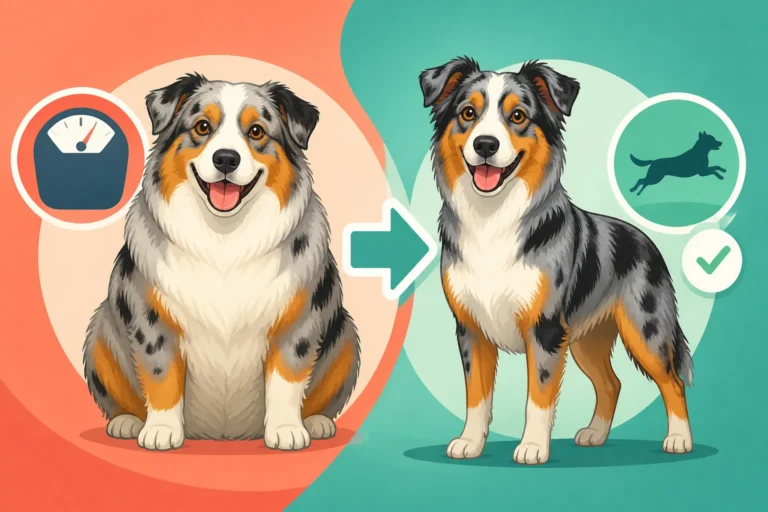
The calculations give us a fantastic starting point, but they are just a starting point. Your Australian Shepherd is an individual, and their actual needs might vary slightly. This is where your keen eye and regular physical assessment come in. The Body Condition Score (BCS) is a crucial tool for fine-tuning your Aussie's diet. It's a subjective measure, but with practice, it becomes incredibly reliable.
You're looking for a score of 4 or 5 on a 9-point scale (or 2-3 on a 5-point scale). Here’s how to assess it:
- Ribs: Gently run your hands along your Aussie's sides. You should be able to easily feel their ribs without pressing hard, like feeling the back of your hand. You shouldn't see them prominently unless your dog is taking a deep breath or turning sharply, but you definitely shouldn't have to search for them under a layer of fat. If you see ribs clearly, your Aussie is likely too thin. If you can't feel them at all, they're likely overweight.
- Waist: Look at your Aussie from above. They should have a noticeable "tuck" or hourglass shape behind their ribs, before their hips. If they look like a straight line from chest to tail, or bulge out, they're carrying too much weight.
- Abdominal Tuck: Look at your Aussie from the side. Their belly should tuck up slightly from their chest, not hang low or be level with their chest. This is particularly noticeable in Aussies given their deep chests.
It can be a bit tricky with an Australian Shepherd's thick double coat to accurately assess their BCS. Finding Aussie Ribs Under a Winter Coat delves deeper into how to perform this assessment effectively despite the fur. If your Aussie feels too lean, you'll want to slightly increase their daily calories, maybe by 5-10%, and reassess in a couple of weeks. If they feel a little too padded, a slight reduction is in order. Consistency is key here. Make small adjustments and give your dog's body time to respond. Rapid changes in diet can cause digestive upset, and sudden, drastic calorie cuts can be unhealthy.
The Role of Food Type and Density
The type of food you choose for your Australian Shepherd also plays a significant role in their calorie intake and overall nutrition. Not all calories are created equal, and the density of the food will directly impact how much volume you need to feed to meet their DER.
Dry Kibble: This is the most common and often most cost-effective option. Kibble varies hugely in caloric density. Some "light" or "senior" formulas might have as little as 300 kcal per cup, while high-performance or puppy formulas could pack in 450+ kcal per cup. It’s essential to check the specific bag you’re using. Many popular brands are readily available through retailers like Chewy or Amazon, making it easy to compare nutritional information and customer reviews before purchasing. Always look for high-quality protein as the first ingredient and appropriate fat levels for your Aussie's activity.
Wet Food: Generally much lower in caloric density than kibble due to its high moisture content. While great for hydration and palatability, you'd have to feed a huge volume of wet food to meet an active Aussie's calorie needs, which can be expensive and sometimes lead to looser stools. Often used as a topper or for dogs with specific health needs.
Fresh/Cooked/Raw Diets: These diets, like those offered by services such as Ollie, are gaining popularity. They can be highly palatable and digestible, but calculating exact caloric intake can be more complex, especially if you're home-cooking. Fresh food services typically provide pre-portioned meals based on your dog's weight and activity, which simplifies things. If you're preparing meals yourself, you must work with a veterinary nutritionist to ensure complete and balanced nutrition, as deficiencies can have serious long-term consequences for your Aussie's health. The calorie count of various meats, organs, and vegetables can vary significantly, so precise measurement is paramount.
Regardless of the food type, remember that the "kcal per unit" is your guiding star once you have your DER. This number allows you to convert your Aussie's daily calorie needs into a measurable amount of food. And always transition foods slowly over 7-10 days to avoid upsetting your Aussie's stomach.
Common Calorie Conundrums for Australian Shepherds
Living with an Australian Shepherd means embracing their unique quirks, and that extends to their metabolism and appetite. Owners often run into specific challenges when trying to manage their Aussie's caloric intake. It's not always a straightforward path, especially when you're dealing with a breed renowned for its energy and intelligence.
The High-Energy, Lean Aussie
This is perhaps the most common "conundrum" for Australian Shepherd owners. You have a dog who never seems to stop moving, a furry blur constantly looking for the next job or adventure. You feed them according to the bag, perhaps even a bit more, and yet they remain lean, sometimes even looking a little too thin despite eating what seems like a mountain of food. It's frustrating when you're doing everything right, and your dog still looks like they could use a few more pounds.
The reality is that some Australian Shepherds are simply metabolic powerhouses. Their high drive and efficient bodies burn through calories at an astonishing rate. For these lean, high-energy Aussies, you'll often need to feed well above the "average" recommendations. This is where those higher activity multipliers (2.5x to 5.0x RER) really come into play. On days when they're truly working, whether it's a full day of herding, an intense competition, or a several-hour hike, their caloric needs can skyrocket. You might even consider splitting their daily ration into three meals instead of two to help with digestion and nutrient absorption throughout the day.
When you're trying to put healthy weight on a very lean Aussie, focus on quality fats and proteins. Adding a spoonful of high-calorie, healthy fat source like cooked and drained ground beef, a little canned pumpkin (for fiber and stomach settling), or a high-quality fish oil supplement can boost calories without adding excessive volume. However, be cautious not to overwhelm their digestive system with too much fat too quickly. Consulting with your vet or a certified canine nutritionist is invaluable in these situations, especially if you suspect underlying issues beyond just high metabolism. They can help you craft a diet that supports their energy demands without risking digestive upset.
The Couch Potato (Rare, But It Happens!)
While it might sound like an oxymoron to describe an Australian Shepherd as a "couch potato," it can happen. Maybe you've adopted an older Aussie who is slowing down, or perhaps your individual dog just isn't as intensely driven as the breed stereotype. Some Aussies, due to age, injury, or even just personality, might not have the same frantic energy levels. In these cases, their caloric needs will be significantly lower than their high-octane counterparts.
The danger here is continuing to feed them as if they're still a whirlwind of activity. Excess calories will inevitably lead to weight gain, which can exacerbate existing joint issues like Australian Shepherd hip dysplasia or contribute to new health problems. For a less active Aussie, you'll want to use the lower end of the activity multipliers, perhaps 1.4-1.6x RER for a neutered adult, or even 1.2-1.4x for an inactive senior.
It's all about matching intake to output. If your Aussie's daily exercise consists of leisurely walks and indoor play, their calorie burn will be modest. Focus on a high-quality, balanced diet that supports lean muscle mass without overdoing the fat content. Regular body condition scoring is particularly important for these less active Aussies, as weight creep can be insidious. If you notice them getting a bit pudgy around the middle, don't hesitate to slightly reduce their portion size and consider incorporating more engaging, but still low-impact, mental stimulation to keep their brilliant minds active without overstressing their bodies. Sometimes, the problem isn't food, but rather An Aussie That Paces Indoors because their mental needs aren't met, not their physical.
Treats, Training, and Hidden Calories
This is where many well-intentioned owners unknowingly add hundreds of extra calories to their Australian Shepherd's daily intake. Treats are an essential part of training, bonding, and just spoiling our beloved dogs a little. However, those little morsels add up quickly, especially with a breed as intelligent and trainable as the Aussie, who thrives on positive reinforcement and repetitive training sessions.
Imagine a typical training day: a handful of small, high-value treats for recall practice, a few more for perfecting a stay, some puzzle feeder rewards, and then a couple of chews just because they're cute. Before you know it, your Aussie could easily have consumed 100-300+ extra calories, depending on the treats. If their calculated DER is 1200 kcal, and you're adding 200 kcal in treats, you've essentially increased their intake by 16%, which over time, can lead to weight gain.
The solution isn't to eliminate treats altogether – that would be unrealistic and counterproductive for such a smart, work-driven dog. Instead, incorporate treats into the total daily calorie budget. When you're calculating your Aussie's food, factor in how many calories their typical treats add, and then reduce their meal portions accordingly. For example, if your Aussie needs 1200 kcal/day and gets 150 kcal from training treats, then their regular meals should provide only 1050 kcal.
Choosing low-calorie, high-value treats is also smart. Small pieces of cooked chicken, carrots, green beans, or even some of their regular kibble can serve as excellent training rewards. Break larger treats into tiny, pea-sized pieces to maximize the number of rewards without overfeeding. You can even find specific low-calorie training treats on sites like Chewy or Amazon that are designed for frequent use. Remember, the goal is to reinforce good behavior, not to stuff your Aussie. Treats Small Enough for Aussie Training Repetition offers great ideas for effective and calorie-conscious training rewards.
When to Re-evaluate and Seek Professional Advice
Calculating your Australian Shepherd's daily calorie needs is a dynamic process, not a static one-time calculation. Life happens, and your Aussie's body and needs will change over time. Being attuned to these changes and knowing when to seek professional guidance is crucial for their long-term health and well-being. Don't be afraid to revisit your calculations and, more importantly, to consult your veterinarian.
Changes in Age, Activity, or Health
Your Australian Shepherd's caloric requirements are rarely constant throughout their life. What worked perfectly for your energetic two-year-old might be completely inappropriate for the same dog at eight or twelve years old.
As your Aussie ages, their metabolism often slows down, and their activity levels naturally decrease. Even if they still love their walks, the intensity might lessen, or they might not be able to sustain prolonged periods of high-energy play. This is a critical time to re-evaluate their DER. Continuing to feed a senior Aussie the same amount as their younger, more active self is a surefire way to pack on extra pounds, which can put undue stress on Australian Shepherd Arthritis After Years of Work or exacerbate other age-related conditions. You might find yourself needing to reduce their multiplier and switch to a senior-specific food formula that offers fewer calories but still provides all the necessary nutrients and joint support.
Likewise, significant changes in activity level warrant a recalculation. Has your working Aussie retired from the farm? Are you no longer competing in agility? Or, conversely, have you started a new, more intensive sport? These shifts will directly impact their energy expenditure. Even seasonal changes can play a role; some Aussies might be less active during hot summer months and more active when the weather is cooler.
Health issues are another major trigger for re-evaluation. An Australian Shepherd recovering from surgery, battling an illness, or on certain medications might have altered nutritional needs. For example, a dog with Australian Shepherd Autoimmune Disease might require specific dietary considerations, while one managing Australian Shepherd Epilepsy Starting Between One and Five might need a stable, consistent diet to minimize triggers. Always discuss any health changes with your veterinarian, as they can provide tailored dietary recommendations or even refer you to a veterinary nutritionist for complex cases. They might suggest a prescription diet or specific supplements to support recovery or manage chronic conditions.
The Vet's Role: Beyond Just Food Recommendations
Your veterinarian is your most valuable partner in ensuring your Australian Shepherd's optimal health and nutritional status. While we've provided comprehensive guidelines for calculating calories, your vet brings a level of expertise and diagnostic capability that you simply can't replicate at home.
Beyond just giving you a number, your vet can conduct a thorough physical examination, accurately assess your Aussie's Body Condition Score, and evaluate their overall health. They can identify subtle signs of being underweight or overweight that might be hidden by their coat. More importantly, they can rule out underlying medical conditions that could be affecting your Aussie's weight or appetite. For instance, unexplained weight loss could be a symptom of thyroid issues or other internal problems, while sudden weight gain might indicate a metabolic disorder. These are things that no amount of home calorie calculation can address.
Your vet can also help you interpret food labels, understand the nuances of different diet types (kibble, wet, fresh, raw), and advise on specific nutrient profiles that might benefit your individual Australian Shepherd. If your Aussie has allergies, they can guide you through elimination diets and recommend appropriate novel protein or hydrolyzed protein foods. They are also the go-to resource for discussing supplements, such as joint support for working dogs or fish oil for coat health.
Don't hesitate to bring your calorie calculations and feeding plan to your vet for review. They can offer feedback, adjust multipliers based on their professional assessment of your dog's health and lifestyle, and provide peace of mind that you're on the right track. Remember, investing in regular vet check-ups is one of the best ways to ensure your Australian Shepherd lives a long, healthy, and happy life, full of all the energy they need to herd, play, and love.
Disclaimer
This article is for general informational purposes only and does not constitute professional advice. Laws, prices and regulations vary by location and change over time. Consult a qualified professional for guidance on your specific situation.