Biking Safely With an Australian Shepherd
As Australian Shepherd owners, we know the struggle: a brisk walk around the block, even a good long hike, sometimes just isn't enough to truly satisfy the boundless energy and sharp minds of our incredible dogs. You might be left wondering how to truly tire them out and give them the mental and physical workout they crave, often leading you to consider options like biking. This guide will walk you through everything you need to know about biking safely and effectively with your Australian Shepherd, ensuring it’s a positive, enriching, and most importantly, safe experience for both of you.
Understanding Your Aussie's Readiness for Biking
Before you even think about attaching your Aussie to your bike, it’s crucial to assess if they are truly ready for this kind of activity. It's not just about their enthusiasm; it's about their physical maturity, temperament, and foundational training. Rushing into it can lead to injuries or create negative associations with what could otherwise be a fantastic bonding activity.
Age and Physical Maturity
One of the absolute most critical factors for any high-impact exercise like biking is your Australian Shepherd's age. Their growth plates, which are the soft areas at the ends of their bones, need to be fully closed. For most Aussies, this happens between 12 and 18 months, but some larger or slower-maturing individuals might not be fully developed until they are closer to two years old. Engaging in repetitive, high-impact activities like running alongside a bike too early can cause irreparable damage to their joints, leading to painful conditions like hip or elbow dysplasia later in life. It's simply not worth the risk.
Think of it like a human teenager trying to run a marathon before their bones are fully fused – it's a recipe for injury. Until your vet gives you the green light, stick to gentler exercises. Slow, controlled walks and short bursts of play are fine, but long-distance running or hard impacts should be avoided. You can find more detail on Exercise Limits for an Australian Shepherd Under a Year and Australian Shepherd Growth Plates and When They Close to help gauge this crucial timing. Waiting until your dog is fully mature is an investment in their long-term health and mobility.
Temperament and Training Foundation
Beyond physical readiness, your Aussie's temperament and existing training play a huge role in their suitability for biking. Australian Shepherds are intelligent and driven, but that also means they can be easily distracted by their environment, especially when moving at speed. A dog that pulls incessantly on a leash, lunges at squirrels, or barks at passing cars is not a candidate for biking until those behaviors are addressed.
Solid recall is non-negotiable. If your Aussie has a strong prey drive and might bolt after a rabbit or a deer, your safety and theirs are compromised. They need to understand and reliably respond to commands like "leave it," "stay," and a rock-solid recall, even with high distractions. Australian Shepherd Recall Around Moving Things is a great resource to revisit those fundamental skills. If your Aussie tends to be reactive to other dogs, people, or vehicles, biking will only amplify these challenges. You need a dog that is calm, focused, and responsive to your cues, even when the world is whizzing by. For those whose Aussies tend to react to fast-moving objects, learning to manage this is key, as explored in An Aussie That Reacts to Skateboards and Bikes.
Health Check-Ups and Joint Health
Even if your Aussie is past the puppy stage and seems full of vigor, a comprehensive vet check-up is an absolute must before embarking on a biking routine. Your veterinarian can assess their overall health, check their joints, and ensure there are no underlying conditions that could be exacerbated by this type of exercise. This is especially important for Australian Shepherds, a breed known for its propensity towards certain orthopedic issues.
Conditions like hip dysplasia or elbow dysplasia, even if not outwardly obvious, can be made significantly worse by the repetitive impact of running alongside a bike. Your vet might recommend X-rays to check joint health, especially if your dog comes from lines with a history of these issues. Discussing your plans for biking will allow your vet to give you tailored advice, perhaps recommending joint supplements or suggesting specific warm-up and cool-down routines. Knowing the state of your dog's Australian Shepherd Hip Dysplasia and Working Joints or reviewing the process of Australian Shepherd Elbow X-Rays at Two Years can give you peace of mind and help you make informed decisions. Don't skip this critical step – it's all about proactive care for your loyal companion.
Essential Gear for Safe Bikejoring or Biking Alongside
Once you've determined your Aussie is physically and temperamentally ready, it's time to gather the right equipment. This isn't just about convenience; it's about safety for both you and your dog. Cutting corners on gear can lead to accidents and injuries that are entirely preventable.
The Right Bike Attachment System
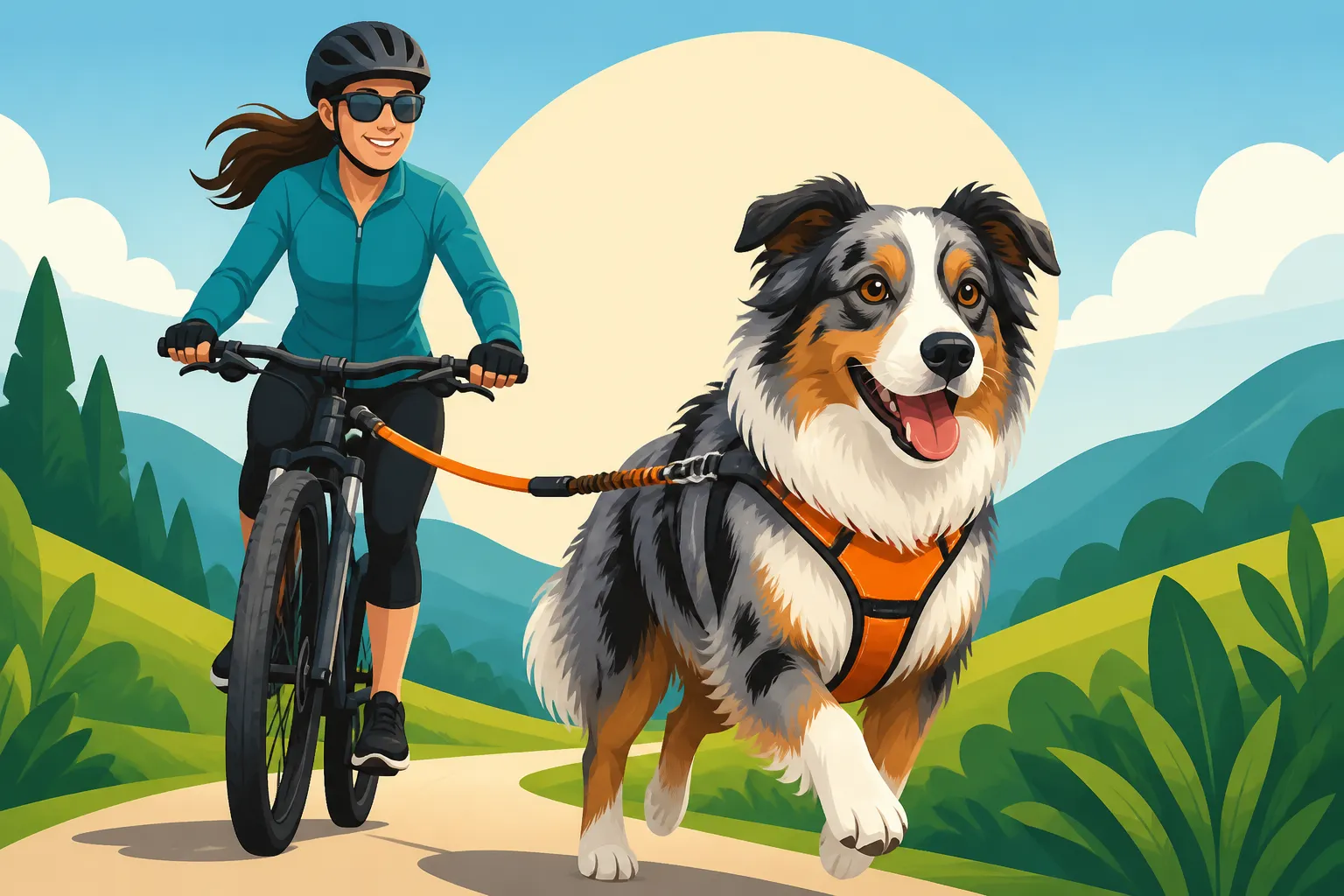
Forget about trying to hold your dog's leash in one hand while steering with the other – it’s incredibly dangerous and impractical. You absolutely need a specialized bike attachment system. These devices are designed to keep your dog at a safe distance from your bike, prevent tangles, and often include a quick-release mechanism for emergencies.
There are a few main types:
- Spring-Loaded Arm Attachments: These typically mount to the seat post or frame of your bike. They feature a rigid arm with a spring-loaded segment that absorbs shocks and keeps your dog gently alongside. Brands like WalkyDog or Springer are popular in this category. They're excellent for maintaining a consistent distance and are generally very stable.
- Hands-Free Waist Leashes/Bikejoring Belts: If you're looking to get more into "bikejoring" (where your dog pulls you), a specialized belt worn by the rider, connected to the dog's harness via a long leash with a bungee section, is ideal. This allows your hands to stay on the handlebars and your core to absorb the dog's pulling power. However, this is for dogs specifically trained to pull.
- Bike Leash Adapters: These are often simpler, shorter attachments that secure a regular leash to your bike frame. While they offer a hands-free solution, they don't always provide the same shock absorption or distance regulation as the spring-loaded arms.
Regardless of the system you choose, ensure it has a quick-release function. This allows you to rapidly detach your dog in an emergency, such as if they spot something irresistible or if there’s an obstacle. It's a non-negotiable safety feature. You can find a wide range of these products on sites like Amazon or Chewy, making it easy to compare options and read reviews.
Harness vs. Collar
This is another non-negotiable: your Australian Shepherd must wear a well-fitting, comfortable harness designed for activity, not a neck collar, when biking. A collar, even a flat buckle collar, can put immense pressure on your dog's trachea if they pull, especially at speed. This can lead to coughing, choking, and even damage to their throat or neck.
Look for a harness that distributes pressure evenly across their chest and shoulders, allowing for full range of motion. Y-front harnesses or those designed for pulling sports (like sledding or canicross harnesses) are often excellent choices, as they prevent pressure on the sensitive throat area. Avoid harnesses that restrict shoulder movement or rub in the armpit area, as this can cause discomfort and chafing on longer rides. Ensure it fits snugly enough that your dog can't back out of it, but loose enough that it doesn't chafe or inhibit breathing. A good fit is crucial for both comfort and safety.
Paw Protection and Hydration
When you're biking, you're likely covering more ground and at a faster pace than during a typical walk. This means your Aussie's paws are exposed to more friction and potentially rougher terrain. Concrete, asphalt, gravel, and even certain trails can be abrasive, leading to sore, cracked, or even injured paw pads.
Investing in a good set of dog booties is highly recommended, especially when you're starting out or if you plan to bike on varied surfaces. They provide a protective barrier against sharp objects, hot pavement, and rough ground. Just remember to introduce them gradually at home before hitting the trails. Beyond paw protection, hydration is paramount. Your Aussie will be working hard, especially in warmer weather, and can quickly become dehydrated. Always carry plenty of fresh water for both of you. Collapsible water bowls are fantastic for on-the-go hydration, and many bike frame bags or hydration packs for humans have extra room for a dog's water bottle. Consider a water bottle that dispenses into a built-in cup, or a separate bowl. Don't forget that Australian Shepherd Paw Pads After Rough Ground need specific care, and having Australian Shepherd Water Bowls on the Road is essential for their well-being.
Training Your Aussie for Biking Success
Biking with your Australian Shepherd isn't something you just jump into. It requires careful, patient training to ensure your dog understands what's expected of them, builds confidence around the bike, and most importantly, remains safe. Think of it as teaching a new sport – it takes time and dedication.
Gradual Introduction and Positive Reinforcement
The key to successful biking is a slow, positive introduction. Start by simply having the bike (with the attachment) present in your dog's environment. Let them sniff it, investigate it, and get comfortable with its presence. Reward calm curiosity with high-value treats. Next, practice walking with the bike, but without your dog attached. Push the bike alongside you, letting your dog walk on a regular leash on the other side. This helps them get used to the sounds and movement of the bike.
Once they're comfortable with that, attach them to the bike system, but start by just walking slowly. Keep sessions short and positive, ending on a good note. Gradually increase the pace, moving from a walk to a jog, then to very short, slow bike rides in a quiet, low-distraction area like your driveway or a very quiet park. Always reward calm behavior and looking at you for guidance. Never force them or chastise them for being unsure; this will only create negative associations. Patience and positive reinforcement are your best friends here.
Teaching Commands for Biking
Your Aussie needs to understand specific commands to navigate safely alongside your bike. These are distinct from their regular obedience cues because they're given in the context of movement and speed. Start teaching these commands on foot, then incorporate them slowly with the bike.
Essential commands include:
- "Let's Go!" / "Hike!": A clear cue to start moving forward.
- "Whoa" / "Stop": Crucial for stopping safely and immediately. Practice this extensively.
- "Easy" / "Slow": For when they're pulling too hard or going too fast.
- "Left" / "Right": To guide them around turns.
- "Leave It": Absolutely vital for ignoring distractions like squirrels, garbage, or other dogs. Your Aussie's inherent prey drive means their Aussie Impulse Control With Moving Toys might be naturally challenged, so this command needs to be ironclad.
Practice these commands in a low-distraction environment first, rewarding generously for correct responses. Only introduce them to the biking context once they are consistently reliable. Use clear, consistent hand signals along with verbal cues, as visual cues can sometimes be easier for a dog to pick up when you're both in motion.
Managing Energy and Overarousal
Australian Shepherds are high-energy dogs, but that energy, if not properly channeled, can quickly turn into overarousal or frustration, especially during an exciting activity like biking. You might find your Aussie starting off strong, pulling hard, and then becoming frantic or unfocused. This isn't productive and can be dangerous.
The goal isn't just to tire them out, but to engage their minds as well. If your Aussie tends to get "worse in the evening" or experiences An Australian Shepherd That Gets Worse in the Evening, it could be a sign of being over-tired but under-stimulated. During biking, watch for signs of overarousal: excessive panting (beyond normal exertion), frantic pulling, inability to focus, barking, or ignoring commands. Keep initial biking sessions short to prevent them from becoming overtired or overstimulated. Incorporate mental breaks by stopping, asking for a "sit" or "down," and rewarding calm behavior.
Teach them an "off switch" – a command that signals it's time to settle down. This could be a "mat stay" or a simple "relax" cue. Biking should be an extension of their training, not just a physical free-for-all. Understand that Australian Shepherd Overarousal and Frustration can manifest in many ways, and for an Aussie, too much physical activity without mental engagement can actually increase, rather than decrease, these behaviors. Build their endurance slowly and ensure they're mentally engaged with your commands throughout the ride.
Safety Considerations and Environmental Factors
Even with the best gear and training, success in biking with your Aussie heavily relies on choosing the right environment and being constantly aware of surrounding conditions. Ignoring these factors can quickly turn a fun outing into a dangerous situation.
Choosing Safe Routes and Surfaces
Where you choose to bike with your Australian Shepherd is just as important as how you bike. Busy city streets with heavy traffic, confusing intersections, and constant distractions are generally not suitable for dog biking, especially when you're starting out. The risk of accidents is simply too high.
Opt for quieter routes such as dedicated bike paths, paved trails, or well-maintained dirt roads. These provide a more predictable environment with fewer sudden hazards. Consider the surface you'll be riding on. Asphalt and concrete can get incredibly hot, especially on sunny days. If the pavement is too hot for your bare hand, it's too hot for your dog's paws, even with booties. Remember, Summer Pavement Under an Aussie Foot can reach scorching temperatures, leading to burns. Dirt trails are often cooler and softer on joints, but be vigilant for sharp rocks, thorns, or other debris that could injure paws. Always scope out your route beforehand if possible, paying attention to potential hazards like sudden turns, steep hills, or areas with high foot or dog traffic.
Weather Conditions and Temperature Management
Australian Shepherds have a dense double coat that, while fantastic for insulation in cold weather, can make them prone to overheating in warm or hot conditions. You might feel comfortable in a tank top, but your dog is essentially wearing a permanent fur coat.
Avoid biking during the hottest parts of the day, typically late morning to late afternoon. Early mornings or late evenings are usually best. Watch for signs of overheating: excessive panting, drooling, bright red gums, staggering, or reluctance to move. If you see any of these, stop immediately, get your dog into the shade, offer water, and cool them down with wet cloths. Never push a dog that is showing signs of heat distress. A Cooling Kit That Works Under an Aussie Coat can be a lifesaver, including cooling vests or bandanas. It's vital to remember that Exercising an Australian Shepherd Over Eighty Degrees requires extreme caution and often should be avoided altogether. Always carry enough water for both of you, and plan your route to include shady spots or water sources.
Emergency Preparedness
Despite all precautions, accidents can happen. Being prepared for an emergency can make a critical difference. Always carry a small first-aid kit for both yourself and your dog. This should include essentials like antiseptic wipes, bandages, medical tape, tweezers (for splinters or thorns), and any specific medications your dog might need.
It’s also wise to carry your phone, identification for yourself and your dog (including microchip info and your vet's number), and emergency contact information. Make sure your dog always wears identification tags on their harness, even if chipped. Consider taking a basic pet first-aid course so you know how to handle common injuries like cuts, sprains, or heatstroke. Knowing how to perform CPR or identify symptoms of serious issues could save your dog's life. Think about where you're biking: if you're far from civilization, consider carrying a small light for visibility, a whistle, and perhaps even a small blanket. The more prepared you are, the more confident you'll feel, and the safer both you and your Australian Shepherd will be on your biking adventures.
| Aspect | Recommendation | Why It Matters |
|---|---|---|
| Age | Minimum 18-24 months | Protects developing joints from long-term damage (e.g., hip/elbow dysplasia). |
| Vet Check | Mandatory pre-biking vet visit | Ensures no underlying health issues; verifies joint health. |
| Gear – Attachment | Spring-loaded arm or bikejoring belt with quick-release | Prevents tangles, absorbs shocks, allows emergency detachment. |
| Gear – Harness | Y-front or pulling harness, never a collar | Prevents throat/neck injury; distributes pressure evenly across chest. |
| Paw Protection | Dog booties for varied terrain/hot surfaces | Prevents cuts, abrasions, and burns on paw pads. |
| Hydration | Plenty of water + collapsible bowl/dispenser | Prevents dehydration, crucial for active dogs, especially in heat. |
| Training | Gradual introduction, specific verbal/hand commands ("Stop", "Left", "Leave It") | Builds confidence, ensures control, prevents unpredictable behavior. |
| Route Choice | Quiet bike paths, paved trails, dirt roads; avoid busy traffic | Minimizes distractions, reduces accident risk, safer surfaces. |
| Weather | Avoid extreme heat; bike during cooler parts of the day | Prevents heatstroke, especially in double-coated Aussies. |
| Emergency Prep. | First-aid kit, phone, ID, emergency contacts | Enables quick response to injuries or unforeseen situations. |
Disclaimer
This article is for general informational purposes only and does not constitute professional advice. Laws, prices and regulations vary by location and change over time. Consult a qualified professional for guidance on your specific situation.